
Оставить заявку
Для заказа и получения более подробной информации оставьте заявку, наш менеджер свяжется с Вами!
Нажимая на кнопку, вы даете согласие на обработку персональных данных и соглашаетесь c политикой конфиденциальности
Достижения в фенотипировании чайных растений с использованием технологии гиперспектральной визуализации
Байдун Ло1, Хунвэй Сунь1*, Лэйлэй Чжан2, Фэннун Чэнь1 и Кайхуа У1*
1Колледж искусственного интеллекта, Ханчжоуский университет электронной науки и технологии, Ханчжоу, Китай. 2Ключевая лаборатория контроля качества и рисков специализированной сельскохозяйственной продукции провинции Чжэцзян, Колледж наук о жизни, Китайский университет метрологии, Ханчжоу, Китай.
Тип: обзор. Получено: 1 июня 2024 г. Принято: 15 июля 2024 г. Опубликовано: 1 августа 2024 г. DOI: 10.3389/fpls.2024.1442225.
Редактор: Вэньюй Чжан, Усийский филиал Цзянсуской академии сельскохозяйственных наук, Китай. Рецензенты: Вэньсю Ван, Хэбэйский сельскохозяйственный университет, Китай; Хунчжэ Цзян, Нанкинский лесотехнический университет, Китай.
Для корреспонденции: Хунвэй Сунь, sunhongwei@hdu.edu.cn; Кайхуа У, wukaihua@hdu.edu.cn.
Аннотация
Быстрое определение фенотипических признаков растений имеет решающее значение для селекции и возделывания. Традиционные измерения выполняются опытными агрономами и требуют значительных затрат времени и труда. Однако по мере роста потребности в быстром и высокопроизводительном определении признаков чайных растений цифровая селекция и интеллектуальное возделывание чая всё в большей степени зависят от точных методов измерения фенотипических признаков. Среди них технология гиперспектральной визуализации (HSI) выделяется способностью предоставлять насыщенную информацией картину в реальном времени. В настоящей статье приведён всесторонний обзор принципов гиперспектральной визуализации, методов обработки кубических данных и соответствующих алгоритмов в феномике чайного растения; рассмотрен прогресс применения HSI для получения сведений о фенотипах чайных растений, состоянии роста и показателях качества при воздействии факторов среды. В заключение с разных позиций обсуждаются трудности, с которыми сталкивается HSI при выявлении фенотипических признаков чайного растения, предлагаются возможные решения и намечаются перспективы развития этой технологии в цифровой селекции и интеллектуальном возделывании чая. Обзор призван обеспечить теоретическую и техническую основу применения HSI для определения фенотипической информации чайного растения и тем самым способствовать развитию производства высококачественного чая с высокой урожайностью.
Ключевые слова: гиперспектральная визуализация, чайные растения, феномика растений, высокая производительность, быстрое определение, стресс окружающей среды.
Цитирование: Luo B, Sun H, Zhang L, Chen F and Wu K (2024) Advances in the tea plants phenotyping using hyperspectral imaging technology. Front. Plant Sci. 15:1442225. doi: 10.3389/fpls.2024.1442225.
Авторское право: © 2024 Luo, Sun, Zhang, Chen и Wu. Статья распространяется в открытом доступе на условиях лицензии Creative CommonsAttribution (CC BY). Использование, распространение или воспроизведение на других ресурсах разрешается при условии указания первоначальных авторов и правообладателя и цитирования оригинальной публикации в данном журнале в соответствии с принятой академической практикой. Использование, распространение или воспроизведение, не соответствующее этим условиям, не разрешается.
1 Введение
Чайное растение — популярная культура, используемая для приготовления напитка и широко выращиваемая, в частности, в Азии и Африке. Например, в 2020 году в связанных с чаем отраслях Китая было занято свыше семидесяти миллионов работников, доход которых тесно связан с урожайностью и качеством чайной продукции. В современной аграрной науке для получения конкретных фенотипических признаков чайных растений и повышения производства чая возникли технологии цифровой селекции и точного возделывания (Lu et al., 2020; Wang et al., 2023). Цифровая селекция главным образом направлена на расшифровку генетической основы фенотипических признаков чайного растения, тогда как технология точного возделывания — на выявление регуляторной сети, связывающей фенотип чайного растения с факторами окружающей среды. Следовательно, фенотип чайных растений формируется при совместном регулирующем воздействии генетического материала и среды.
В отличие от зерновых и других садовых культур, чайные растения являются типичными листовыми культурами с особыми целевыми фенотипическими показателями. Так, площадь листьев чайного растения в определённой мере непосредственно связана с урожайностью, а морфология чайных почек служит критерием при оценке сортности китайского зелёного чая. Содержание в листьях полифенолов и теанина существенно определяет пригодные способы переработки чайного сырья и играет важнейшую роль в формировании аромата и вкуса чая. Таким образом, фенотипическая информация о чайных растениях охватывает реакции на стрессовые факторы среды, состояние роста и признаки качества; она отличается богатым содержанием и целевой направленностью признаков.
По сравнению с технологиями генетической селекции и возделывания традиционное определение фенотипа в исследованиях растений обычно выполняется вручную, имеет низкую эффективность, сильно зависит от опытных специалистов и требует значительных затрат времени и труда. Особенно при определении биохимических компонентов растений методы мокрой химии создают «фенотипическое узкое место» (Watt et al., 2020; Tao et al., 2022). Для удовлетворения потребности в быстром высокопроизводительном определении фенотипа растений исследователи стали уделять повышенное внимание гиперспектральной визуализации. Метод HSI позволяет восстанавливать признаки растений по изменениям их оптических свойств и собирать мультимодальные данные, включающие спектральную и пространственную информацию, что особенно удобно для одновременного мониторинга нескольких признаков. В сочетании с машинным обучением и искусственным интеллектом HSIобеспечивает автоматизированное и точное определение фенотипов растений, потенциально повышая производительность, уменьшая ошибки, обусловленные человеческим фактором, и обеспечивая более объективное и точное представление признаков (Atefi et al., 2021).
В последние годы гиперспектральная визуализация как мощный способ получения информации о растениях широко применяется в исследованиях фенотипа чайного растения, включая признаки устойчивости к условиям среды, физиологические и биохимические признаки. Вместе с тем дальнейшему применению HSI в цифровой селекции и точном возделывании препятствует множество проблем. Например, необходимо глубоко понять взаимосвязь между фенотипическими признаками чайного растения и гиперспектральной информацией, а также всесторонне оценить осуществимость и ограничения фенотипирования. Поэтому мы излагаем принципы HSI и обобщаем типичные рабочие процессы и соответствующие алгоритмические методы анализа гиперспектральных данных. На основе предшествующих исследований применение HSI в фенотипировании чайного растения подразделяется нами на оценку реакций на стресс среды, состояния роста и признаков качества. Одновременно обсуждаются современные трудности применения HSI для определения фенотипической информации чайного растения и возможные будущие направления. Наша цель — всесторонне обобщить современное состояние исследований по выявлению фенотипической информации чайного растения с помощью HSI и представить углублённые комментарии и предложения относительно нынешних затруднений при анализе фенотипа чайного растения.
2 Принципы гиперспектральной визуализации при определении фенотипа чайного растения
Гиперспектральная визуализация объединяет спектроскопию и компьютерное зрение и позволяет измерять оптическое поглощение, рассеяние и отражение тканями и органами растений в широком диапазоне длин волн для количественного анализа и качественной оценки таких важнейших агрономических признаков, как состояние роста, урожайность и качество чайного растения. В видимой и ближней инфракрасной области спектра (400–2500 нм) технология регистрирует информацию о молекулярных колебаниях биохимических компонентов растения, содержащих водородсодержащие группы, например хлорофилла и других фотосинтетических пигментов (Slaton etal., 2001; Tang et al., 2024). Кроме того, HSI позволяет контролировать пространственное распределение фенотипических признаков растений на разных масштабах — от клеток и органов до отдельных особей и популяций, как показано на рисунке 1 (Mahlein, 2016; Kuswidiyanto et al., 2022).
Поэтому гиперспектральные данные обычно хранятся в виде многомерного куба: его спектральное измерение регистрирует содержание химических компонентов в листе растения, а пространственное измерение подробно описывает распределение различных компонентов в кроне либо морфологическое строение чайного растения и область распространения вредителей и болезней. Например, визуальное представление распределения влаги в чайных листьях позволяет более наглядно и всесторонне наблюдать содержание воды на уровне каждого пикселя, тем самым предлагая инновационный способ оценки потребности чайных растений в орошении (Sun et al., 2019).
В феномике растений принципы фенотипирования с помощью HSI можно разделить на прямые и косвенные (Zhang N. et al., 2020). При определении содержания воды и полифенолов в листьях с использованием HSI можно непосредственно построить математическую модель между поглощением света чайными листьями и содержанием воды и полифенолов, поскольку эти вещества имеют выраженные полосы поглощения в ближней инфракрасной области; это относится к прямым методам определения. При исследовании вредителей растений после заражения патогенами на листьях часто возникают пятна различной формы, некротические или увядшие участки, а содержание и активность пигментов снижаются. В результате отражательная способность в видимом диапазоне возрастает, тогда как красный край (670–730 нм) смещается в коротковолновую сторону (Bai et al., 2020).
В ходе поражения растений вредителями и болезнями спектральный отклик связан с вызванными ими изменениями пигментов, воды, площади листьев и других биохимических характеристик; это относится к косвенным методам определения. По сравнению с прямым определением точность косвенного обычно чувствительна к различиям вида и возраста растений и даже условий выращивания, вследствие чего модель приходится периодически калибровать заново. Однако такой метод способен отражать взаимосвязи между различными признаками растений, а также влияющие факторы и закономерности их изменения.
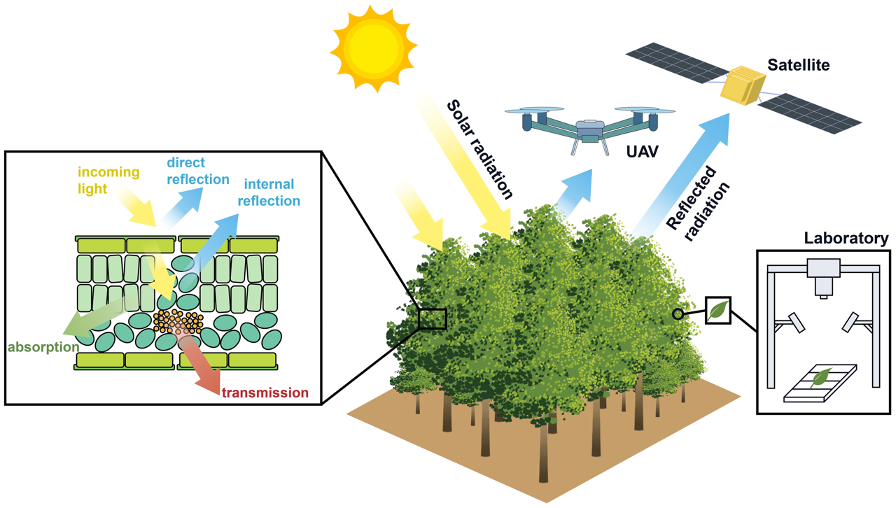
РИСУНОК 1. Схема многомасштабного измерения гиперспектральных данных.
3 Рабочий процесс применения HSI при анализе фенотипа чайного растения
Единый стандартный процесс обработки гиперспектральных данных чайного растения пока не разработан. Однако на основании обобщения предшествующих работ по определению фенотипической информации чайного растения с помощью HSI весь процесс обработки данных в общем случае можно разделить на четыре этапа: сбор данных, предварительная обработка данных, анализ данных и применение данных (рисунок 2) (Li et al., 2013; Paulusand Mahlein, 2020).
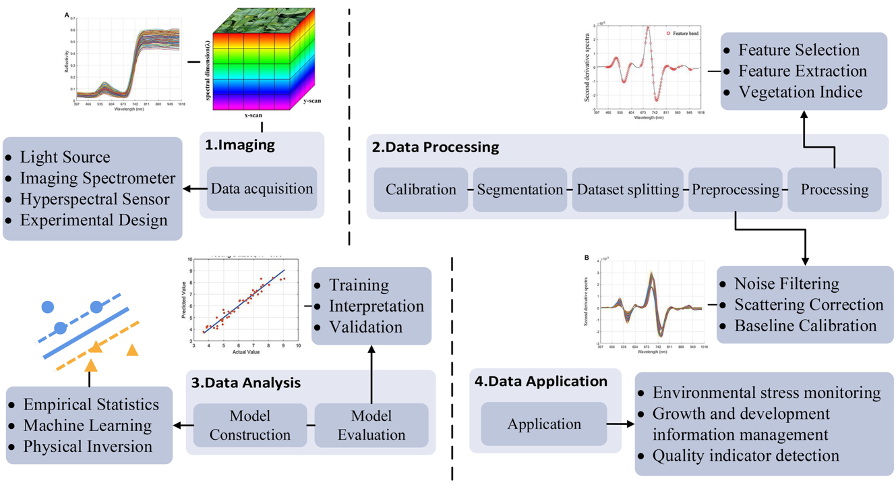
РИСУНОК 2. Рабочий процесс обработки гиперспектральных данных.
3.1 Сбор гиперспектральных данных
Системы гиперспектральной визуализации обычно размещают на различных платформах — спутниках, самолётах, беспилотных летательных аппаратах (БПЛА) и стационарном наземном оборудовании. Как правило, система включает источник света, оптическую линзу, спектрометр формирования изображения, фотоэлектрический детектор и компьютерную систему обработки данных (Lu et al., 2020). При регистрации оптических характеристик чайного растения образцы освещаются естественным или искусственным источником света, например галогенной лампой, а оптическая линза собирает отражённое образцами излучение. Дифракционная решётка спектрометра разделяет отражённый свет по длинам волн, после чего фотоэлектрический детектор преобразует интенсивность света в электрические сигналы. Наконец, компьютерная система принимает и обрабатывает эти сигналы, преобразует их в цифровую форму и формирует спектр исследуемого растения (Mishraet al., 2017).
Существуют четыре основных способа сбора гиперспектральных данных: точечное сканирование, линейное сканирование, площадное сканирование и мгновенная съёмка (рисунок 3). При точечном сканировании (whisk-broom) спектральная информация регистрируется попиксельно, что обеспечивает высокое гиперспектральное разрешение, однако из-за малой скорости требуется весьма стабильная платформа, предотвращающая размытие и искажение изображения. Линейное сканирование (push-broom), в настоящее время наиболее распространённое, регистрирует за один раз одну строку пикселей, обеспечивая баланс пространственного и спектрального разрешения; при этом во время съёмки следует сводить к минимуму артефакты движения.
При площадном сканировании (staring) полосовые фильтры регистрируют изображения отдельных спектральных диапазонов; последовательное сканирование диапазон за диапазоном формирует гиперспектральный куб данных и обеспечивает изображения высокого пространственного разрешения. Однако для точности пространственной привязки и спектральной информации сцена во время съёмки должна оставаться неподвижной. Технология мгновенной съёмки одновременно регистрирует пространственную и спектральную информацию всей сцены. Один снимок представляет перспективную проекцию куба данных, по которой можно восстановить его трёхмерную структуру. Поскольку технология находится на ранней стадии развития, получаемые изображения часто отличаются сравнительно низким пространственным и спектральным разрешением (Hagen and Kudenov, 2013).
В силу различий принципов определения каждый режим имеет собственные преимущества и недостатки в практическом применении. Глубокое понимание основных принципов каждого режима визуализации позволяет гибко выбирать подходящий способ сбора данных в различных условиях, в наибольшей степени удовлетворять требованиям съёмки и повышать её эффективность. Вместе с тем разные способы сбора затрудняют стандартизацию данных, поэтому необходимо создать платформу совместного использования гиперспектральных фенотипических данных, которая будет способствовать глобальному обмену исходными данными и методами обработки и тем самым поддерживать согласованность данных (Xu et al., 2020; Sun et al., 2022). Несмотря на постоянное развитие HSI, обеспечиваемое ею высокое разрешение связано со значительными затратами, что может ухудшать экономическую эффективность по сравнению с другими методами спектрального зондирования. Тем не менее по мере развития оптических технологий эти экономические препятствия, как ожидается, будут постепенно ослабевать, способствуя массовому внедрению HSI в точном земледелии, экологическом мониторинге и других областях.
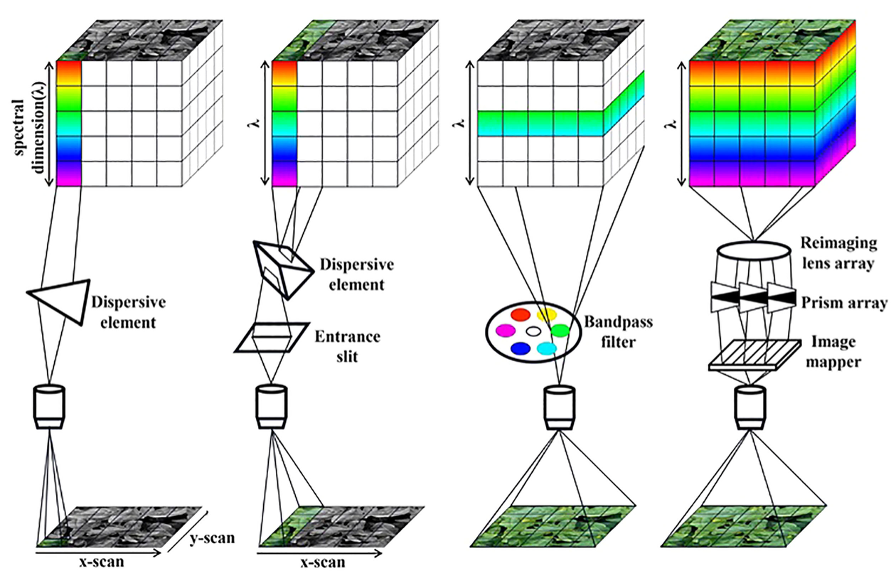
РИСУНОК 3. Четыре режима сбора гиперспектральных данных.
3.2 Предварительная обработка гиперспектральных данных
До анализа гиперспектральных данных в спектральной области необходимо сегментировать изображение в пространственной области, чтобы извлечь спектральные и пространственные характеристики объекта. Сегментация изображения предназначена для эффективного различения веществ или объектов на изображении путём их разделения на взаимно независимые области, каждая из которых состоит из пикселей с определёнными сходными характеристиками и свойствами. При определении фенотипической информации растений эта операция заключается в построении масок, точно ограничивающих области интереса (ROI), и тем самым исключает не относящуюся к объекту и потенциально мешающую информацию (ElMasry et al., 2009). К распространённым стратегиям относятся пороговая сегментация, морфологическая обработка, сегментация по границам и сегментация спектральных изображений (Tripathi et al., 2012; Wu and Sun, 2013).
Обычно перед сегментацией гиперспектрального изображения выбирают одноканальное подызображение, максимально контрастирующее с фоном, и сегментируют его для получения маски, исключающей фоновые пиксели (Wang et al., 2020d). При пороговой сегментации задаётся подходящий порог, преобразующий полутоновое изображение в бинарную маску, после чего гиперспектральные данные целевого объекта извлекаются по его положению на изображении.
При измерении спектральных данных растений системой HSI часто возникает интерференционный шум, обусловленный изменениями параметров прибора, источника света и условий окружающей среды (Mishra et al., 2020; Çetin and Yıldız, 2022). В зависимости от характеристик шум обычно проявляется как непрерывные возмущения либо кратковременные выбросы данных. Широко применяемый для сглаживания фильтр Савицкого–Голея (S-G) (Steinier et al., 1972) аппроксимирует входной сигнал полиномом, эффективно удаляя шум и сохраняя общую тенденцию данных, однако слабо устраняет низкочастотный шум спектральных данных. В реальных измерениях многокомпонентный шум спектральных данных может сопровождаться дрейфом базовой линии (Zhangand Wang, 2023).
Производные позволяют корректировать влияние базовой линии, одновременно устраняя фоновую помеху и уменьшая дрейф. Однако непосредственное применение производной высокого порядка к спектральным данным с исходно низким отношением сигнал/шум способно усилить присутствующий шум (Yan et al., 2000; Chu et al., 2004). Поэтому для спектров с низким отношением сигнал/шум производные следует применять осторожно; для уменьшения возможного влияния шума предварительно может потребоваться сглаживание или иная обработка. Кроме того, сложное строение тканей и микрорельеф поверхности чайного растения могут приводить к неоднородному рассеянию света в разных точках и различным эффектам рассеяния.
Для коррекции рассеяния обычно применяются преобразование стандартной нормальной вариации (SNV) (Barneset al., 1989) и мультипликативная коррекция рассеяния (MSC) (Wu et al., 2019). MSC корректирует эффекты рассеяния в спектрах путём сравнения отношения спектров образца к эталонным спектрам (Geladi et al., 1985), тогда как SNV в каждой длине волны выполняет вычитание среднего и деление на стандартное отклонение, преобразуя спектральные данные к стандартному нормальному распределению. Оба алгоритма способны устранять эффекты рассеяния и спектральные различия, вызванные дрейфом базовой линии, уменьшая шумовые помехи, возникающие при измерении.
ТАБЛИЦА 1. Распространённые алгоритмы предварительной обработки, применяемые при использовании HSI для определения фенотипической информации чайного растения.
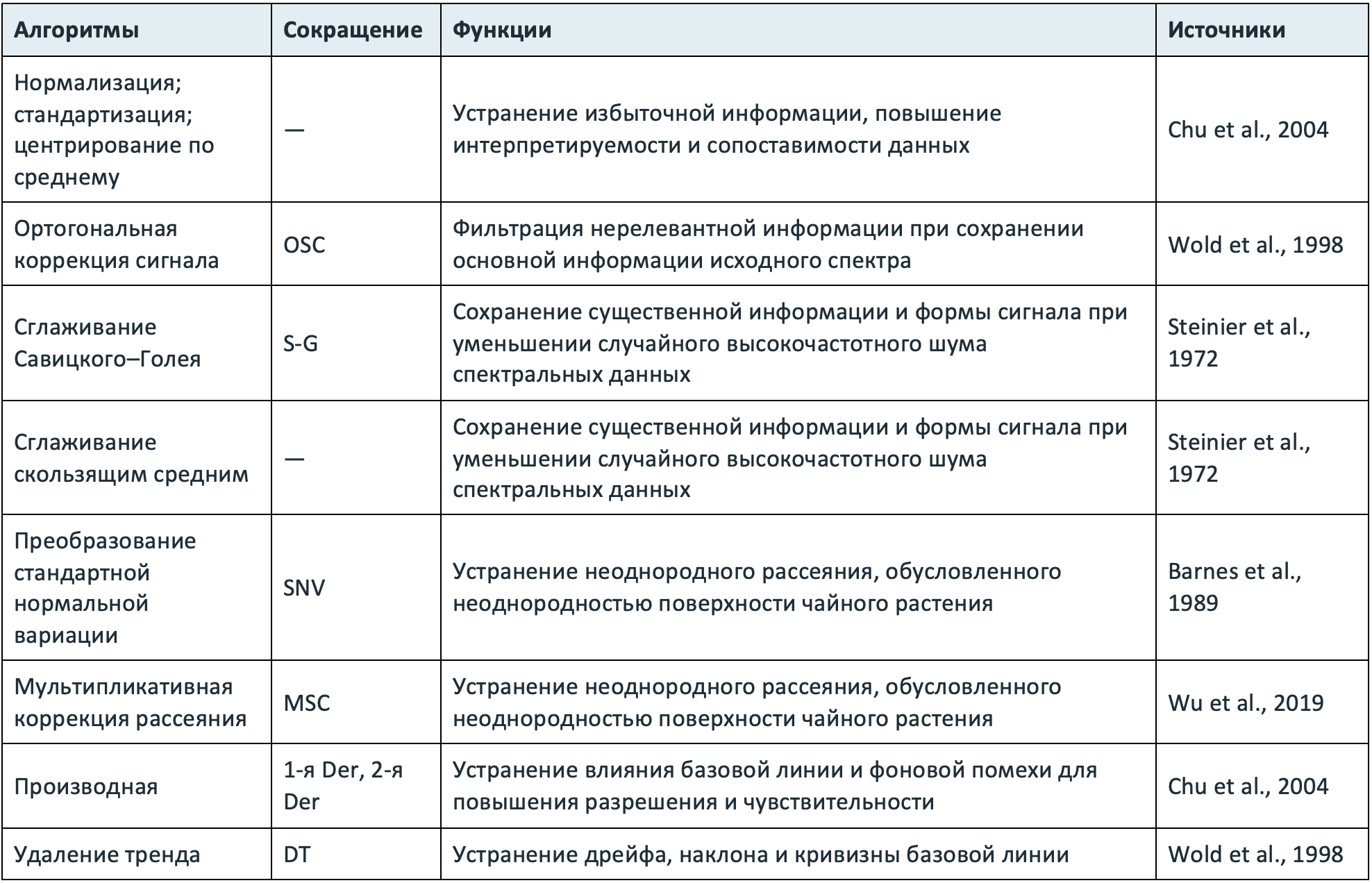
Оба алгоритма способны устранять эффекты рассеяния и спектральные различия, вызванные дрейфом базовой линии, уменьшая шумовые помехи, возникающие при обработке производными. Для демонстрации особенностей распространённых алгоритмов предварительной обработки, используемых при HSI-анализе фенотипа чайного растения, в таблице 1 подробно описан механизм действия каждого метода. Чтобы дополнительно повысить эффективность предварительной обработки спектральных данных, обычно комбинируют несколько методов либо совершенствуют структуру и оптимизируют параметры классических алгоритмов.
Кроме того, для предварительной обработки спектров всё чаще применяют модели машинного обучения. Например, автоэнкодеры (AE) используют самообучение, чтобы отображать зашумлённые входные данные в пространство скрытых переменных и восстанавливать выходные данные, максимально близкие к исходным данным без шума, тем самым выполняя автоматическое шумоподавление (Zhang C. et al., 2020). Эти методы не только повышают точность и эффективность моделирования спектральных данных, но и создают прочную основу для более сложного анализа и практических приложений.
3.3 Обработка гиперспектральных данных
Огромный объём гиперспектральных данных нередко усложняет вычисления и затрудняет выявление действительно полезной информации. Поэтому необходимо выбирать наиболее информативные признаки из множества спектральных диапазонов и удалять избыточные или ненужные данные (Cheng et al., 2022; Omia et al., 2023). До построения модели взаимосвязи фенотипического признака растения с гиперспектральными данными обычно требуется уменьшить размерность посредством отбора или извлечения признаков, чтобы преодолеть «проклятие размерности» гиперспектральных данных.
Отбор признаков представляет собой выделение наиболее репрезентативного подмножества из исходного набора. Его цель — сохранить информацию, наиболее значимую для задачи исследования, и исключить нерелевантные признаки, уменьшая влияние избыточности и шума (Adao et al., 2017). При анализе фенотипической информации чайного растения широко применяются конкурентное адаптивное перевзвешенное сэмплирование (CARS) и исключение неинформативных переменных (UVE). Алгоритм CARS опирается на принцип «выживания наиболее приспособленных» и рассчитывает конкурентоспособность признаков на основе их взаимной корреляции в подмножестве. Li et al. с помощью CARS выбрали 19 репрезентативных диапазонов из набора, состоявшего из 700 диапазонов; соответствующая модель CARS-PLS снизила RMSECV на 0,0433 по сравнению с традиционной PLS-моделью (Li et al., 2009).
Алгоритм UVE, напротив, формирует исходный набор из признаков с высоким информационным выигрышем либо высоким значением критерия хи-квадрат для связи выбранной целевой переменной и признаков, а затем последовательно удаляет неинформативные переменные, не оказывающие существенного влияния на качество классификации (Centner et al., 1996). Извлечение признаков заключается в отображении исходных признаков в новое пространство с помощью определённого преобразования и последующем выборе ключевых признаков, описывающих существенные свойства исходных данных.
Алгоритм последовательных проекций (SPA) (Milanez et al., 2017) — широко используемый метод извлечения признаков, последовательно выбирающий направления проекции, которые максимально сохраняют ключевые характеристики исходных данных, и отображающий данные высокой размерности в подпространство меньшей размерности. При исследовании показателей качества свежих чайных листьев после сбора модель SPA-MLR, построенная с использованием SPA, заметно превзошла другие модели по оптимизации характеристик. Это показало, что алгоритм повышает точность прогнозирования и одновременно упрощает моделирование (Wang et al., 2020b).
В целом перечисленные алгоритмы уменьшения размерности основаны на данных, поэтому физический смысл получаемых результатов объяснить трудно. Кроме того, оборудование HSI отличается высокой стоимостью. В ответ на эту проблему исследователи начали применять более экономичную мультиспектральную визуализацию (Tran, 2001; Xu et al., 2023). Как правило, она регистрирует ограниченное число — обычно не более десяти — дискретных широкополосных изображений объекта с шириной диапазона 50–200 нм. Сочетание гиперспектральных данных с теоретическим анализом для выделения длин волн, связанных с конкретными показателями фенотипа растений, делает мультиспектральную технологию эффективной альтернативой, особенно при создании портативных приборов для конкретных задач определения (Wang et al., 2023).
Дальнейшее развитие портативных мультиспектральных приборов способно не только снизить стоимость применения технологии, но и расширить область использования гиперспектральных методов в сельскохозяйственном производстве, повысив их практичность и экономическую отдачу в реальных производственных условиях (Yang et al., 2021; Saric et al., 2022).
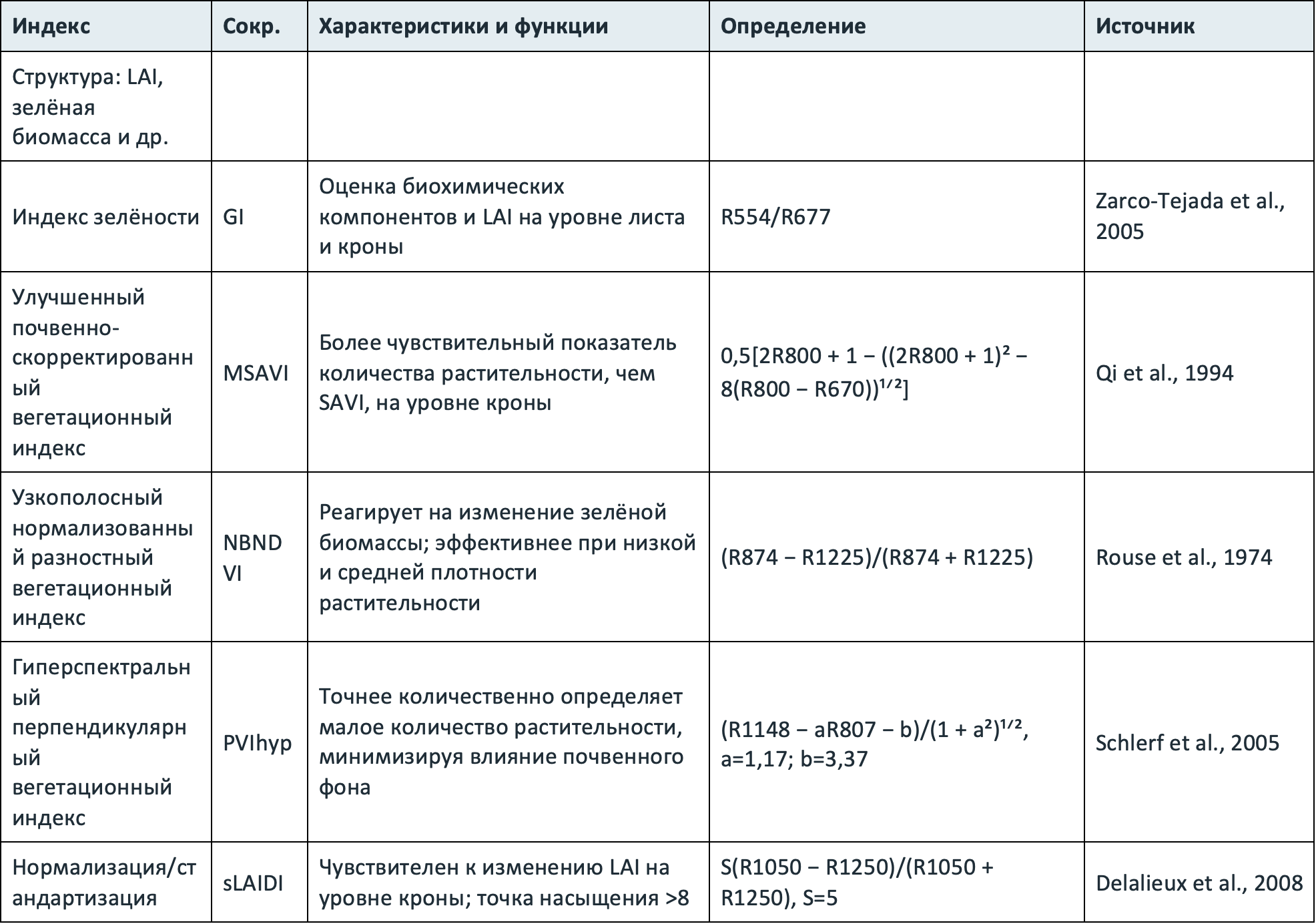
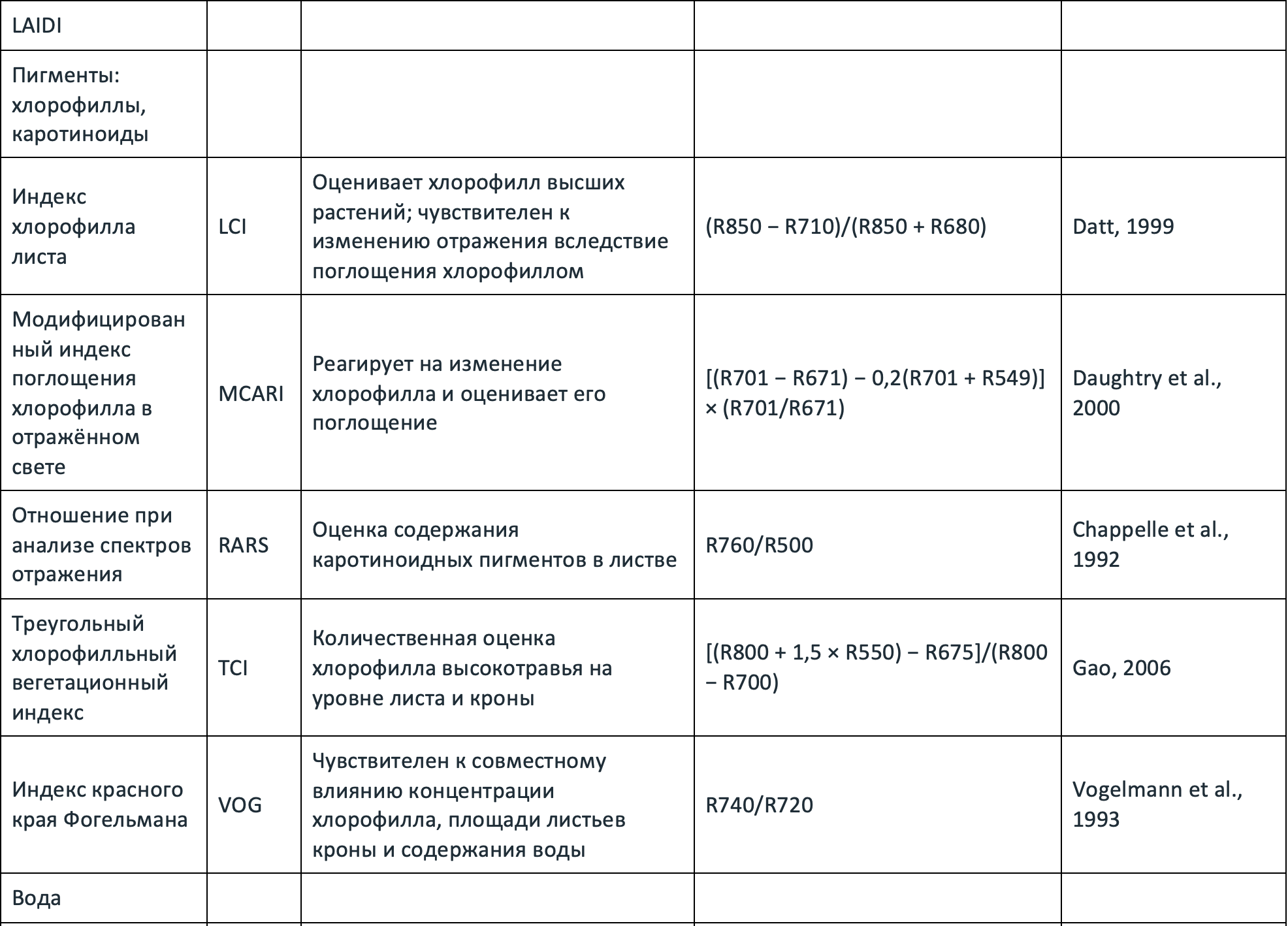
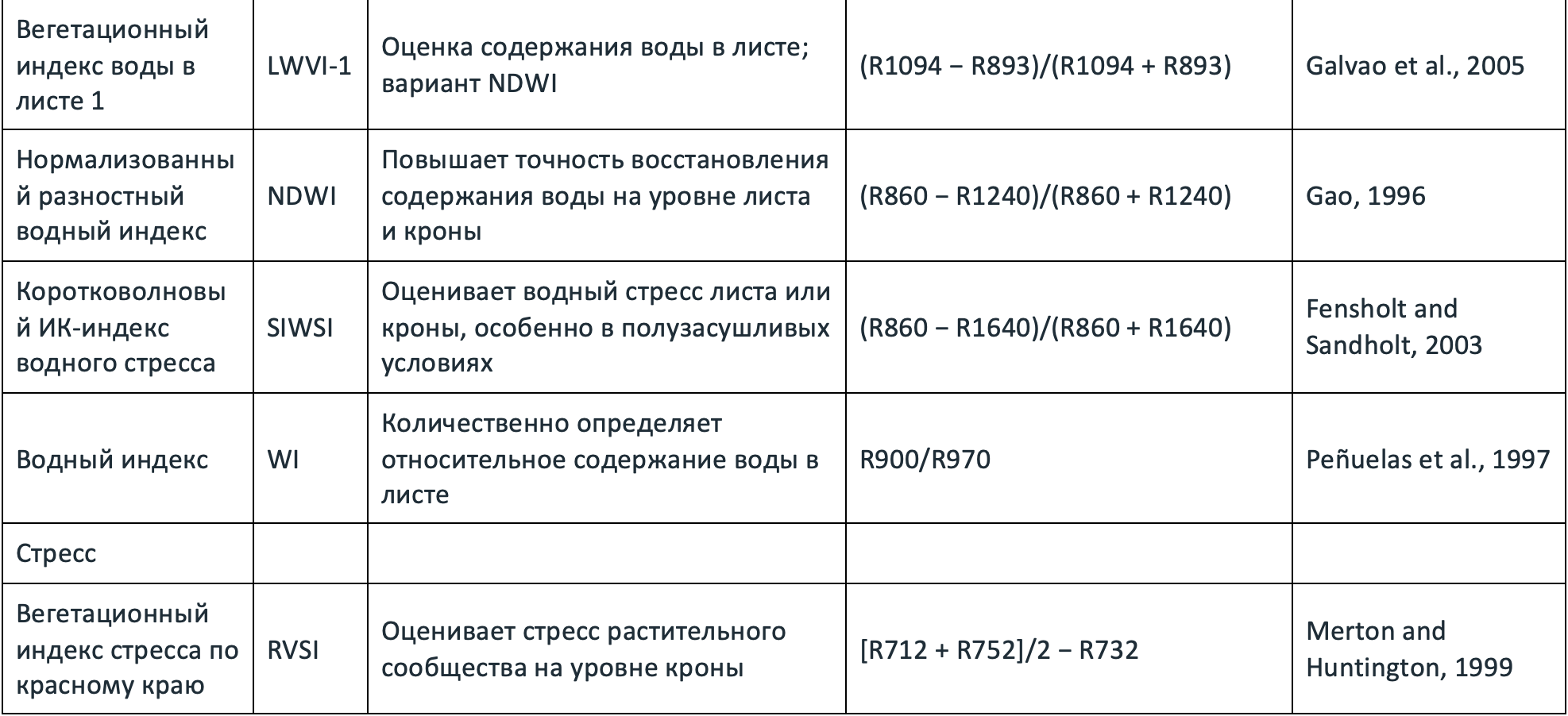
При спутниковом дистанционном зондировании и наблюдениях с БПЛА распространённым способом обработки гиперспектральных данных также является построение вегетационных индексов. Обычно они составляются из разностей или отношений переменных двух и более спектральных диапазонов и представляют один или несколько параметров состояния растительности (Xue and Su, 2017; He et al., 2023). Типичные мультиспектральные вегетационные индексы преимущественно используют красный и ближний инфракрасный диапазоны: красный диапазон отражает содержание хлорофилла, а ближний инфракрасный тесно связан со структурными характеристиками листьев. Такие индексы в основном применяются для мониторинга растительности и в некоторой степени снижают влияние фоновых помех.
Появление HSI расширило наблюдаемый спектральный диапазон и обеспечило более узкие полосы. Благодаря этому гиперспектральные вегетационные индексы позволяют на основе исходных подходов детальнее и точнее отслеживать общие фенотипы растений, а также оценивать и восстанавливать больше связанных фенотипических признаков (Verrelst et al., 2015; He et al., 2023). Например, они позволяют различать отдельные растения и популяции при воздействии разных стрессов, включая дефицит воды и питательных веществ. Высокоточные спектральные данные обладают исключительной научной ценностью для оценки здоровья растительности, динамики роста и даже изучения адаптации к изменениям среды (Fu et al., 2021). В таблице 2 приведены некоторые гиперспектральные вегетационные индексы, применяемые при определении фенотипической информации чайного растения.
ТАБЛИЦА 2. Распространённые гиперспектральные вегетационные индексы в исследованиях фенотипической информации чайного растения.
3.4 Построение моделей определения фенотипической информации
Наиболее важный этап фенотипирования чайного растения с помощью гиперспектральной технологии — построение математических моделей, связывающих признаки растения с его оптическими характеристиками. Как показано на рисунке 4, модель строится методами машинного обучения: измеренные спектральные, пространственные или объединённые признаки выступают независимыми переменными, а фактически измеренные фенотипические параметры чайного растения — зависимыми (Ang and Seng, 2021).
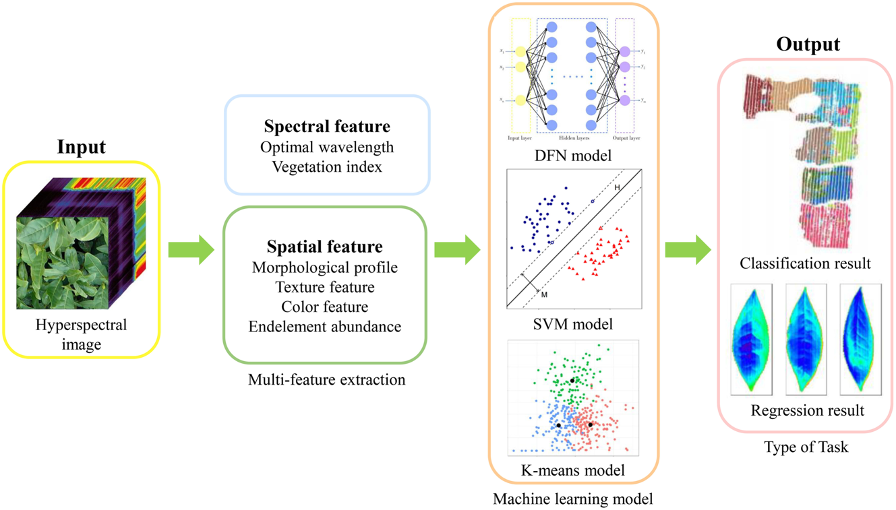
РИСУНОК 4. Рабочий процесс построения модели определения фенотипической информации.
При построении модели применяются одномерные и многомерные статистические модели. Первые сосредоточены на статистическом анализе одной переменной для выявления характеристик данных. В исследованиях фенотипа чайного растения одномерные методы обычно предусматривают создание переменных спектральных признаков — вегетационных индексов, спектрального положения и др., — которые посредством статистической обработки конкретных диапазонов отражают фенотипические характеристики (Sonobe et al., 2018b; Cao et al., 2022b). Согласно Wu et al., построенная переменная вегетационного индекса VI4 (VI4 = SDr/SDy) имела коэффициент корреляции 0,799 с содержанием азота в листьях чайного растения, а модель на основе VI4 показала наименьшую RMSE, равную 0,1029, то есть превосходное качество аппроксимации (Wu et al., 2018).
Многомерные методы статистического анализа, напротив, используют весь спектральный диапазон либо выбранные информативные полосы и направлены на всестороннее распознавание закономерностей, скрытых во множестве переменных, что способствует глубокому пониманию общих характеристик данных. Регрессионные алгоритмы часто применяются в фенотипировании растений для определения непрерывных признаков, например высоты растения или содержания хлорофилла. Наиболее распространены множественная линейная регрессия (MLR) (Huang et al., 2020) и регрессия методом частичных наименьших квадратов (PLSR) (Cao et al., 2022a). PLSRспециально учитывает корреляцию независимых переменных и преобразует коллинеарные переменные исходных спектральных данных в небольшое число независимых скрытых переменных. Поэтому PLSR обычно характеризуется высокой прогностической эффективностью и считается базовым методом анализа гиперспектральных данных.
Помимо регрессии, распространёнными моделями определения фенотипической информации являются классификация и кластеризация (Plaza et al., 2009; Layne et al., 2020). Классификация прогнозирует дискретные метки категорий либо различает пиксели изображения — например, при идентификации сортов чайного растения, диагностике стресса среды и выявлении областей поражения болезнями и вредителями. Кластеризация используется для обнаружения внутренней структуры набора данных. Методы кластеризации, например K-средних (Shan et al., 2018), позволяют разделить образцы чайного растения на самостоятельные группы так, чтобы сходство данных внутри одной категории было выше, чем между разными категориями (Davis et al., 2020). Алгоритмы кластеризации применимы и для сегментации изображений, поскольку эффективно различают и идентифицируют объекты и формы (Zhang and Xu, 2018; Nikbakhsh et al., 2020).
Глубокое обучение как новое направление машинного обучения сосредоточено на архитектуре и функционировании нейронных сетей, особенно глубоких. В последние годы оно продемонстрировало выдающиеся результаты при обнаружении сельскохозяйственных вредителей и болезней (Golhani et al., 2018; Xiao et al., 2022) и мониторинге стресса (Singh et al., 2018). В отличие от традиционного машинного обучения глубокие модели самостоятельно обнаруживают скрытые закономерности и признаки, избавляя от ручного проектирования и отбора признаков. Глубокие нейронные сети состоят из нескольких скрытых слоёв, каждый из которых преобразует входные данные, поэтому более глубокие сети способны улавливать более сложные признаки (LeCun et al., 2015; Zhao et al., 2022b). Это делает глубокое обучение особенно пригодным для обработки многомерных и крупномасштабных сложных наборов данных.
Некоторые модели глубокого обучения уже применяются в исследованиях фенотипа чайного растения. Например, модели на основе свёрточных нейронных сетей (CNN) превосходят традиционные методы машинного обучения по общей эффективности количественной оценки низкотемпературного стресса в чайных листьях (Mao etal., 2023a). По мере развития глубокого обучения особого внимания заслуживают генеративные модели и распространение крупномасштабных моделей в обработке сельскохозяйственных гиперспектральных данных. Генеративные модели обеспечивают эффективное расширение и синтез данных, уменьшение размерности, обнаружение аномалий и спектральное разделение смесей, открывая новые направления обработки гиперспектральных данных (Bhatt and Joshi, 2020; Hu et al., 2022; Guerri et al., 2024). Эти достижения не только улучшают существующие методы, но и ведут обработку гиперспектральных данных к большей интеллектуальности и эффективности.
4 Применение HSI в фенотипировании чайного растения
На основании обзора недавно опубликованных исследований мы рассматриваем применение HSI в фенотипировании чайного растения по трём направлениям: диагностика стресса среды, мониторинг состояния роста и оценка показателей качества. HSI способна обеспечить высокопроизводительную комплексную техническую поддержку и источник данных для фенотипирования чайного растения. В таблице 3 обобщено применение этой технологии к фенотипическим признакам чайных растений.
4.1 Диагностика стресса окружающей среды
Фенотип растений формируется под совместным влиянием генетических и средовых факторов. HSI широко применяется для исследования фенотипа чайного растения при биотических и абиотических стрессах (Sun et al., 2021; Sanaeifar et al., 2023). Вызванные этими условиями физиологические изменения могут существенно воздействовать на рост чайного растения. Точные мониторинг и оценка степени стресса с помощью HSI позволяют своевременно принимать обоснованные меры для ослабления отрицательного воздействия.
ТАБЛИЦА 3. Примеры применения HSI для определения фенотипической информации чайного растения. Часть 1.
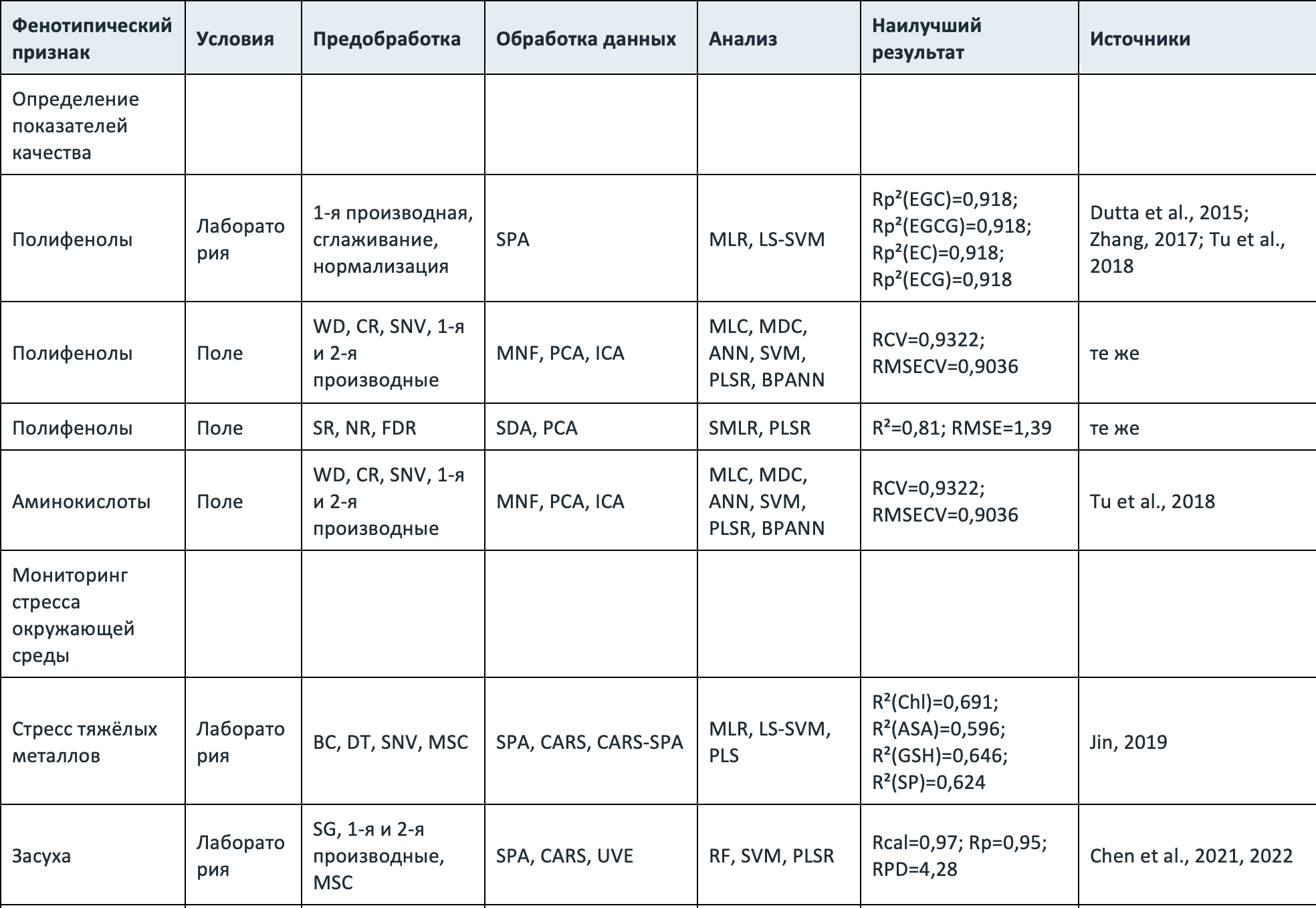
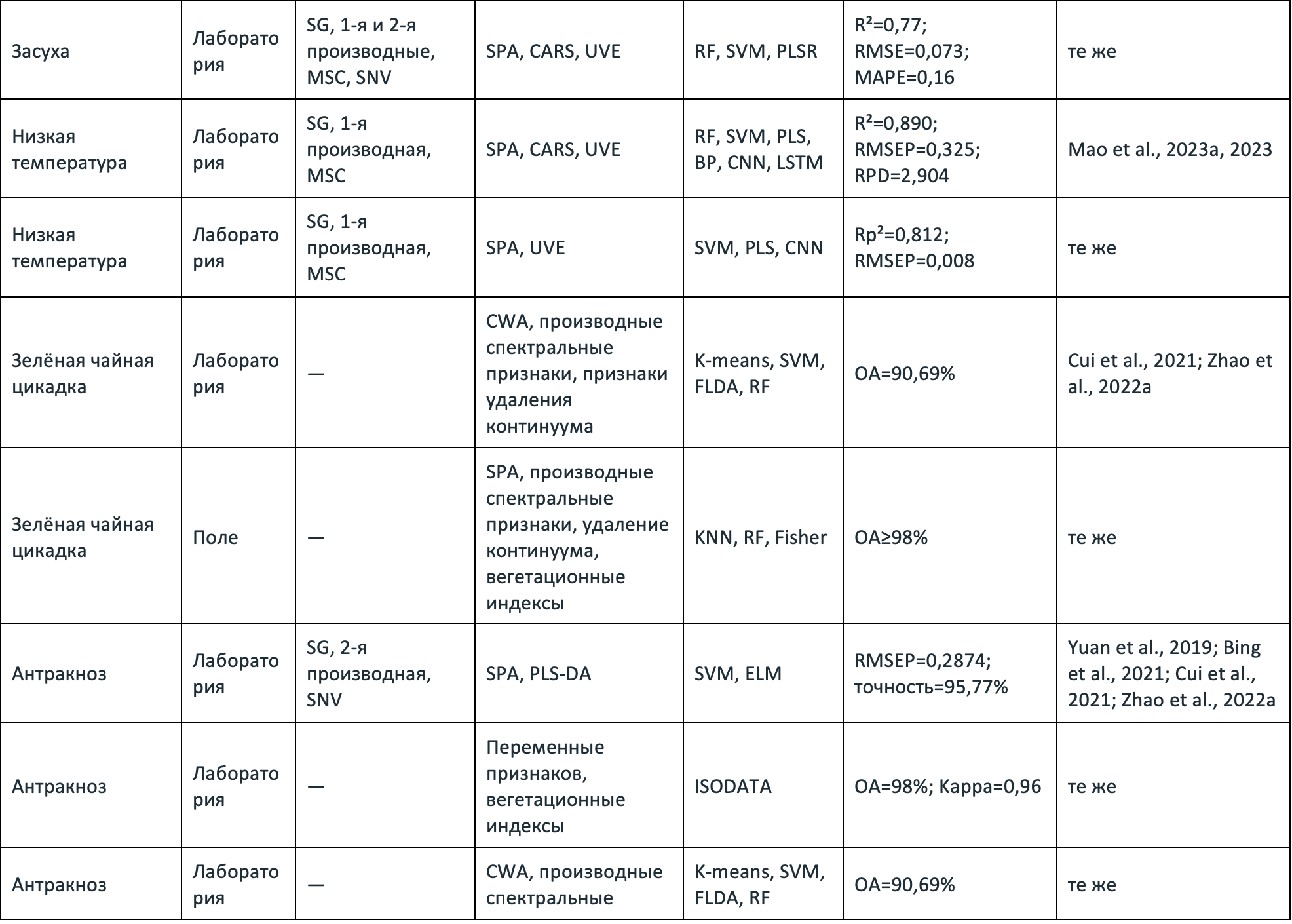
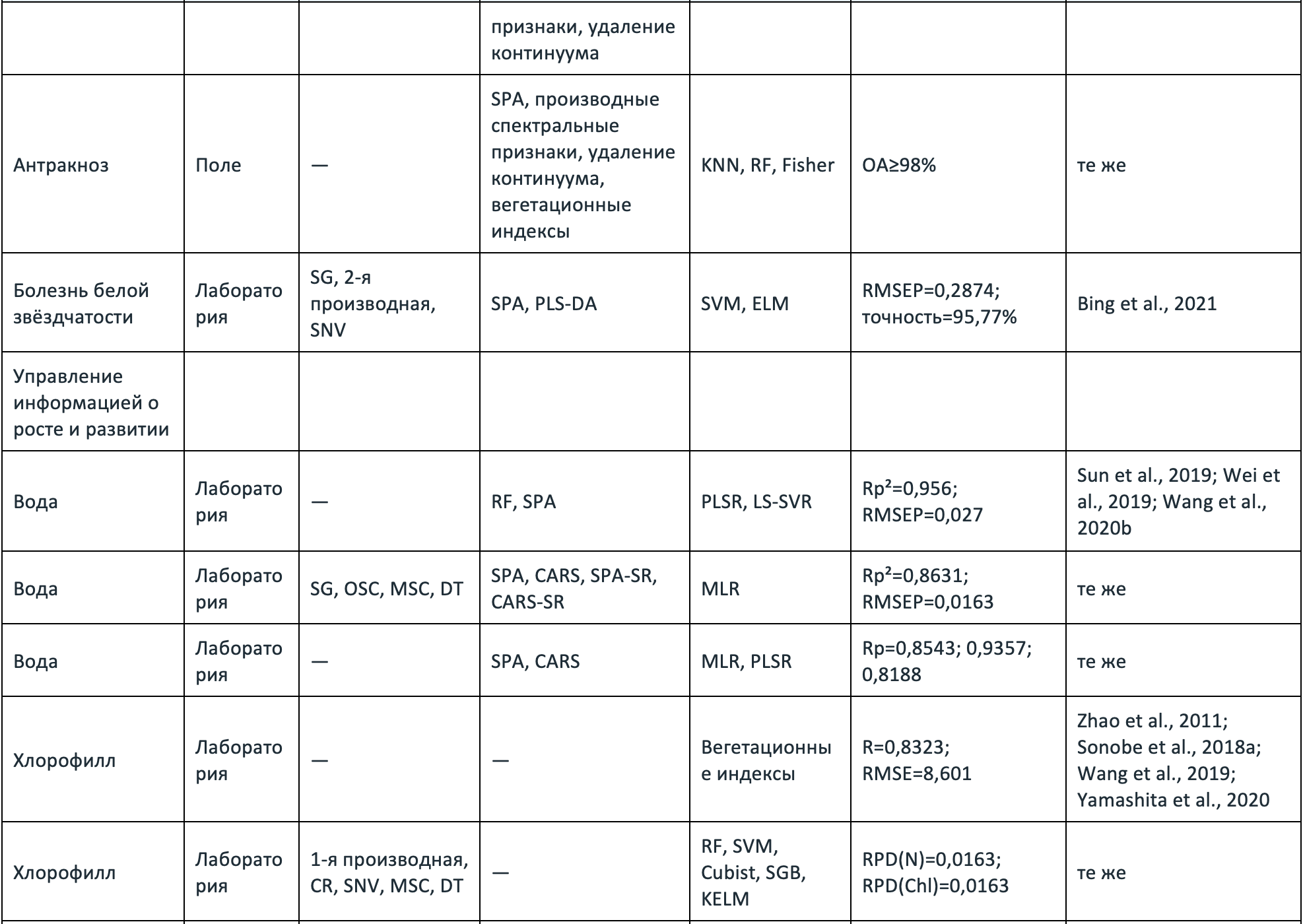
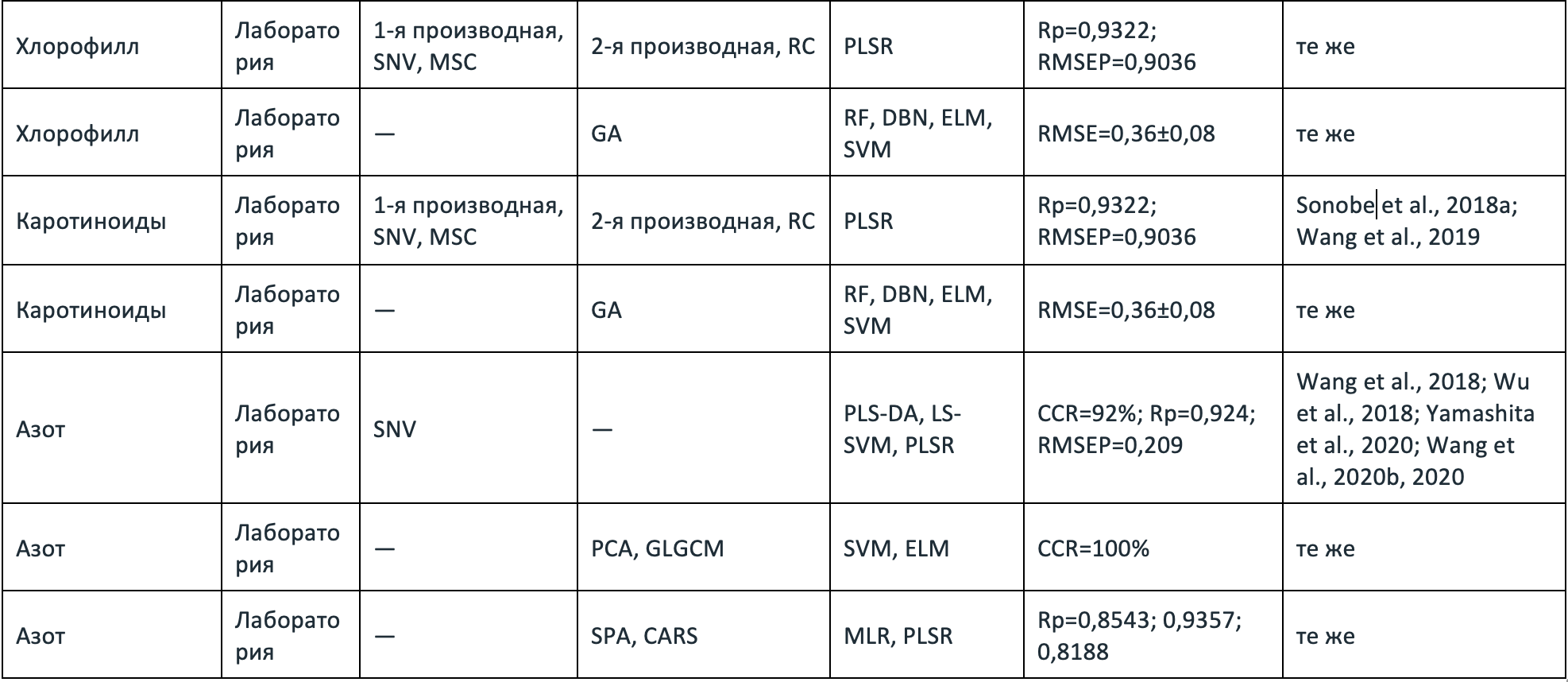
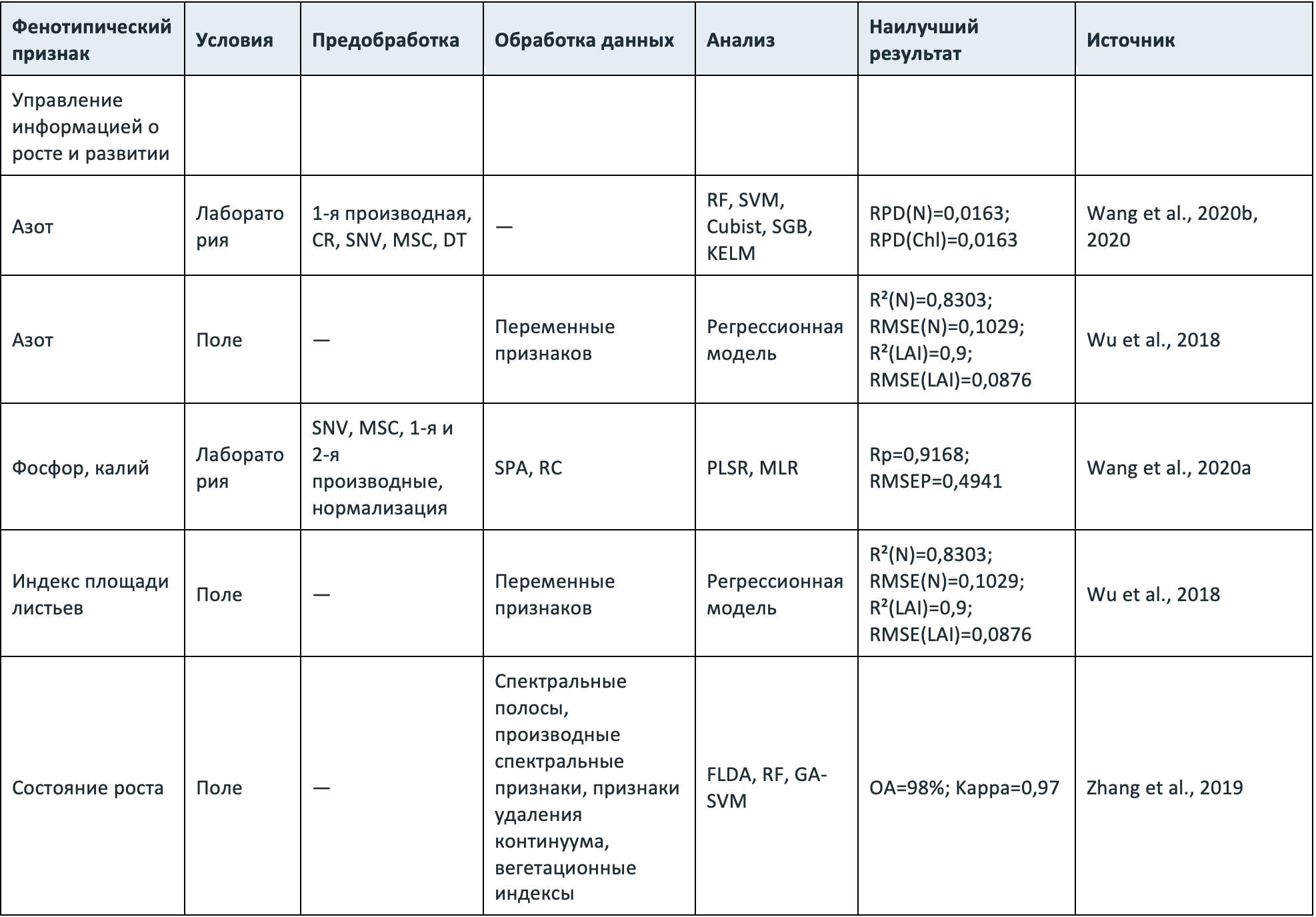
Точный мониторинг и оценка степени стресса чайных растений с помощью HSI позволяют не только своевременно принимать обоснованные меры для уменьшения отрицательного влияния стресса на рост, но и содействуют отбору и выведению устойчивых сортов, что, в свою очередь, повышает урожайность и качество чая.
4.1.1 Биотический стресс
Биотический стресс означает воздействие на чайное растение в процессе роста и помехи со стороны таких биологических факторов, как патогенные микроорганизмы, вредители, сорняки или конкуренция с другими растениями (Jeyaraj et al., 2020; Zahir et al., 2022). Например, HSI применялась для выявления антракноза — распространённого заболевания листьев чайного растения. Как показано на рисунке 5, Yuan et al. отобрали оптимальный набор гиперспектральных признаков для обнаружения антракнозных пятен, наблюдая вызванное антракнозом смещение в красную область в диапазоне 450–950 нм, а затем использовали автокорреляционный анализ для точного и быстрого выявления поражённой области на чайных листьях.
Исследователи объединили неконтролируемую классификацию и двумерную адаптацию порога и создали аналитическую схему обнаружения пятен, обеспечившую общую точность распознавания заболевания на уровне пикселей 94%. По сравнению с традиционной попиксельной классификацией метод эффективно выявляет больные чайные листья и оценивает степень заражения; это показывает, что HSI способна улучшить выявление болезней чайного растения и управление насаждениями (Yuan et al., 2019).
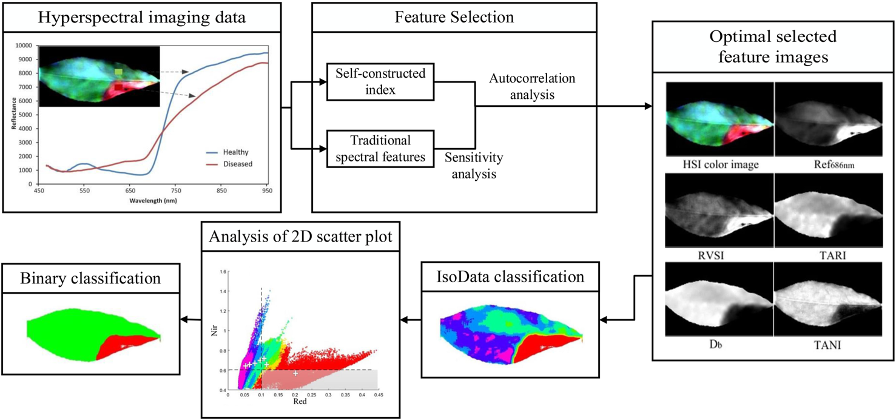
РИСУНОК 5. Схема рабочего процесса обнаружения антракноза чайного растения на основе HSI.
При различении болезней листьев с несколькими сходными симптомами Lu et al. использовали HSI в диапазоне 420–946 нм, чтобы идентифицировать и различать белую звёздчатость и антракноз, имеющие сходные признаки на изображениях. Из-за большого сходства морфологических характеристик средних спектров всего листа, поражённого этими двумя заболеваниями, разделимость данных была сравнительно низкой, тогда как средние спектры областей поражения заметно различались. Поэтому средние спектры пятен, извлечённых после пороговой сегментации и обработки маской, объединили с разными моделями машинного обучения для классификации. Результаты показали, что точность прогноза модели ELM на основе нейросетевой структуры была выше, чем модели SVM с разными ядерными функциями, и достигала 95,77% (Bing et al., 2021).
Для этих двух сходных заболеваний HSI позволяет точно распознавать болезнь и оценивать её тяжесть уже на ранней стадии. По сравнению с компьютерным зрением приведённые исследования показывают определённые преимущества HSI для раннего обнаружения болезней чайного растения. Однако применение по-прежнему главным образом основано на внешних признаках поражения и не обеспечивает качественного выявления растения на самой ранней стадии заражения патогеном. Поэтому дальнейшие исследования должны предусматривать прогнозный анализ на начальной стадии заражения, чтобы обеспечить эффективную профилактику и борьбу с болезнями чайного растения (Lowe et al., 2017).
Для минимизации ущерба от вредителей их раннее обнаружение играет ключевую роль в предотвращении распространения. В реальном чайном саду вредители и болезни нередко присутствуют совместно, а из-за сходства симптомов повреждения различить их бывает трудно. Cui et al. предложили метод на основе гиперспектральных данных кроны в диапазоне 450–950 нм для обнаружения и различения трёх стрессов чайного растения со сходными внешними проявлениями: антракноза, чайной цикадки и солнечного ожога. Посредством анализа спектральной чувствительности были определены наилучшие спектральные признаки для трёх операций — удаления растительного фона, выявления повреждённых участков и различения типов стресса. Затем с помощью кластеризации K-средних и KNN построили модель выявления повреждённых областей, а для различения типов стресса в них применили линейный дискриминантный анализ Фишера.
При проверке модели точность обнаружения повреждённых областей достигла 95%, а точность различения стрессов — 98% (Cui et al., 2021). Эти исследования показывают, что методы на основе гиперспектральных изображений преимущественно устанавливают взаимосвязь спектральных признаков со степенью болезни или типом вредителя с помощью разных алгоритмов статистического различения или интеллектуального анализа данных. Этот подход сходен с анализом при идентификации заболеваний чайного растения и позволяет точно оценивать заражённые области при разных типах стресса. Он имеет потенциал для управления болезнями на больших чайных плантациях, особенно для мониторинга в реальном времени и точной диагностики. Уменьшая применение пестицидов и оптимизируя стратегии борьбы с вредителями, HSI способна заметно снизить экологическое воздействие сельскохозяйственного производства и одновременно повысить урожай и качество чайных листьев.
4.1.2 Абиотический стресс
В начальный период абиотического стресса у чайного растения часто отсутствуют заметные внешние изменения. Существенные различия внешних признаков могут проявиться лишь при достижении стрессом определённой тяжести, когда растениям уже причинён необратимый ущерб. Поэтому раннее выявление и оценка изменений признаков при абиотическом стрессе жизненно важны для своевременной разработки мер, способных ослабить или обратить его воздействие (Gerhards et al., 2019; Krishnatreya et al., 2021).
Поскольку ранние признаки абиотического стресса чайного растения обычно выражаются в изменениях соответствующих биохимических параметров тканей в ходе стрессовой реакции, эти изменения можно зарегистрировать в виде спектральных различий. Это позволяет качественно анализировать степень адаптации растений к текущему абиотическому стрессу. В настоящее время применение HSI для определения уровня абиотического стресса активно и углублённо исследуется. Далее рассмотрены три фактора абиотического стресса чайного растения: засуха, низкая температура и тяжёлые металлы.
4.1.2.1 Стресс засухи
Из-за глобального потепления, увеличивающего частоту экстремальных погодных явлений, и нехватки сельскохозяйственной воды, снижающей эффективность орошения, чайные растения всё чаще испытывают засуху, отрицательно влияющую на рост, развитие и урожайность. Для противодействия засухе растения запускают ряд физиологических защитных механизмов, включая устьичную регуляцию, осмотическую корректировку и регуляцию системы антиоксидантных ферментов (Liu and Chen, 2014; Tony et al., 2016). HSI применялась для изучения изменений физиологических и биохимических параметров этих механизмов и оценки тяжести засухи.
Chen et al. при обработке проростков чая засухой разной степени получили пять связанных с засухой физиолого-биохимических показателей: малоновый диальдегид (MDA), утечку электролитов (EL), максимальную эффективность фотосистемы II (Fv/Fm), растворимые сахара (SS) и степень повреждения засухой (DDD). Испытав различные алгоритмы обработки данных и методы моделирования, исследователи прогнозировали тяжесть засухи у разных проростков. Модель UVE-SVM для DDD показала высокую точность прогноза: Rcal=0,97, Rp=0,95, RPD=4,28, — обеспечив всестороннюю и объективную оценку засухоустойчивости чайных растений (Chen et al., 2021).
В другом исследовании той же группы HSI в диапазоне 400–1000 нм использовалась для мониторинга засухи у десяти разных ресурсов зародышевой плазмы чая и определения их засухоустойчивости. Работа подтвердила осуществимость и эффективность HSI для отбора засухоустойчивой зародышевой плазмы. Три показателя, непосредственно применявшихся при оценке засухи, — малоновый диальдегид, растворимые сахара и суммарные фенолы — внесли положительный вклад в построение комплексного коэффициента засухоустойчивости DTC. Наилучшие результаты отбора показала модель MSC-2D-UVE-SVM: R²=0,77, RMSE=0,073, MAPE=0,16 (Chen et al., 2022).
Исходя из этих работ, определение засухи чайного растения с помощью HSI — от начального этапа генетического отбора до всего цикла жизнедеятельности — получило технологии точного мониторинга в реальном времени признаков, проявляющихся при засухе. Однако условия выращивания и стадии роста в определённой мере обусловливают вариабельность реакции на засуху. Поэтому необходимы дальнейшие исследования чайных растений со сложными изменениями фенотипических признаков; они откроют более широкие перспективы оптимизации селекции и точного возделывания.
В целом современные исследования стресса среды чайного растения преимущественно сосредоточены на одном типе стресса и не учитывают, что в естественных условиях растение часто одновременно подвергается нескольким стрессам (Safavi-Rizi et al., 2021). Например, оно может в один период испытывать засуху и высокую температуру, причём фенотипическая реакция способна заметно отличаться от реакции только на засуху или только на жару (Tang et al., 2023). Такой узкий подход серьёзно ограничивает применимость результатов, препятствует целостному пониманию фенотипа и не позволяет раскрыть сложные взаимодействия и комплексные реакции на средовые факторы, влияющие на рост и физиологию чайного растения (Cao et al., 2015).
4.1.2.2 Низкотемпературный стресс
Низкая температура — одно из важных ограничений скорости роста и развития, урожайности и естественного географического распространения чайного растения. При холодовом стрессе повреждаются структура и функции клеточных мембран, запускается ряд аномальных физиолого-биохимических реакций и возникают нарушения клеточного метаболизма, что приводит к повреждению растения. Исследования показали, что при низкой температуре чайное растение вырабатывает защитные ферменты — каталазу (CAT), пероксидазу (POD) и супероксиддисмутазу (SOD), — нейтрализующие избыточные активные кислородные радикалы (Wang et al., 2021). Следовательно, изменение этих ферментов можно отслеживать гиперспектральными методами для измерения степени холодового стресса.
Зависимыми факторами при оценке низкотемпературного стресса могут служить и некоторые физиологические показатели, участвующие в холодоустойчивости: малоновый диальдегид, растворимые белки и сахара. Mao et al. исследовали спектральные изменения чайных листьев после воздействия в течение 8 и 12 часов при нормальной (25°C), пониженной (4°C) и отрицательной (-4°C) температуре. С применением разных методов отбора переменных и моделей машинного обучения анализировали содержание хлорофилла (значение SPAD), растворимых сахаров (SS) и малонового диальдегида (MDA), активность CAT, POD и SOD, а также индекс реакции на низкую температуру (LTRI). Модель UVE-CNN показала высокую точность прогноза LTRI: Rp²=0,8631 и RMSEP=0,325 (Mao et al., 2023a).
Работа выявила потенциальные преимущества HSI для определения низкотемпературного стресса и может обеспечить точные данные для предотвращения повреждения чайного растения заморозками. При анализе абиотического стресса многопараметрическая модель в целом превосходила модель единственного физико-химического показателя. Вероятно, это объясняется тем, что параметры могли служить друг для друга внутренними стандартами и учитывалась их реакция на низкую температуру. Однако выбор биохимических компонентов чайного растения и механизм их связи с холодовым стрессом требуют дальнейшего исследования.
4.1.2.3 Стресс тяжёлых металлов
Тяжёлые металлы в чайном растении главным образом имеют антропогенное происхождение: промышленные выбросы и чрезмерное применение удобрений загрязняют воздух, воду и почву. Металлы поступают в растение двумя основными путями — через поглощение корнями и проникновение через листья, нарушают усвоение питательных веществ и метаболические функции и препятствуют нормальному росту и развитию (Zhang J. et al., 2018; Sanaeifar et al., 2022). Кроме того, они могут накапливаться в чайных листьях, создавая серьёзную угрозу здоровью человека. Поэтому своевременный мониторинг и управление загрязнением тяжёлыми металлами крайне важны для чайных плантаций. Как и при других абиотических стрессах, по мере развития стресса тяжёлых металлов изменяются связанные со стрессом физиологические показатели чайного растения.
Jin et al. предложили метод на основе HSI в диапазоне 420–946 нм и хемометрики для количественной оценки изменения четырёх показателей — хлорофилла (Chl), аскорбиновой кислоты (ASA), глутатиона (GSH) и растворимого белка (SP) — в листьях и корнях чайного растения в разные моменты времени и при разных уровнях свинцового стресса. Для каждого показателя с помощью оптимальной предобработки и выбора характерных длин волн была построена модель количественного анализа. Все MLR-модели были простыми и эффективными, показывали хорошие прогностические результаты, а коэффициент детерминации прогноза Rp² достигал примерно 0,6–0,9 (Jin, 2019).
Аналогичным образом Sanaeifar et al. успешно применили модель PLS-RBFNN на основе спектроскопии видимого и ближнего ИК-диапазона для точного прогнозирования показателей качества чайных листьев при листовом стрессе через разные интервалы и при разных уровнях обработки (Sanaeifar et al., 2022). Оба подхода позволяют быстро анализировать и точно определять физиологическое состояние чайного растения при стрессе тяжёлых металлов. Однако загрязнение воздуха и почвы обычно не ограничивается одним металлом, а воздействие разных металлов на чайное растение различается. Поэтому определение различных видов стресса тяжёлых металлов может стать ценным направлением исследований HSI-фенотипирования чайного растения (Zhang et al., 2021).
4.2 Мониторинг информации о росте и развитии
Информация о росте и развитии чайного растения главным образом включает воду, фотосинтетические пигменты, элементы питания, а также морфологические и структурные параметры. Она позволяет глубоко понять текущее физиологическое состояние и сложность многолетнего процесса роста, обеспечивая научную основу для оценки и повышения урожайности чая (Li et al., 2022). HSI делает возможным более точный количественный анализ и визуальное представление фенотипических параметров неразрушающим способом.
Вода — важнейший элемент жизнедеятельности чайного растения, непосредственно участвующий в росте и развитии, физиологическом обмене и формировании морфологической структуры. Вода также играет важную регулирующую роль в образовании компонентов, определяющих качество чая. Поэтому точное определение водного состояния в реальном времени имеет большое значение для возделывания чайного растения и орошения плантаций. Оценка влажности листьев стала важным направлением HSI-исследований (Zhang X. et al., 2018). Исследователи применяли ближнюю инфракрасную HSI совместно с разными комбинациями алгоритмов для количественного моделирования и визуализации распределения влаги в чайном листе (Sun et al., 2019).
Wei et al. предположили, что в процессе производства чая гиперспектральные данные лицевой и обратной сторон листа в диапазоне 380–1030 нм различаются. Они разработали логистический классификационный регрессор со 100%-ной долей правильной классификации сторон, после чего по характерным полосам для каждой стороны построили модель LS-SVR и получили карты распределения воды в чайном листе (Wei et al., 2019). Опубликованные работы преимущественно сосредоточены на точном анализе содержания воды на уровне листа. Для более полного картирования водного состояния всего растения будущие исследования должны распространить оценку на уровень кроны.
Исследования водного состояния других культур подтверждают потенциал HSI кроны. Так, Lü et al. количественно оценивали и прогнозировали водное состояние Arabidopsis thaliana (Lü et al., 2020), а Wocher et al. выявили значимую связь между отражением кроны и содержанием влаги у озимой пшеницы и кукурузы (Wocher etal., 2018). Эти работы подтверждают эффективность спектральных данных уровня кроны для разных культур и создают важную основу для переноса подхода на мониторинг водного состояния чайного растения.
Фотосинтетические пигменты чайного растения главным образом представлены хлорофиллом и каротиноидами — важными компонентами фотосинтеза. Их содержание непосредственно отражает фотосинтетическую способность и степень адаптации к среде. В настоящее время HSI стала эффективным инструментом точной оценки содержания пигментов и их пространственного распределения в чайных листьях. Например, Zhao et al. с помощью прогностической модели MSAVI2 — модифицированного вторичного почвенно-скорректированного вегетационного индекса — успешно рассчитали концентрацию хлорофилла на уровне элементов изображения (Zhao et al., 2011).
Совместное измерение хлорофилла и каротиноидов может использоваться для выявления стресса среды. Sonobe et al. применили ядерную экстремальную обучающую машину KELM для установления связи между гиперспектральными данными 400–900 нм и содержанием трёх фотосинтетических пигментов — хлорофиллов a и bи каротиноидов. Среднеквадратические ошибки моделей составили соответственно 1,95±0,36, 1,08±0,11 и 0,68±0,10 мкг/см² (Sonobe et al., 2018a). Азот листьев чайного растения в основном содержится в фотосинтетических пигментах, поэтому его статус можно эффективно отслеживать по динамике пигментов. Wang et al. с высокой точностью спрогнозировали содержание хлорофиллов a и b, общего хлорофилла и каротиноидов в листьях при разных дозах азота, применив SNV-PLSR ко всему диапазону 400–1000 нм и 2-Der-PLSR к характерным длинам волн (Wang et al., 2019).
Эта серия работ наглядно показывает высокую точность и эффективность HSI при измерении фотосинтетических пигментов чайного растения. Динамические изменения пигментов тесно связаны с физиологическим состоянием. Последующие исследования могут преобразовать пространственно-временную динамику пигментов в количественную оценку ключевых показателей роста и развития, расширив практическое применение в производстве чая.
Азот, фосфор и калий — необходимые элементы для роста, развития и формирования урожая чайного растения; обычно их вносят в виде удобрений. Эффективный, неразрушающий и точный мониторинг питания помогает диагностировать состояние роста, повысить эффективность удобрений и уменьшить ущерб почвенным питательным веществам и среде от их избытка, обеспечивая точное управление возделыванием. Wang et al. объединили HSI с многомерной классификацией для различения уровней азотного питания. Из данных 400–1000 нм, включавших 553 длины волны, методом главных компонент выделили пять оптимальных длин волн, затем с помощью матрицы ковариации градиента уровней серого (GLGCM) извлекли текстурные признаки их изображений. Модель SVM на объединённых данных показала наилучший результат: 100% правильной классификации проверочного набора (Wang et al., 2018).
В связанной работе эта группа совместила HSI 400–1000 нм с хемометрикой и с помощью SNV-LS-SVM точно различила уровень и состояние азотного питания с долей правильной классификации соответственно 82 и 92%. Модель SNV-PLSR успешно количественно определила содержание азота в листьях с коэффициентом корреляции Rp=0,924 (Wang et al., 2020c). Затем результаты распространили на фосфор и калий (рисунок 6): SPA-MLRобеспечила высокоточную оценку их содержания у разных сортов с Rp=0,9423 и 0,9168 соответственно (Wang et al., 2020a).
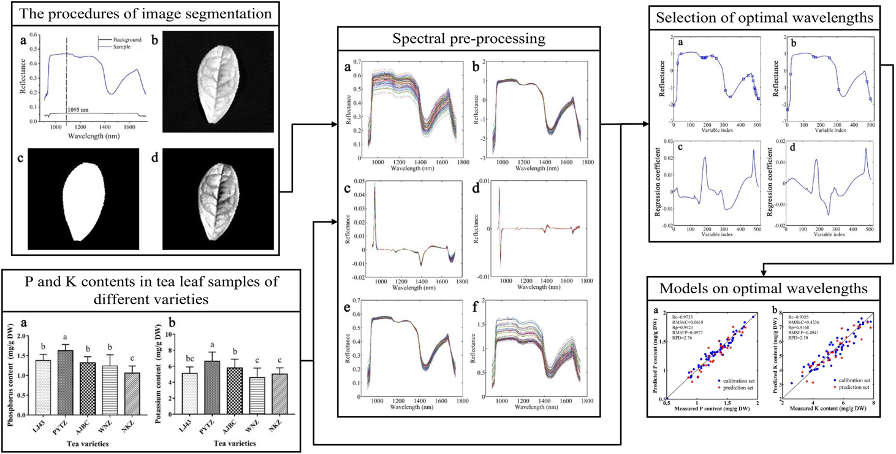
РИСУНОК 6. Схема обработки изображений и анализа данных для количественного определения фосфора и калия у разных сортов чайного растения.
Эти работы демонстрируют перспективность HSI для динамического мониторинга питания и управления внесением удобрений в поле, однако переносу результатов в практику препятствуют трудности и ограничения. Общая проблема — слабая переносимость построенных моделей, главным образом из-за влияния сорта, географического положения и факторов среды на прогноз информации о росте и развитии. В будущем следует создавать более широко применимые диагностические модели на основе гиперспектральных данных разных видов чайного растения в различных условиях среды.
Морфологические и структурные параметры — ещё одна важная тема определения информации о росте; к ним относятся площадь листьев, биомасса, ширина кроны и другие показатели. Вегетационные индексы на основе гиперспектральных данных позволяют отслеживать изменения этих параметров, оценивать состояние роста и отражать производственный потенциал. Чтобы преодолеть трудоёмкость и разрушающий характер традиционного ручного определения индекса площади листьев (LAI), Wu et al. проанализировали его корреляцию с переменными гиперспектральных признаков, выделили три наиболее коррелирующих признака — амплитуду жёлтого края, отражение зелёного пика и положение красной впадины — и построили по ним разные инверсионные модели. Наилучшей оказалась логарифмическая аппроксимация с отражением зелёного пика Rg как независимой переменной: на проверочных образцах R²=0,764 и RMSE=0,0876. Работа подтвердила возможность быстрого неразрушающего измерения LAI в реальном времени (Wu et al., 2018).
Поскольку морфологические и структурные признаки наблюдаются более непосредственно, обычные спектральные методы уже обеспечивают достаточно точные результаты. Высокая стоимость HSI и сложность анализа данных пока не создали большой потребности в ней для изучения морфологической структуры. Однако углублённый анализ богатой информации спектральных полос и спектральных признаков высокого разрешения может компенсировать ограничения традиционных методов по пространственному разрешению растительности и чувствительности данных и обеспечить построение вегетационных индексов, точно определяющих морфологические параметры при дистанционном зондировании.
4.3 Определение показателей качества
Качество чая — один из ключевых факторов, определяющих его рыночную стоимость и способы переработки. Содержание в листе органических веществ — чайных полифенолов, аминокислот и кофеина — является важным показателем качества и вкуса чая (Peng et al., 2016; Cao et al., 2020). Традиционно содержание этих веществ оценивали путём разрушающего отбора образцов с последующим анализом методами мокрой химии.
Традиционные методы основаны на разрушающем отборе образцов с последующим анализом методами мокрой химии; они трудоёмки, требуют значительного времени и не позволяют адекватно представить пространственную изменчивость всего чайного растения. Dutta et al. проанализировали гиперспектральные данные, измеренные непосредственно на месте в диапазоне 347–2506 нм, применив разные методы многомерного анализа для выбора наилучших прогностических моделей. Они разработали модель частичных наименьших квадратов для спектров первой производной (FDR-PLSR), обеспечившую точную оценку содержания чайных полифенолов на уровне листа; значения R² и RMSE составили соответственно 0,81 и 1,39 (Dutta et al., 2015).
Гиперспектральные методы также позволяют оценивать и отслеживать качество чая в пространственном масштабе. Tu et al. точно классифицировали сорта чайного растения на больших плантациях по спектральным характеристикам данных кроны, полученным гиперспектральной камерой 450–998 нм, установленной на БПЛА. Гиперспектральные данные также обрабатывали PLSR после преобразования стандартной нормальной вариации (SNV) для прогнозирования содержания чайных полифенолов и аминокислот. Хотя модель показала сравнительно значимую точность прогноза для отношения полифенолов к аминокислотам — основного показателя органолептического качества чая, RCV=0,66 и RMSECV=13,27, — это подтвердило связь спектральных данных с показателями качества. Для практического прогнозирования этих показателей на платформе БПЛА требуются более глубокие исследования и повышение точности модели (Tu et al., 2018).
Согласно имеющимся работам, HSI позволяет независимо анализировать и измерять содержание нескольких отдельных компонентов в составе основных веществ чая, чтобы точно оценивать его текущее качество и давать полезные рекомендации по оптимизации последующего производства и переработки.
Вместе с тем современные исследования преимущественно опираются на спектральные данные, полученные в один момент времени, и не учитывают временную динамику фенотипических характеристик в течение фенологических циклов (Mahlein et al., 2018). Фенотипическая экспрессия чайного растения может меняться со временем, поэтому для точной регистрации динамики необходимо непрерывное наблюдение. В будущих исследованиях рекомендуется расширить выборку растений, охватив фенотипические различия в разных условиях среды. Долгосрочные наблюдения и создание комплексных баз фенотипических данных чайного растения повысят статистическую значимость и надёжность исследований и помогут разрабатывать более точные и обобщаемые модели (Wijewardane et al., 2023).
5 Итоги и перспективы
В настоящей статье всесторонне рассмотрен прогресс HSI в определении фенотипической информации чайного растения. Основные направления применения включают диагностику стресса окружающей среды, мониторинг информации о росте и развитии и определение показателей качества. Использование HSI для определения фенотипической информации чайного растения всё ещё находится на ранней стадии и характеризуется заметными пробелами в исследованиях.
Несмотря на существенное обогащение представлений о фенотипах растений благодаря этой технологии, сохраняется проблема возможной утраты важной фенотипической информации из-за ограниченной регистрации на определённых длинах волн или при определённом разрешении. Поэтому особенно важно внедрять более совершенные гиперспектральные технологии, повышающие точность и полноту сбора данных.
На этапе обработки и анализа гиперспектральные данные проходят сложный и тщательный рабочий процесс. Ошибка на любом его этапе способна привести к несогласованности данных. Следовательно, разработка более эффективных алгоритмов обработки и анализа имеет важнейшее значение для извлечения из гиперспектральных данных более точной и надёжной информации. Кроме того, для сопоставимости данных разных исследований необходимо дальнейшее создание стандартизированных методов обработки и анализа гиперспектральных данных.
На уровне применения современные исследования фенотипа чайного растения также имеют ограничения, особенно отсутствие комплексного метода, охватывающего несколько масштабов наблюдения: органы-листья, отдельные растения и популяции. Объединение наблюдений разных масштабов крайне важно для всестороннего понимания фенотипической информации чайного растения, однако единая методологическая схема интеграции результатов разных масштабов ещё не создана.
Будущие исследования должны уделять внимание перекрёстной реакции чайного растения на несколько стрессов, чтобы с более целостной позиции раскрыть взаимосвязи его фенотипических характеристик и тем самым способствовать глубокой оптимизации стратегий селекции и управления возделыванием.
Вклад авторов
BL: рецензирование и редактирование текста. HS: руководство проектом, подготовка первоначального варианта рукописи. LZ: рецензирование и редактирование текста. FC: разработка концепции, методология, рецензирование и редактирование текста. KW: рецензирование и редактирование текста.
Финансирование
Авторы заявляют, что исследование, авторство и/или публикация этой статьи получили финансовую поддержку. Проект поддержан Фондом естественных наук провинции Чжэцзян, Китай (№ LQ21C130007), программой исследований и разработок провинции Чжэцзян «Pioneer» и «Leading Goose» (№ 2022C04002), а также крупным проектом научно-технических инноваций Вэньчжоу (№ ZNF2023007).
Благодарности
Авторы благодарят Фонд естественных наук провинции Чжэцзян.
Конфликт интересов
Авторы заявляют, что исследование проводилось при отсутствии каких-либо коммерческих или финансовых отношений, которые могли бы быть истолкованы как потенциальный конфликт интересов.
Примечание издателя
Все утверждения, изложенные в статье, принадлежат исключительно авторам и не обязательно отражают позицию организаций, с которыми они связаны, а также издателя, редакторов и рецензентов. Издатель не гарантирует и не поддерживает какие-либо продукты, которые могут оцениваться в статье, или заявления их производителей.
Примечание к списку литературы: библиографические записи, названия журналов, DOI и названия цитируемых работ сохранены в оригинальном написании, как принято в научных переводах, чтобы исключить искажение реквизитов и обеспечить точный поиск источников.
Список литературы
Adao, T., Hruska, J., Pádua, L., Bessa, J., Peres, E., Morais, R., et al. (2017). Hyperspectral imaging: A review on UAV-based sensors, data processing and applications for agriculture and forestry. Remote Sens. 9, 1110. doi: 10.3390/rs9111110
Ang, K. L. M., and Seng, J. K. P. (2021). Big data and machine learning with hyperspectral information in agriculture. IEEE Access. 9, 36699–36718. doi: 10.1109/ Access.6287639
Atefi, A., Ge, Y. F., Pitla, S., and Schnable, J. (2021). Robotic technologies for high- throughput plant phenotyping: contemporary reviews and future perspectives. Front. Plant Sci. 12. doi: 10.3389/fpls.2021.611940
Bai, X. B., Yu, J. S., Fu, Z. T., Zhang, L. X., and Li, X. X. (2020). Application of spectral imaging technology for detecting crop disease information: A review. Spectrosc. Spect. Anal. 40, 350–355. doi: 10.3964/j.issn.1000-0593(2020)02-0350-06
Barnes, R. J., Dhanoa, M. S., and Lister, S. J. (1989). Standard normal variate transformation and de-trending of near-infrared diffuse reflectance spectra. Appl. Spectrosc. 43, 772–777. doi: 10.1366/0003702894202201
Bhatt, J. S., and Joshi, M. V. (2020). “Deep learning in hyperspectral unmixing: A review,” in IGARSS 2020 - 2020 IEEE International Geoscience and Remote Sensing Symposium (IEEE, Waikoloa, HI, USA), 2189–2192. doi: 10.1109/IGARSS39084.2020
Bing, L., Sun, J., Yang, N., Wu, X. H., and Zhou, X. (2021). Identification of tea white star disease and anthrax based on hyperspectral image information. J. Food Process Eng. 44, e13584. doi: 10.1111/jfpe.13584
Cao, D., Lin-Long, M. A., Jin, X. F., and Gong, Z. M. (2015). Research advance of resistance to abiotic stresses of tea. Hunan. Agric. Sci. 10, 152–154. doi: 10.16498/ j.cnki.hnnykx.2015.10.043
Cao, Q., Yang, G. J., Duan, D. D., Chen, L. Y., Wang, F., Xu, B., et al. (2022a). Combining multispectral and hyperspectral data to estimate nitrogen status of tea plants (Camellia sinensis (L.) O. Kuntze) under field conditions. Comput. Electron. Agric. 198, 107084. doi: 10.1016/j.compag.2022.107084
Cao, Q., Yang, G. J., Wang, F., Chen, L. Y., Xu, B., Zhao, C. J., et al. (2022b). Discrimination of tea plant variety using in-situ multispectral imaging system and multi- feature analysis. Comput. Electron. Agric. 202, 107360. doi: 10.1016/j.compag.2022.107360
Cao, Y., Li, H. R., Sun, J., Zhou, X., Yao, K. S., and Nirere, A. (2020). Nondestructive determination of the total mold colony count in green tea by hyperspectral imaging technology. J. Food Process Eng. 43, e13570. doi: 10.1111/jfpe.13570 Centner, V., Massart, D. L., de Noord, O. E., de Jong, S., Vandeginste, B. M., and
Sterna, C. (1996). Elimination of uninformative variables for multivariate calibration. Anal. Chem. 68, 3851–3858. doi: 10.1021/ac960321m
Çetin, V., and Yıldız, O. (2022). A comprehensive review on data preprocessing techniques in data analysis. Pamukkale Üniv Mühendis Bilim Derg. 28, 299–312. doi: 10.5505/pajes.2021.62687
Chappelle, E. W., Kim, M. S., and McMurtrey Iii, J. E. (1992). Ratio analysis of reflectance spectra (RARS): an algorithm for the remote estimation of the concentrations of chlorophyll a, chlorophyll b, and carotenoids in soybean leaves. Remote Sens. Environ. 39, 239–247. doi: 10.1016/0034-4257(92)90089-3
Chen, S. Z., Gao, Y., Fan, K., Shi, Y. J., Luo, D. N., Shen, J. Z., et al. (2021). Prediction of drought-induced components and evaluation of drought damage of tea plants based on hyperspectral imaging. Front. Plant Sci. 12. doi: 10.3389/fpls.2021.695102
Chen, S. Z., Shen, J. Z., Fan, K., Qian, W. J., Gu, H. L., Li, Y. C., et al. (2022). Hyperspectral machine-learning model for screening tea germplasm resources with drought tolerance. Front. Plant Sci. 13. doi: 10.3389/fpls.2022.1048442
Cheng, J. H., Sun, J., Yao, K. S., Xu, M., and Cao, Y. (2022). A variable selection method based on mutual information and variance inflation factor. Spectrochim. Acta A. 268, 120652. doi: 10.1016/j.saa.2021.120652
Chu, X. L., Yuan, H. F., and Lu, W. Z. (2004). Progress and application of spectral data pretreatment and wavelength selection methods in NIR analytical technique. Prog. Chem. 16, 528–542. doi: 10.3321/j.issn:1005-281X.2004.04.008
Cui, L. H., Yan, L. J., Zhao, X. H., Yuan, L., Jin, J., and Zhang, J. C. (2021). Detection and discrimination of tea plant stresses based on hyperspectral imaging technique at a canopy level. Phyton. Int. J. Exp. Bot. 90, 621–634. doi: 10.32604/phyton.2021.015511
Datt, B. (1999). A new reflectance index for remote sensing of chlorophyll content in higher plants: tests using Eucalyptus leaves. J. Plant Physiol. 154, 30–36. doi: 10.1016/ S0176-1617(99)80314-9 Daughtry, C. S. T., Walthall, C. L., Kim, M. S., De Colstoun, E. B., and McMurtrey Iii,
J. E. (2000). Estimating corn leaf chlorophyll concentration from leaf and canopy reflectance. Remote Sens. Environ. 74, 229–239. doi: 10.1016/S0034-4257(00)00113-9
Davis, R. L., Greene, J. K., Dou, F. G., Jo, Y. K., and Chappell, T. M. (2020). A practical application of unsupervised machine learning for analyzing plant image data collected using unmanned aircraft systems. Agronomy 10, 633. doi: 10.3390/ agronomy10050633 Delalieux, S., Somers, B., Hereijgers, S., Verstraeten, W. W., Keulemans, W., and
Coppin, P. (2008). A near-infrared narrow-waveband ratio to determine Leaf Area Index in orchards. Remote Sens. Environ. 112, 3762–3772. doi: 10.1016/ j.rse.2008.05.003
Dutta, D., Das, P. K., Bhunia, U. K., Singh, U., Singh, S., Sharma, J. R., et al. (2015). Retrieval of tea polyphenol at leaf level using spectral transformation and multi-variate statistical approach. Int. J. Appl. Earth Obs. Geoinf. 36, 22–29. doi: 10.1016/ j.jag.2014.11.001
ElMasry, G., Wang, N., and Vigneault, C. (2009). Detecting chilling injury in Red Delicious apple using hyperspectral imaging and neural networks. Postharvest Biol. Technol. 52, 1–8. doi: 10.1016/j.postharvbio.2008.11.008
Fensholt, R., and Sandholt, I. (2003). Derivation of a shortwave infrared water stress index from MODIS near- and shortwave infrared data in a semiarid environment. Remote Sens. Environ. 87, 111–121. doi: 10.1016/j.rse.2003.07.002
Fu, Y. Y., Yang, G. J., Song, X. Y., Li, Z. H., Xu, X. G., Feng, H. K., et al. (2021). Improved estimation of winter wheat aboveground biomass using multiscale textures extracted from UAV-based digital images and hyperspectral feature analysis. Remote Sens. 13, 581. doi: 10.3390/rs13040581
Galvao, L. S., Formaggio, A. R., and Tisot, D. A. (2005). Discrimination of sugarcane varieties in southeastern Brazil with EO-1 hyperion data. Remote Sens. Environ. 94, 523–534. doi: 10.1016/j.rse.2004.11.012
Gao, B.-C. (1996). NDWI—A normalized difference water index for remote sensing of vegetation liquid water from space. Remote Sens. Environ. 58, 257–266. doi: 10.1016/ S0034-4257(96)00067-3
Gao, J. (2006). Canopy Chlorophyll Estimation With Hyperspectral Remote Sensing (Manhattan: Kansas State University).
Geladi, P., MacDougall, D., and Martens, H. (1985). Linearization and scatter- correction for near-infrared reflectance spectra of meat. Appl. Spectrosc. 39, 491–500. doi: 10.1366/0003702854248656
Gerhards, M., Schlerf, M., Mallick, K., and Udelhoven, T. (2019). Challenges and future perspectives of multi-/hyperspectral thermal infrared remote sensing for crop water-stress detection: A review. Remote Sens. 11, 1240. doi: 10.3390/rs11101240
Golhani, K., Balasundram, S. K., Vadamalai, G., and Pradhan, B. (2018). A review of neural networks in plant disease detection using hyperspectral data. Inf. Process. Agric. 5, 354–371. doi: 10.1016/j.inpa.2018.05.002
Guerri, M. F., Distante, C., Spagnolo, P., Bougourzi, F., and Taleb-Ahmed, A. (2024). Deep learning techniques for hyperspectral image analysis in agriculture: A review. ISPRS Open J. Photogramm. Remote Sens. 12, 100062. doi: 10.1016/ j.ophoto.2024.100062
Hagen, N., and Kudenov, M. W. (2013). Review of snapshot spectral imaging technologies. Opt. Eng. 52, 90901. doi: 10.1117/1.OE.52.9.090901
He, Z. T., Wu, K. H., Wang, F. M., Jin, L. S., Zhang, R. X., Tian, S. P., et al. (2023). Fresh yield estimation of spring tea via spectral differences in UAV hyperspectral images from unpicked and picked canopies. Remote Sens. 15, 1100. doi: 10.3390/ rs15041100
Hu, X., Xie, C., Fan, Z., Duan, Q., Zhang, D., Jiang, L., et al. (2022). Hyperspectral anomaly detection using deep learning: A review. Remote Sens. 14, 1973. doi: 10.3390/ rs14091973 Huang, Y. F., Dong, W. T., Sanaeifar, A., Wang, X. M., Luo, W., Zhan, B. S., et al.
(2020). Development of simple identification models for four main catechins and caffeine in fresh green tea leaf based on visible and near-infrared spectroscopy. Comput. Electron. Agric. 173, 105388. doi: 10.1016/j.compag.2020.105388
Jeyaraj, A., Elango, T., Li, X. H., and Guo, G. Y. (2020). Utilization of microRNAs and their regulatory functions for improving biotic stress tolerance in tea plant [Camellia sinensis(L.) O. Kuntze]. RNA Biol. 17, 1365–1382. doi: 10.1080/15476286.2020.1774987
Jin, J. (2019). Detection of Heavy Metal Stress in Camellia sinensis and Physiological Indices Changes Based on Spectral Technology. Zhejiang University, Hangzhou Zhejiang.
Krishnatreya, D. B., Agarwala, N., Gill, S. S., and Bandyopadhyay, T. (2021). Understanding the role of miRNAs for improvement of tea quality and stress tolerance. J. Biotechnol. 328, 34–46. doi: 10.1016/j.jbiotec.2020.12.019
Kuswidiyanto, L. W., Noh, H. H., and Han, X. Z. (2022). Plant disease diagnosis using deep learning based on aerial hyperspectral images: A review. Remote Sens. 14, 6031. doi: 10.3390/rs14236031
Layne, E., Dort, E. N., Hamelin, R., Li, Y., and Blanchette, M. (2020). Supervised learning on phylogenetically distributed data. Bioinformatics 36, I895–I902. doi: 10.1093/bioinformatics/btaa842
LeCun, Y., Bengio, Y., and Hinton, G. (2015). Deep learning. Nature 521, 436–444. doi: 10.1038/nature14539
Li, H., Wang, Y., Fan, K., Mao, Y. L., Shen, Y. Z., and Ding, Z. T. (2022). Evaluation of important phenotypic parameters of tea plantations using multi-source remote sensing data. Front. Plant Sci. 13. doi: 10.3389/fpls.2022.898962
Li, H. D., Liang, Y. Z., Xu, Q. S., and Cao, D. S. (2009). Key wavelengths screening using competitive adaptive reweighted sampling method for multivariate calibration. Anal. Chim. Acta 648, 77–84. doi: 10.1016/j.aca.2009.06.046
Li, Q. L., He, X. F., Wang, Y. T., Liu, H. Y., Xu, D. R., and Guo, F. M. (2013). Review of spectral imaging technology in biomedical engineering: achievements and challenges. J. Biomed. Opt. 18, 100901. doi: 10.1117/1.JBO.18.10.100901
Liu, S. C., and Chen, L. (2014). Research advances on the drought-resistance mechanism and strategy of tea plant. J. Tea Sci. 34, 111–121. doi: 10.3969/ j.issn.1000-369X
Lowe, A., Harrison, N., and French, A. P. (2017). Hyperspectral image analysis techniques for the detection and classification of the early onset of plant disease and stress. Plant Methods 13, 80. doi: 10.1186/s13007-017-0233-z
Lu, B., Dao, P. D., Liu, J. G., He, Y. H., and Shang, J. L. (2020). Recent advances of hyperspectral imaging technology and applications in agriculture. Remote Sens. 12, 2659. doi: 10.3390/rs12162659
Lü, M. Q., Song, Y. J., Weng, H. Y., Sun, D. W., Dong, X. Y., Fang, H., et al. (2020). Effect of near infrared hyperspectral imaging scanning speed on prediction of water content in Arabidopsis. Spectrosc. Spect. Anal. 40, 3508–3514. doi: 10.3964/j.issn.1000- 0593(2020)11-3508-07
Mahlein, A. K. (2016). Plant disease detection by imaging sensors - parallels and specific demands for precision agriculture and plant phenotyping. Plant Dis. 100, 241– 251. doi: 10.1094/PDIS-03-15-0340-FE
Mahlein, A. K., Kuska, M. T., Behmann, J., Polder, G., and Walter, A. (2018). Hyperspectral sensors and imaging technologies in phytopathology: state of the art. Annu. Rev. Phytopathol. 56, 535–558. doi: 10.1146/annurev-phyto-080417-050100
Mao, Y. L., Li, H., Wang, Y., Fan, K., Shen, J. Z., Zhang, J., et al. (2023a). Low temperature response index for monitoring freezing injury of tea plant. Front. Plant Sci. 14. doi: 10.3389/fpls.2023.1096490
Mao, Y. L., Li, H., Wang, Y., Fan, K., Sun, L. T., Wang, H., et al. (2023b). Quantitative judgment of freezing injury of tea leaves based on hyperspectral imaging. Spectrosc. Spect. Anal. 43, 2266–2271. doi: 10.3964/j.issn.1000-0593(2023)07-2266-06
Merton, R., and Huntington, J. (1999). “Early simulation results of the ARIES-1 satellite sensor for multi-temporal vegetation research derived from AVIRIS,” in Proceedings of the eighth annual JPL airborne earth science workshop (Jet Propulsion Lab., California Inst. of Tech, Pasadena, CA, USA), 9–11. Milanez, K., Nóbrega, T. C. A., Nascimento, D. S., Galvao, R. K. H., and Pontes, M. J.
C. (2017). Selection of robust variables for transfer of classification models employing the successive projections algorithm. Anal. Chim. Acta 984, 76–85. doi: 10.1016/ j.aca.2017.07.037 Mishra, P., Asaari, M. S. M., Herrero-Langreo, A., Lohumi, S., Diezma, B., and
Scheunders, P. (2017). Close range hyperspectral imaging of plants: A review. Biosyst. Eng. 164, 49–67. doi: 10.1016/j.biosystemseng.2017.09.009
Mishra, P., Biancolillo, A., Roger, J. M., Marini, F., and Rutledge, D. N. (2020). New data preprocessing trends based on ensemble of multiple preprocessing techniques. Trends Anal. Chem. 132, 116045. doi: 10.1016/j.trac.2020.116045
Nikbakhsh, N., Baleghi, Y., and Agahi, H. (2020). A novel approach for unsupervised image segmentation fusion of plant leaves based on G-mutual information. Mach. Vision Appl. 32, 5. doi: 10.1007/s00138-020-01130-0
Omia, E., Bae, H., Park, E., Kim, M. S., Baek, I., Kabenge, I., et al. (2023). Remote sensing in field crop monitoring: A comprehensive review of sensor systems, data analyses and recent advances. Remote Sens. 15, 354. doi: 10.3390/rs15020354
Paulus, S., and Mahlein, A. K. (2020). Technical workflows for hyperspectral plant image assessment and processing on the greenhouse and laboratory scale. GigasScience 9, giaa090. doi: 10.1093/gigascience/giaa090
Peng, J. Y., Song, X. L., Liu, F., Bao, Y. D., and He, Y. (2016). Fast detection of Camellia sinensis growth process and tea quality informations with spectral technology: A review. Spectrosc. Spect. Anal. 36, 775–782. doi: 10.3964/j.issn.1000-0593(2016)03-0775-08
Peñuelas, J., Pinol, J., Ogaya, R., and Filella, I. (1997). Estimation of plant water concentration by the reflectance water index WI (R900/R970). Int. J. Remote Sens. 18, 2869–2875. doi: 10.1080/014311697217396 Plaza, A., Benediktsson, J. A., Boardman, J. W., Brazile, J., Bruzzone, L., Camps-Valls,
G., et al. (2009). Recent advances in techniques for hyperspectral image processing. Remote Sens. Environ. 113, S110–S122. doi: 10.1016/j.rse.2007.07.028
Qi, J., Chehbouni, A., Huete, A. R., Kerr, Y. H., and Sorooshian, S. (1994). A modified soil adjusted vegetation index. Remote Sens. Environ. 48, 119–126. doi: 10.1016/0034- 4257(94)90134-1
Rouse, J. W., Haas, R. H., Schell, J. A., and Deering, D. W. (1974). Monitoring vegetation systems in the Great Plains with ERTS. NASA Spec. Publ. 351, 309.
Safavi-Rizi, V., Uellendahl, K., Ohrlein, B., Safavi-Rizi, H., and Stohr, C. (2021). Cross-stress tolerance: Mild nitrogen (N) deficiency effects on drought stress response of tomato (Solanum lycopersicum L.). Plant. Environ. Interact. 2, 217–228. doi: 10.1002/pei3.10060
Sanaeifar, A., Yang, C., Guardia, M. D., Zhang, W. K., Li, X. L., and He, Y. (2023). Proximal hyperspectral sensing of abiotic stresses in plants. Sci. Total Environ. 861, 160652. doi: 10.1016/j.scitotenv.2022.160652
Sanaeifar, A., Zhang, W. K., Chen, H. T., Zhang, D. Y., Li, X. L., and He, Y. (2022). Study on effects of airborne Pb pollution on quality indicators and accumulation in tea plants using Vis-NIR spectroscopy coupled with radial basis function neural network. Ecotox. Environ. Safe. 229, 113056. doi: 10.1016/j.ecoenv.2021.113056
Saric, R., Nguyen, V. D., Burge, T., Berkowitz, O., Trtı́lek, M., Whelan, J., et al. (2022). Applications of hyperspectral imaging in plant phenotyping. Trends Plant Sci. 27, 301– 315. doi: 10.1016/j.tplants.2021.12.003
Schlerf, M., Atzberger, C., and Hill, J. (2005). Remote sensing of forest biophysical variables using HyMap imaging spectrometer data. Remote Sens. Environ. 95, 177–194. doi: 10.1016/j.rse.2004.12.016
Shan, J. J., Wang, X., Zhou, H., Han, S. Q., Al Riza, D. F., and Kondo, N. (2018). Variable selection based on clustering analysis for improvement of polyphenols prediction in green tea using synchronous fluorescence spectra. Method. Appl. Fluoresc. 6, 025006. doi: 10.1088/2050-6120/aaae0a
Singh, A. K., Ganapathysubramanian, B., Sarkar, S., and Singh, A. (2018). Deep learning for plant stress phenotyping: trends and future perspectives. Trends Plant Sci. 23, 883–898. doi: 10.1016/j.tplants.2018.07.004
Slaton, M. R., Raymond Hunt, E. Jr., and Smith, W. K. (2001). Estimating near- infrared leaf reflectance from leaf structural characteristics. Am. J. Bot. 88, 278–284. doi: 10.2307/2657019
Sonobe, R., Miura, Y., Sano, T., and Horie, H. (2018a). Monitoring photosynthetic pigments of shade-grown tea from hyperspectral reflectance. Can. J. Remote Sens. 44, 104–112. doi: 10.1080/07038992.2018.1461555
Sonobe, R., Sano, T., and Horie, H. (2018b). Using spectral reflectance to estimate leaf chlorophyll content of tea with shading treatments. Biosyst. Eng. 175, 168–182. doi: 10.1016/j.biosystemseng.2018.09.018
Steinier, J., Termonia, Y., and Deltour, J. (1972). Smoothing and differentiation of data by simplified least square procedure. Anal. Chem. 44, 1906–1909. doi: 10.1021/ ac60319a045
Sun, D. W., Robbins, K., Morales, N., Shu, Q. Y., and Cen, H. Y. (2022). Advances in optical phenotyping of cereal crops. Trends Plant Sci. 27, 191–208. doi: 10.1016/ j.tplants.2021.07.015
Sun, J., Zhou, X., Hu, Y. G., Wu, X. H., Zhang, X. D., and Wang, P. (2019). Visualizing distribution of moisture content in tea leaves using optimization algorithms and NIR hyperspectral imaging. Comput. Electron. Agric. 160, 153–159. doi: 10.1016/ j.compag.2019.03.004
Sun, Y. J., Zhou, J., and Guo, J. S. (2021). Advances in the knowledge of adaptive mechanisms mediating abiotic stress responses in Camellia sinensis. Front. Biosci. Landmrk. 26, 1714–1722. doi: 10.52586/5063
Tang, T., Luo, Q., Yang, L., Gao, C. L., Ling, C. J., and Wu, W. B. (2024). Research review on quality detection of fresh tea leaves based on spectral technology. Foods 13, 25. doi: 10.3390/foods13010025
Tang, Z.-Y., Du, Y., Yang, H.-B., Li, X.-H., Yu, Y.-B., and Wang, W.-D. (2023). Changes of endogenous hormone contents and expression analysis of related genes in leaves of tea plants under heat and drought stresses. J. Tea Sci. 43, 489–500. doi: 10.3969/j.issn.1000-369X.2023.04.005
Tao, H. Y., Xu, S., Tian, Y. C., Li, Z. F., Ge, Y., Zhang, J. P., et al. (2022). Proximal and remote sensing in plant phenomics: 20 years of progress, challenges, and perspectives. Plant Commun. 3, 100344. doi: 10.1016/j.xplc.2022.100344
Tony, M., Samson, K., Charles, M., Paul, M., Richard, M., Mark, W., et al. (2016). Transcriptome-based identification of water-deficit stress responsive genes in the tea plant, Camellia sinensis. J. Plant Biotechnol. 43, 302–310. doi: 10.5010/ JPB.2016.43.3.302
Tran, C. D. (2001). Development and analytical applications of multispectral imaging techniques: an overview. Fresenius J. Anal. Chem. 369, 313–319. doi: 10.1007/s002160000653
Tripathi, S., Kumar, K., Singh, B. K., and Singh, R. P. (2012). Image segmentation: A review. Int. J. Comput. Sci. Manage. Res. 1, 838–843. doi: 10.5772/15833
Tu, Y. X., Bian, M., Wan, Y. K., and Fei, T. (2018). Tea cultivar classification and biochemical parameter estimation from hyperspectral imagery obtained by UAV. Peerj 6, e4858. doi: 10.7717/peerj.4858 Verrelst, J., Camps-Valls, G., Muñoz-Marı́, J., Rivera, J. P., Veroustraete, F., Clevers,
J., et al. (2015). Optical remote sensing and the retrieval of terrestrial vegetation bio- geophysical properties - A review. ISPRS J. Photogramm. Remote Sens. 108, 273–290. doi: 10.1016/j.isprsjprs.2015.05.005
Vogelmann, J. E., Rock, B. N., and Moss, D. M. (1993). Red edge spectral measurements from sugar maple leaves. Int. J. Remote Sens. 14, 1563–1575. doi: 10.1080/01431169308953986
Wang, J. H., Li, X., Wang, W. C., Wang, F., Liu, Q. C., and Yan, L. (2023). Research on rapid and low-cost spectral device for the estimation of the quality attributes of tea tree leaves. Sensors-Basel 23, 571. doi: 10.3390/s23020571
Wang, Y., Li, Y., Wang, J. H., Xiang, Z., Xi, P. Y., and Zhao, D. G. (2021). Physiological Changes and Differential Gene Expression of Tea Plants (Camellia sinensis (L.) Kuntze var.niaowangensis QH Chen) Under Cold Stress. DNA Cell Biol. 40, 906–920. doi: 10.1089/dna.2021.0147
Wang, Y. J., Hu, X., Hou, Z. W., Ning, J. M., and Zhang, Z. Z. (2018). Discrimination of nitrogen fertilizer levels of tea plant (Camellia sinensis) based on hyperspectral imaging. J. Sci. Food Agric. 98, 4659–4664. doi: 10.1002/jsfa.8996
Wang, Y. J., Hu, X., Jin, G., Hou, Z. W., Ning, J. M., and Zhang, Z. Z. (2019). Rapid prediction of chlorophylls and carotenoids content in tea leaves under different levels of nitrogen application based on hyperspectral imaging. J. Sci. Food Agric. 99, 1997–2004. doi: 10.1002/jsfa.9399
Wang, Y. J., Jin, G., Li, L. Q., Liu, Y., Kalkhajeh, Y. K., Ning, J. M., et al. (2020a). NIR hyperspectral imaging coupled with chemometrics for nondestructive assessment of phosphorus and potassium contents in tea leaves. Infrared Phys. Technol. 108, 103365. doi: 10.1016/j.infrared.2020.103365
Wang, Y. J., Li, T. H., Jin, G., Wei, Y. M., Li, L. Q., Kalkhajeh, Y. K., et al. (2020c). Qualitative and quantitative diagnosis of nitrogen nutrition of tea plants under field condition using hyperspectral imaging coupled with chemometrics. J. Sci. Food Agric. 100, 161–167. doi: 10.1002/jsfa.10009
Wang, Y. J., Li, L. Q., Shen, S. S., Liu, Y., Ning, J. M., and Zhang, Z. Z. (2020b). Rapid detection of quality index of postharvest fresh tea leaves using hyperspectral imaging. J. Sci. Food Agric. 100, 3803–3811. doi: 10.1002/jsfa.10393
Wang, Y. Z., Lv, H., Deng, R., and Zhuang, S. B. (2020d). A comprehensive survey of optical remote sensing image segmentation methods. Can. J. Remote Sens. 46, 501–531. doi: 10.1080/07038992.2020.1805729
Watt, M., Fiorani, F., Usadel, B., Rascher, U., Muller, O., and Schurr, U. (2020). Phenotyping: new windows into the plant for breeders. Ann. Rev. Plant Biol. 71, 689– 712. doi: 10.1146/annurev-arplant-042916-041124
Wei, Y. Z., Wu, F. Y., Xu, J., Sha, J. J., Zhao, Z. F., He, Y., et al. (2019). Visual detection of the moisture content of tea leaves with hyperspectral imaging technology. J. Food Eng. 248, 89–96. doi: 10.1016/j.jfoodeng.2019.01.004 Wijewardane, N. K., Zhang, H. C., Yang, J. L., Schnable, J. C., Schachtman, D. P., and
Ge, Y. F. (2023). A leaf-level spectral library to support high-throughput plant phenotyping: predictive accuracy and model transfer. J. Exp. Bot. 74, 4050–4062. doi: 10.1093/jxb/erad129
Wocher, M., Berger, K., Danner, M., Mauser, W., and Hank, T. (2018). Physically- based retrieval of canopy equivalent water thickness using hyperspectral data. Remote Sens. 10, 1924. doi: 10.3390/rs10121924
Wold, S., Antti, H., Lindgren, F., and Öhman, J. (1998). Orthogonal signal correction of near-infrared spectra. Chemometr. Intell. Lab. 44, 175–185. doi: 10.1016/S0169-7439 (98)00109-9
Wu, D., and Sun, D. W. (2013). Advanced applications of hyperspectral imaging technology for food quality and safety analysis and assessment: A review - Part I: Fundamentals. Innovative Food Sci. Emerg. Technol. 19, 1–14. doi: 10.1016/ j.ifset.2013.04.014
Wu, W. B., Li, J. Y., Zhang, Z. B., Ling, C. J., Lin, X. K., and Chang, X. L. (2018). Estimation model of LAI and nitrogen content in tea tree based on hyperspectral image. Trans. Chin. Soc Agric. Eng. 34, 195–201. doi: 10.11975/j.issn.1002-6819.2018.03.026
Wu, Y. F., Peng, S. L., Xie, Q., Han, Q. J., Zhang, G. W., and Sun, H. G. (2019). An improved weighted multiplicative scatter correction algorithm with the use of variable selection: Application to near-infrared spectra. Chemometr. Intell. Lab. 185, 114–121. doi: 10.1016/j.chemolab.2019.01.005
Xiao, Z. T., Yin, K., Geng, L., Wu, J., Zhang, F., and Liu, Y. B. (2022). Pest identification via hyperspectral image and deep learning. Signal Image Video P. 16, 873–880. doi: 10.1007/s11760-021-02029-7
Xu, J. C., Qu, F. F., Shen, B. H., Huang, Z. X., Li, X. L., Weng, H. Y., et al. (2023). Rapid detection of tea polyphenols in fresh tea leaves based on fusion of visible/short- wave and long-wave near infrared spectroscopy and its device development. Appl. Sci. Basel. 13, 1739. doi: 10.3390/app13031739
Xu, L. X., Chen, J. W., Ding, G. H., Lu, W., Ding, Y. F., Zhu, Y., et al. (2020). Indoor phenotyping platforms and associated trait measurement: Progress and prospects. Smart Agric. 2, 23. doi: 10.12133/j.smartag.2020.2.1.202003-SA002
Xue, J. R., and Su, B. F. (2017). Significant remote sensing vegetation indices: A review of developments and applications. J. Sens. 2017, 1353691. doi: 10.1155/2017/1353691
Yamashita, H., Sonobe, R., Hirono, Y., Morita, A., and Ikka, T. (2020). Dissection of hyperspectral reflectance to estimate nitrogen and chlorophyll contents in tea leaves based on machine learning algorithms. Sci. Rep. 10, 17360. doi: 10.1038/s41598-020-73745-2
Yan, Y., Zhao, L., Li, J., Zhang, L., and Min, S. (2000). Information technology of modern NIR spectral analysis. Spectrosc. Spect. Anal. 20, 777–780. doi: 10.3321/ j.issn:1000-0593.2000.06.009
Yang, Z. Y., Albrow-Owen, T., Cai, W. W., and Hasan, T. (2021). Miniaturization of optical spectrometers. Science 371, eabe0722. doi: 10.1126/science.abe0722
Yuan, L., Yan, P., Han, W. Y., Huang, Y. B., Wang, B., Zhang, J. C., et al. (2019). Detection of anthracnose in tea plants based on hyperspectral imaging. Comput. Electron. Agric. 167, 105039. doi: 10.1016/j.compag.2019.105039
Zahir, S., Omar, A. F., Jamlos, M. F., Azmi, M. A. M., and Muncan, J. (2022). A review of visible and near-infrared (Vis-NIR) spectroscopy application in plant stress detection. Sens. Actuator A Phys. 338, 113468. doi: 10.1016/j.sna.2022.113468 Zarco-Tejada, P. J., Berjón, A., López-Lozano, R., Miller, J. R., Martı́n, P., Cachorro,
V., et al. (2005). Assessing vineyard condition with hyperspectral indices:: Leaf and canopy reflectance simulation in a row-structured discontinuous canopy. Remote Sens. Environ. 99, 271–287. doi: 10.1016/j.rse.2005.09.002
Zhang, C., Zhou, L., Zhao, Y., Zhu, S., Liu, F., and He, Y. (2020). Noise reduction in the spectral domain of hyperspectral images using denoising autoencoder methods. Chemometr. Intell. Lab. 203, 104063. doi: 10.1016/j.chemolab.2020.104063
Zhang, J., Yang, R. D., Chen, R., Peng, Y. S., Wen, X. F., and Gao, L. (2018). Accumulation of heavy metals in tea leaves and potential health risk assessment: A case study from Puan County, Guizhou Province, China. Int. J. Environ. Res. Public Health 15, 133. doi: 10.3390/ijerph15010133
Zhang, J. C., He, Y. H., Yuan, L., Liu, P., Zhou, X. F., and Huang, Y. B. (2019). Machine learning-based spectral library for crop classification and status monitoring. Agronomy 9, 496. doi: 10.3390/agronomy9090496
Zhang, N., Yang, G. J., Pan, Y. C., Yang, X. D., Chen, L. P., and Zhao, C. J. (2020). A review of advanced technologies and development for hyperspectral-based plant disease detection in the past three decades. Remote Sens. 12, 3188. doi: 10.3390/ rs12193188
Zhang, P., and Xu, L. H. (2018). Unsupervised segmentation of greenhouse plant images based on statistical method. Sci. Rep. 8, 4465. doi: 10.1038/s41598-018-22568-3
Zhang, S. Y., Fei, T., You, X., Wan, Y. K., Wang, Y. J., and Bian, M. (2021). Two hyperspectral indices for detecting cadmium and lead contamination from arice canopy spectrum. Land Degrad. Dev. 32, 66–78. doi: 10.1002/ldr.3721
Zhang, X., Xia, W., and Tang, S. (2018). Rapid determination of moisture content in fresh tea leaves based on visible and near infrared spectroscopy. J. Southwest Minzu Univ. (Nat. Sci. Ed.). 44, 352–357. doi: 10.11920/xnmdzk.2018.04.004
Zhang, Y. (2017). Detection of the Catechin Monomer in Green Tea Based on Spectroscop. Zhejiang University, Hangzhou (Zhejiang.
Zhang, Y. Y., and Wang, Y. Z. (2023). Machine learning applications for multi-source data of edible crops: A review of current trends and future prospects. Food Chem. X. 19, 100860. doi: 10.1016/j.fochx.2023.100860
Zhao, J. W., Wang, K. L., Ouyang, Q., and Chen, Q. S. (2011). Measurement of chlorophyll content and distribution in tea plant’s leaf using hyperspectral imaging technique. Spectrosc. Spect. Anal. 31, 512–515. doi: 10.3964/j.issn.1000-0593(2011)02- 0512-04
Zhao, X. H., Zhang, J. C., Huang, Y. B., Tian, Y. Y., and Yuan, L. (2022a). Detection and discrimination of disease and insect stress of tea plants using hyperspectral imaging combined with wavelet analysis. Comput. Electron. Agric. 193, 106717. doi: 10.1016/ j.compag.2022.106717
Zhao, X. H., Zhang, J. C., Tang, A. L., Yu, Y. F., Yan, L. J., Chen, D. M., et al. (2022b). The stress detection and segmentation strategy in tea plant at canopy level. Front. Plant Sci. 13. doi: 10.3389/fpls.2022.949054
4 августа / 2026