
Оставить заявку
Для заказа и получения более подробной информации оставьте заявку, наш менеджер свяжется с Вами!
Нажимая на кнопку, вы даете согласие на обработку персональных данных и соглашаетесь c политикой конфиденциальности
Картографирование водного дефицита деревьев по тепловой съёмке с БПЛА и метеорологическим данным
Stuart Krause¹˒² · Tanja GM Sanders¹
Получено 25 августа 2022 г. · Доработано 25 сентября 2023 г. · Принято 8 октября 2023 г. · Опубликовано онлайн 23 октября 2023 г. · © Авторы, 2023
Автор для переписки: Tanja GM Sanders, tanja.sanders@thuenen.de.
¹ Институт лесных экосистем имени Тюнена, Alfred-Möller-Str. 1, Haus 41/42, 16225 Эберсвальде, Германия.
² Кафедра географии Боннского университета, Meckenheimer Allee 166, 53115 Бонн, Германия.
Remote Sensing in Earth Systems Sciences (2023) 6:275–296
https://doi.org/10.1007/s41976-023-00094-9 · Исследовательская статья
Аннотация
Картографирование лесных насаждений и отдельных деревьев, испытывающих засушливый стресс, — важный этап целевого лесоуправления, направленного на формирование устойчивых и разнообразных лесов. Тепловая съёмка с беспилотных летательных аппаратов (БПЛА) позволяет получать данные высокого пространственного разрешения. Однако надёжность типичных недорогих датчиков для БПЛА снижают особенности работы самого датчика и внешние факторы, включая интенсивность солнечной радиации, относительную влажность, излучательную способность объекта и ветер. Точная оценка засушливого стресса деревьев также сложна и требует трудоёмких и дорогостоящих методов, особенно в поле. Мы оценили пригодность теплового канала мультиспектральной камеры MicaSense Altum и возможность моделировать водный дефицит деревьев (TWD) по данным точечных дендрометров и температуре крон, полученной с БПЛА. В помещении использование малого числа пикселей (< 3) давало ошибки свыше 1 К. При увеличении измерительной области средняя разность с показаниями датчиков температуры листьев уменьшилась до 0,02 К. На листьях растений без полива среднеквадратическая ошибка была выше (RMSE = 0,66 и 0,73 К), чем на листьях поливаемого растения (0,55 и 0,53 К), вероятно, из-за более низкой излучательной способности сухих листьев. При маршрутной съёмке среднее стандартное отклонение (SD) температуры кроны составило 0,25 К, максимальное — 0,59 К (n = 12). При зависании над кроной с близкого расстояния среднее SD составило 0,09 К, максимальное — 0,1 К (n = 8). При моделировании TWD за вегетационный сезон 2021 г. по метеоданным и точечным дендрометрам (n = 2928) обобщённая аддитивная модель (GAM) дала R² = 0,667. Входными признаками служили дефицит давления водяного пара (VPD), скорость ветра и солнечная радиация. Учитывалось запаздывание дендрометрического отклика на один час. При прогнозировании TWD отдельных деревьев по температуре кроны с БПЛА, относительной влажности и температуре воздуха модель GAM дала RMSE 4,92 мкм и R² = 0,87. При использовании дефицита давления водяного пара между листом и воздухом (LVPD) RMSE составила 6,87 мкм, R² = 0,71. Съёмка одиночными кадрами перспективна для картографирования TWD отдельных буков. Необходимы дальнейшие испытания и разработка метода, в том числе данные за периоды засухи, дополнительные дендрометрические наблюдения и метеорологические данные высокого временного разрешения.
Ключевые слова: засушливый стресс, водный дефицит деревьев, БПЛА, тепловая съёмка, бук.
1 Введение
Деревья выработали физиологические и морфологические приспособления к умеренной засухе. Они позволяют охлаждать крону, ограничивая чрезмерную потерю воды и углеродное голодание. К таким приспособлениям относятся регулирование устьичной проводимости, уменьшение площади листьев и изменение их ориентации относительно Солнца [1, 2]. Некоторые свойства древесины позволяют ксилеме противостоять нарушению водопроводящей функции [3]. Даже умеренная засуха повышает вероятность гибели [4] и может замедлять рост [5, 6] независимо от изменения климата [7]. Недавние экстремальные засухи, например в Европе в 2018 и 2019 гг. [8, 9], вызванные потеплением и изменением режима осадков [10], усилили опасения по поводу роста смертности и массового усыхания деревьев в разных климатических зонах [11].
Бук европейский (Fagus sylvatica) благодаря высокой теневыносливости исторически вытеснял другие древесные виды во многих частях Европы [12]. Однако в последние годы по всей Европе отмечается замедление его роста [13–16]. Со временем бук может постепенно акклиматизироваться к засухе [17].
При обычной засухе поглощение углерода может снижаться вследствие уменьшения устьичной проводимости. Возможны преждевременное старение листьев [18, 19] и уменьшение облиственности в следующем году вследствие сокращения числа почек [20]. Продолжительная засуха, особенно у анизогидрических видов, может привести к необратимым повреждениям, включая эмболию ксилемы [15] и стойкое нарушение водопроводящей системы [21, 22].
Для оценки засухоустойчивости гидравлическую стратегию дерева можно рассматривать на шкале от анизогидрической до изогидрической [18, 23]. Несмотря на многочисленные исследования, математической модели этого признака нет. Обычно стратегию определяют по связи между устьичной проводимостью gₛ и водным потенциалом листа Ψₗ [24]. При нехватке воды изогидрические растения закрывают устьица, уменьшая транспирацию и ассимиляцию CO₂ [25]. Анизогидрические растения дольше держат устьица открытыми. Это повышает риск гидравлического отказа, но позволяет поглощать больше CO₂ во время засухи [8, 26]. При сильной жаре анизогидрическая стратегия требует больше воды для охлаждения листьев и опирается на значительные колебания запаса воды в ксилеме ствола, часто с ночным восполнением [27]. Внутри вида водный режим также может варьировать из-за генетических различий в засухоустойчивости [8, 10]. Высокая фенотипическая пластичность видов может позволять отдельным растениям приспосабливаться к изменению климата [15]. Классификация видов и отдельных географических происхождений [10] по водному режиму с использованием измерений газообмена для оценки устьичной проводимости и данных о температуре листьев может помочь оценить засухоустойчивость. Важно проверять такую классификацию и применять комплексный подход [8], особенно к углеродному балансу целого дерева [21]. В Центральной Европе виды редко строго изогидрические или анизогидрические. Их обычно оценивают относительно друг друга. Например, Quercus обычно более анизогидричен, чем Fagus, а Pinus часто более изогидричен, чем Fagus. Понимание водного режима видов и отдельных деревьев на региональном уровне может помочь уточнить цели лесоуправления.
Понимание влияния засухи на продуктивность и выживание деревьев [17] необходимо для выбора видов и географических происхождений и совершенствования лесоводства, особенно с учётом адаптации к засухе [28]. Будущие последствия длительных и экстремальных засух остаются малоизвестными, а способность деревьев к акклиматизации часто недооценивают [17, 29, 30]. В пятилетнем опыте с искусственной засухой Pretzsch и др. [17] показали, что бук акклиматизировался быстрее ели, а ель быстрее акклиматизировалась в смеси с буком. Некоторые виды могут приспособиться к длительной засухе в пределах одного поколения, если не происходит гидравлического отказа. Определение водного режима помогает подбирать сочетания видов, выявлять виды, успешно сосуществующие при засухе, и оценивать внутривидовую изменчивость.
Тепловые инфракрасные датчики (ТИК, TIR) пригодны для неразрушающей оценки содержания воды и выявления закрытия устьиц [31–33]. Развитие датчиков для БПЛА сделало возможной тепловую съёмку над пологом культур и леса. Gómez-Candón и др. [34] выявляли повышенную температуру крон неполиваемых деревьев по данным БПЛА, проверяя точность по наземным эталонам. Simpson и др. [35] сочетали термографию и мультиспектральные данные БПЛА для картографирования эвапотранспирации дубов. Точность недорогих тепловизоров трудно обеспечить, поэтому ряд исследований посвящён оценке и совершенствованию методов тепловой съёмки [36–43]. Температура воздуха (AT), относительная влажность (RH), солнечная радиация (SR) и скорость ветра (WS) влияют и на температуру крон, и на датчик. Дополнительные трудности связаны с дрейфом, внутренней калибровкой, дефектными пикселями, размером измерительного пятна, изменением угла листьев при ориентации относительно Солнца и необходимостью исключать отдельные пиксели маской.
Основная цель — оценить возможность точной тепловой съёмки отдельных деревьев на участках интенсивного мониторинга лесов (ICP Forests, уровень II). Для этого разработан метод съёмки крон одиночными кадрами MicaSense Altum. Полученные температуры используют для расчёта LVPD и моделирования TWD. Метод проверяют в помещении и в поле по датчикам температуры листьев. Поставлены следующие задачи:
I. Определить минимальное число пикселей для точного измерения температуры и оценить влияние пониженной излучательной способности сухой растительности.
II. Оценить точность измерения температуры кроны по датчикам на листьях верхнего яруса в повторных полётах при разной погоде в течение сезона.
III. Сопоставить разброс ТИК-значений при маршрутной съёмке по сетке и при получении одиночных кадров.
IV. Оценить возможность моделирования TWD по ТИК-данным крон и метеорологическим данным.
2 Материалы и методы
2.1 Район исследования
Исследовательская станция Бритц расположена примерно в 50 км к северо-востоку от Берлина, Германия (52,87° с. ш., 13,83° в. д., 42 м над уровнем моря), и находится в ведении Института лесных экосистем имени Тюнена (www.thuenen.de). Станция основана в 1972 г. для исследований лесной гидрологии. Позднее её задачи расширили до различных направлений интенсивного мониторинга лесов. С 2018 г. станция использует БПЛА с мультиспектральными датчиками для мониторинга уровня II, включая измерение геометрии деревьев, изучение фенологии, оценку прироста и индекса листовой поверхности, картографирование участков, анализ засухи и проверку мультиспектральных датчиков. Обзорная карта станции приведена у Krause и др. [44].
Возраст букового насаждения около 50 лет. Девять отобранных деревьев предназначены для длительных фенологических наблюдений. На шести из них установлены точечные дендрометры. На части деревьев есть аналоговые и цифровые ленточные дендрометры и датчики сокодвижения. На двух деревьях в верхней части кроны установлены датчики температуры листьев.
2.2 Камера Altum
Использована MicaSense Altum (micasense.com) с шестью синхронизированными каналами: синим, зелёным, красным, ближним ИК, каналом красного края и длинноволновым тепловым ИК (LWIR). Характеристики приведены в табл. 1. В камеру встроен радиометрический LWIR-датчик FLIR Lepton (FLIR Systems, 2022), работающий в диапазоне 8–14 мкм с центральной длиной волны 11 мкм. Предусмотрены автоматическая температурная компенсация, шумовые фильтры и коррекция неоднородности (NUC) [45]. NUC автоматически перекалибровывает датчик каждые пять минут или при изменении внутренней температуры на 2 К. Изготовитель указывает точность ±5 К и тепловую чувствительность менее 50 мК (0,05 К). В работе данные теплового канала обозначены TIR.
Таблица 1. Параметры камеры MicaSense Altum.
| Параметр | Значение |
|---|---|
| Камера | MicaSense Altum |
| Разрешение, Мп | 3,2 |
| Фокусное расстояние, мм | 8 (мультиспектр), 1,77 (LWIR) |
| Размер пикселя, мкм | 4,25 |
| Размер матрицы, мм | 7,16 × 5,35 (мультиспектр), 1,9 × 1,43 (LWIR) |
| Размер матрицы, пиксели | 2064 × 1544 (мультиспектр), 160 × 120 (LWIR) |
| Соотношение сторон | 4:3 |
| Тип файла | TIF |
| GSD на высоте 75 м, см | 4,33 |
2.3 Беспилотный летательный аппарат
Использовали DJI Matrice M210 RTK с двумя подвесами для одновременной установки MicaSense Altum и RGB-камеры Zenmuse X7. По данным изготовителя, точность зависания в режиме P с ГНСС составляет около ±0,5 м по вертикали и ±1,5 м по горизонтали. Максимальная взлётная масса — 6,14 кг, продолжительность полёта — около 24 мин даже при одновременном питании Altum и X7.
2.4 Планирование полётов
БПЛА управляли через DJI Pilot (www.dji.com). Центры крон для планирования полётов определяли по существующей ортомозаике, построенной по данным Zenmuse X7 с позиционированием RTK-ГНСС. Маршрут с точками над отдельными деревьями формировали в R [46] в виде KML-файла, совместимого с DJI. Высота составляла минимум 10 м над буковым пологом, обычно около 30 м над землёй. Испытания показали, что минимум 10 м необходим, чтобы нисходящий поток от винтов не приводил сразу в движение листья. Маршрут съёмки одиночными кадрами (рис. 1) занимал около 5–7 мин. В каждой точке БПЛА задерживался минимум на 10 с и обычно получал пять кадров Altum с интервалом 2 с. Для деревьев с датчиками температуры листьев подготовили отдельный маршрут, который обычно проходили не менее двух раз за вылет.
Стандартный еженедельный облёт всей станции Бритц выполняли по сетке на высоте 75 м с продольным и поперечным перекрытием 80–85 %. Продольное перекрытие обеспечивали интервалом съёмки 2 с и скоростью полёта 3 м/с.
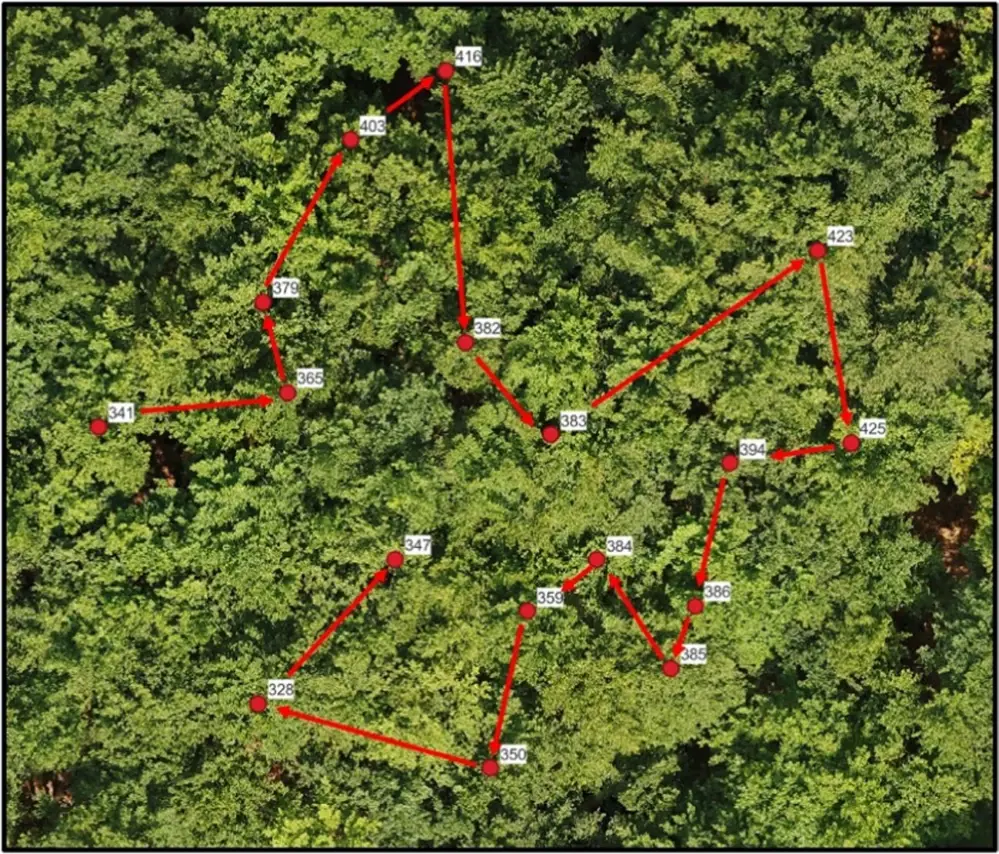
Рис. 1. Пример маршрута съёмки одиночными кадрами. БПЛА зависал над каждой точкой на 10 с и делал пять одиночных тепловых кадров кроны.
2.5 Датчики исследовательской станции
Для проверки температуры листьев использовали LAT-B2 [47]. Датчики измеряют абсолютную температуру поверхности листа и окружающего его воздуха (рис. 2). По данным изготовителя, абсолютная точность обоих измерений составляет ±0,2 К. Датчики обычно устанавливают в начале сезона наблюдений после окончания всех фенологических фаз, что на этом участке обычно приходится на конец июня.
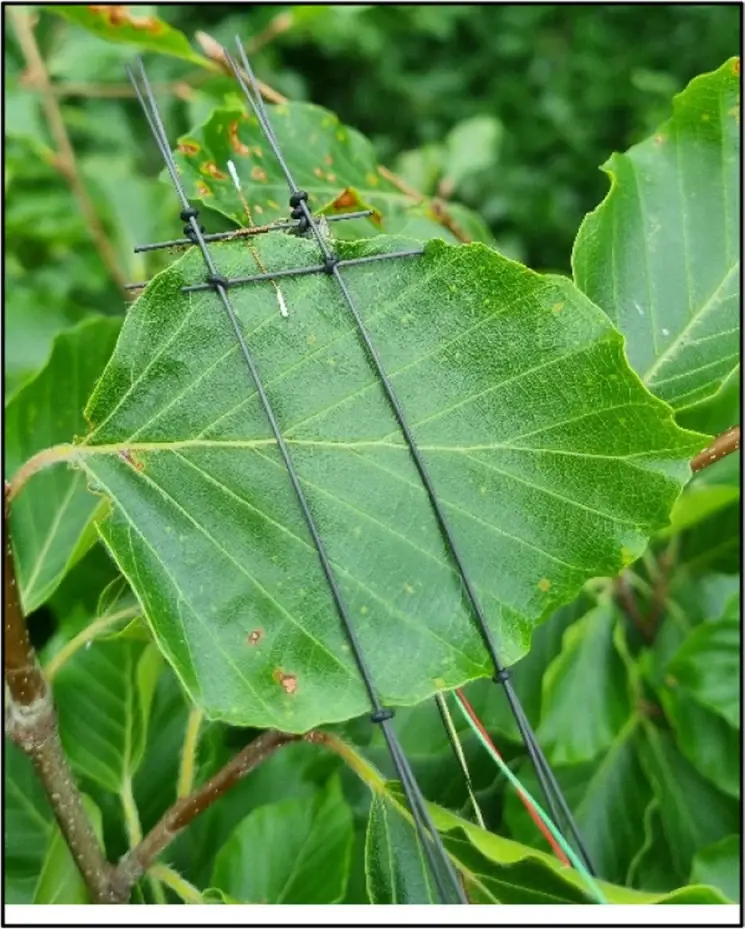
Рис. 2. Датчик температуры листа LAT-B2 [47], установленный в верхней части кроны для проверки ТИК-снимков.
Точечные дендрометры DR1W [47] установили на шести деревьях до начала сезона на постоянной основе. Заявленная максимальная погрешность составляет 4,5 % измеренного значения. Дендрометры измеряют изменение размеров ствола на высоте груди (1,3 м) с микрометровой точностью, регистрируя данные каждые пять минут. Из шести деревьев отобрали пять с наиболее полными данными.
Метеостанция Thies [48] регистрировала температуру воздуха (AT), направление (WD) и скорость ветра (WS), солнечную радиацию (SR), относительную влажность (RH) и атмосферное давление (AP). Станция постоянно размещалась на открытом участке на высоте 2 м над землёй примерно в 180 м от буковой площадки.
2.6 Выбор признаков
Совместное использование мультиспектральных снимков БПЛА и оперативных метеоданных расширяет возможности моделирования по сравнению с использованием одних пиксельных значений. Сравнение исходных тепловых значений за разные дни может вводить в заблуждение. Температура листьев быстро меняется, особенно в жаркие летние дни при переменной облачности. Синхронизация RH, AT и SR с тепловой съёмкой позволяет учесть переменчивую погоду. Это полезно для калибровки снимков и моделирования водного состояния деревьев, в частности TWD [49, 50]. Для точного прогноза необходимо оценить вклад каждого признака. Некоторые признаки, например VPD, получаемый из RH и AT, можно использовать для предсказания TWD самостоятельно [50]. Съёмка с БПЛА может добавить прогнозу пространственное измерение и повысить его точность.
Конструирование признаков помогает улучшить представление данных, уменьшить мультиколлинеарность и влияние несущественных предикторов [51]. Простой пример — расчёт VPD по RH и AT. VPD влияет на испарительный спрос атмосферы и устьичную проводимость [52, 53]. LVPD дополнительно учитывает разницу между температурой по тепловым снимкам БПЛА и AT. Его можно использовать как входной признак модели TWD и как самостоятельный индекс текущего состояния кроны.
VPD характеризует разность между фактическим содержанием водяного пара и способностью воздуха удерживать влагу при насыщении [54]. Максимальное содержание влаги зависит от AT: чем теплее воздух, тем больше давление насыщенного водяного пара (SVP, формула 1). С учётом RH получают фактическое давление пара (AVP, формула 2), характеризующее его количество при данной температуре. Разность SVP и AVP даёт VPD (формула 3).
(1)
(2)
(3)
LVPD учитывает разницу между давлением водяного пара в листе и в окружающем воздухе [52, 55–57]. При расчёте давления пара у листа (LVP, формула 4) используют температуру поверхности листа вместо температуры воздуха, используемой при расчёте AVP (формула 2). LVPD получают вычитанием AVP из LVP (формула 5).
(4)
(5)
Температуру поверхности листьев получали по ТИК-снимкам БПЛА и датчикам, закреплённым непосредственно на листьях. Признаки, индексы и сокращения приведены в табл. 2.
Таблица 2. Признаки и индексы, их сокращения и единицы измерения.
| Признак | Сокращение | Описание | Единица |
|---|---|---|---|
| Тепловой инфракрасный диапазон | TIR | Тепловые данные MicaSense Altum | К |
| Тепловые данные после маскирования | TIRmask | Исключены пиксели грунта и нижней части полога | К |
| Температура воздуха | AT | Метеостанция Бритц | °C |
| Относительная влажность | RH | Метеостанция Бритц | % |
| Солнечная радиация | SR | Метеостанция Бритц | Вт/м² |
| Скорость ветра | WS | Метеостанция Бритц | м/с |
| Дефицит давления водяного пара | VPD | По AT и RH | кПа |
| Дефицит давления пара между листом и воздухом | LVPD | По TIR листа, AT и RH | кПа |
| Водный дефицит дерева | TWD | Удаление тренда и нормализация дендрометрических данных | мкм |
2.7 Водный дефицит деревьев как показатель засушливого стресса
Суточные колебания диаметра ствола вызваны потерей воды через листья, как правило днём, и восполнением запасов ночью. Амплитуда колебаний характеризует текущее водное состояние дерева и точно измеряется точечными дендрометрами на высоте груди. Они регистрируют изменение размеров ствола как вследствие образования новых тканей ксилемы и флоэмы в течение сезона [49, 50], так и вследствие расширения и сжатия эластичных тканей [50, 58]. На рис. 3 показано, как после дневного сжатия из-за транспирации следует ночное расширение, продолжающееся до утра. Красный пунктир обозначает время полётов для тепловой съёмки.
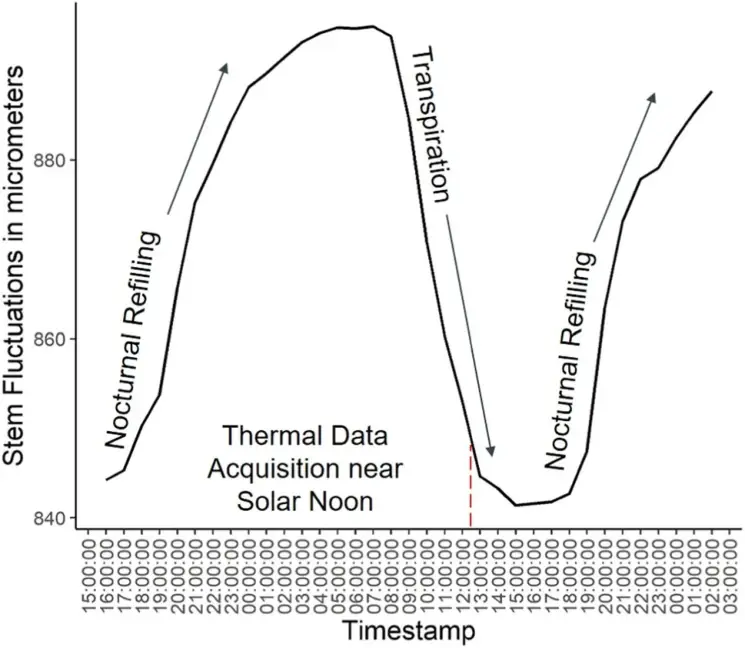
Рис. 3. Суточные колебания размеров ствола. Ночное восполнение воды обычно начинается поздно днём или ранним вечером и заканчивается с началом утренней транспирации. ТИК-данные обычно собирали около солнечного полудня, когда содержание воды в стволе приближалось к минимуму (красный пунктир).
Оси: колебания размеров ствола (мкм) и время. Nocturnal refilling — ночное восполнение воды, Transpiration — транспирация, Thermal data acquisition near solar noon — тепловая съёмка около солнечного полудня.
По методике Zweifel и др. [59] выделили сегменты между последовательными максимумами радиуса ствола за вегетационный сезон (рис. 4a). Эти сегменты описывают необратимый прирост между максимумами. Чтобы выделить обратимые изменения размеров, соответствующие TWD, сначала удаляли тренд роста и оставляли колебания, связанные преимущественно с суточной динамикой воды. Затем нормализовали данные для сопоставления дней и деревьев. Наконец, значения инвертировали, чтобы вершина каждой кривой соответствовала максимальному суточному сжатию (рис. 4b). Это позволяет точно определять максимальное сжатие и анализировать водное состояние и реакцию дерева на условия среды.
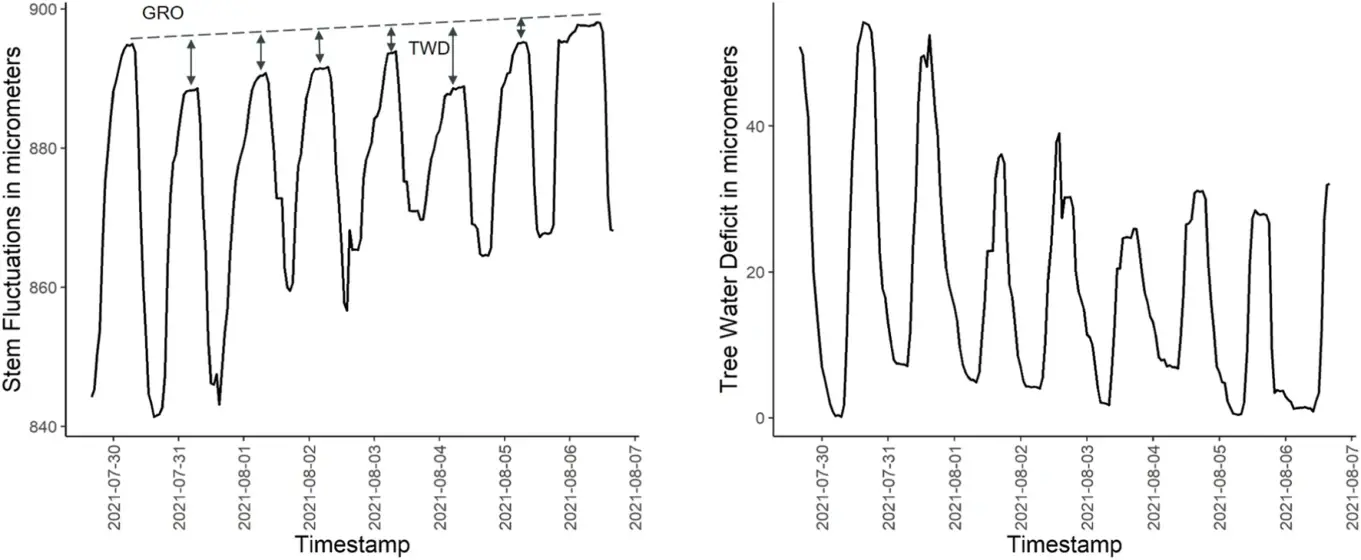
Рис. 4. Слева (a) — сегмент роста (пунктир) между двумя максимумами радиуса ствола. Стрелки показывают отклонения от тренда роста (GRO) и дефицит размеров ствола. Справа (b) — тот же сегмент после удаления тренда, инверсии и нормализации. Максимум сжатия находится вверху графика, что позволяет определять TWD с часовым шагом. Полёты обычно проходили около солнечного полудня, за 3–6 ч до максимального суточного сжатия ствола.
Оси: время и колебания размеров ствола (мкм), справа — водный дефицит дерева (мкм).
2.8 Обработка изображений
MicaSense Altum позволяет совмещать одиночные тепловые кадры с синхронно полученными мультиспектральными каналами. Совмещение выполняли при постобработке библиотекой Python MicaSense Image Processing (https://github.com/micasense/imageprocessing). Нетепловые каналы преобразовывали в энергетическую яркость и радиометрически калибровали по калиброванной панели отражения MicaSense, которую снимали до и после каждого полёта. Коэффициенты отражения после калибровки лежали в диапазоне от 0 до 1. Затем изображения совмещали: исправляли дисторсию по встроенной калибровке объектива, применяли аффинное преобразование и обрезали лишние пиксели [60]. Процедуру выполняли в Python 3.6 с библиотеками MicaSense. Сценарий запускали циклически для каждой соответствующей калибровочной панели.
Дальнейшую обработку проводили в R [46], рассчитывая вегетационные индексы для тестирования и маскирования. Исходные цифровые отсчёты (DN) теплового канала выражены в сотых долях кельвина. Их переводили в градусы Цельсия по формуле изготовителя:
(6)
Изображения и производные данные организовали в многослойные наборы по идентификаторам вылетов. Кроны выделяли вручную методом быстрой разметки, разработанным в R с пакетом Terra [61]. Изображения выводили в RGB или псевдоцветном ИК-композите (CIR). Верхнюю левую и нижнюю правую точки кроны выбирали мышью, задавая синий прямоугольник на рис. 5. Для расчёта длины и ширины определяли центр прямоугольника. Затем строили эллипс, в отдельных случаях почти круглый, приближённо повторяющий форму кроны. Из-за большого числа изображений переход к следующему набору после ввода пользователя автоматизировали. Полигоны и обрезанные изображения сохраняли по единым правилам именования для воспроизводимости.
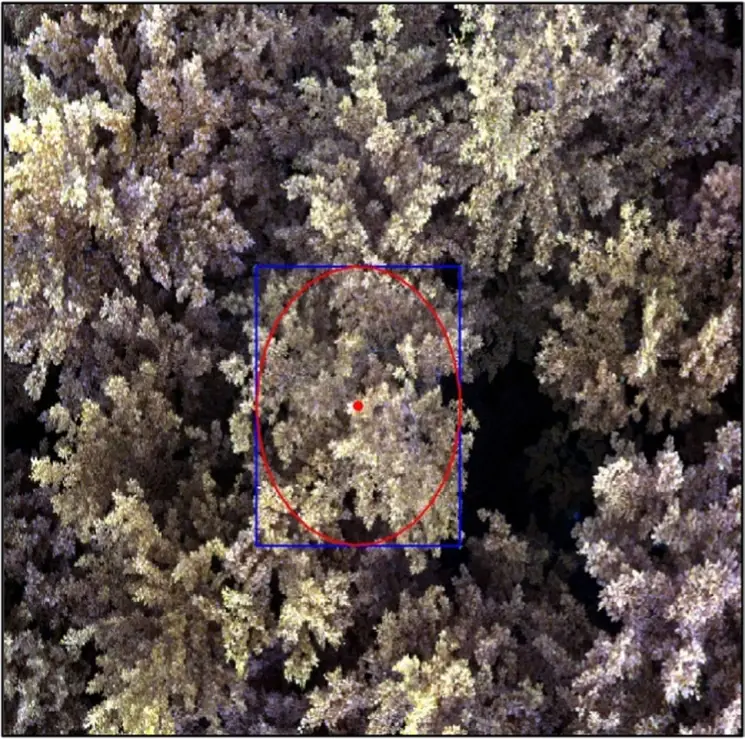
Рис. 5. Быстрая разметка для извлечения пикселей крон в R [46]. Эллипс формируется по щелчкам мышью в верхнем левом и нижнем правом углах кроны.
В цикле в таблицу записывали средние значения TIR, мультиспектральных каналов и вегетационных индексов для крон и время съёмки, полученное через exiftoolr [62]. Метки времени снимков и дендрометров округляли до ближайшего часа и совмещали с почасовыми метеоданными. Исходные данные дендрометров с пятиминутным шагом синхронизировали для почасового расчёта TWD. Сформировали три набора с разным временным лагом TWD: без задержки, с задержкой на один и на два часа.
2.9 Анализ и моделирование
Статистический анализ и моделирование проводили в R [46]. Наборы проверяли на нормальность распределения и корреляцию, выбирая методы по результатам проверки. Для параметрических данных использовали корреляцию Пирсона, для данных с ненормальным распределением — ранговую корреляцию Спирмена. Для усреднения коэффициенты преобразовывали по Фишеру (Fisher Z) функцией fisherZ пакета DescTools [63], усредняли и обратным преобразованием возвращали к коэффициентам корреляции [64]. Для дальнейшего анализа непараметрических данных применяли полиномиальную регрессию второго порядка и GAM. Данные GAM делили на обучающую и проверочную выборки в отношении 70:30. GAM и линейную регрессию оценивали по RMSE, MAE и R². Модели сравнивали по информационному критерию Акаике (AIC). Поскольку дендрометрических данных при фактической засухе не было, моделирование ограничили простыми регрессионными кривыми для проверки осуществимости и потенциальной экстраполяции.
3 Результаты
3.1 Оценка теплового датчика
3.1.1 Эксперимент в помещении
Для оценки теплового канала MicaSense Altum извлечённые значения TIR сравнивали с показаниями контактных датчиков температуры листьев. В помещении использовали два эпипремнума золотистых (Epipremnum aureum), на каждом из которых установили по два датчика. Выбор был практическим: зимой в Центральной Европе трудно найти облиственный бук для эксперимента. Опыты длились 30–50 мин. Управляемым образом меняли время и интенсивность воздействия нагревательных ламп и вентилятора. Тепловой датчик запускали в начале каждого опыта с интервалом съёмки 2 с. Специального прогрева не проводили, но до работы датчик находился в том же помещении не менее 30 мин. Лампы и вентилятор разместили так, чтобы они воздействовали и на растения, и на датчик.
Температуру извлекали из области около датчиков на листьях (рис. 6). В трёх испытаниях использовали три вида полигонов: весь лист, около десяти пикселей вокруг датчика и около трёх пикселей рядом с ним. При использовании примерно десяти пикселей (испытание 2) средняя разность составила 0,02 К. Для всего листа и трёх пикселей она составила соответственно 0,11 и 1,18 К (табл. 3).
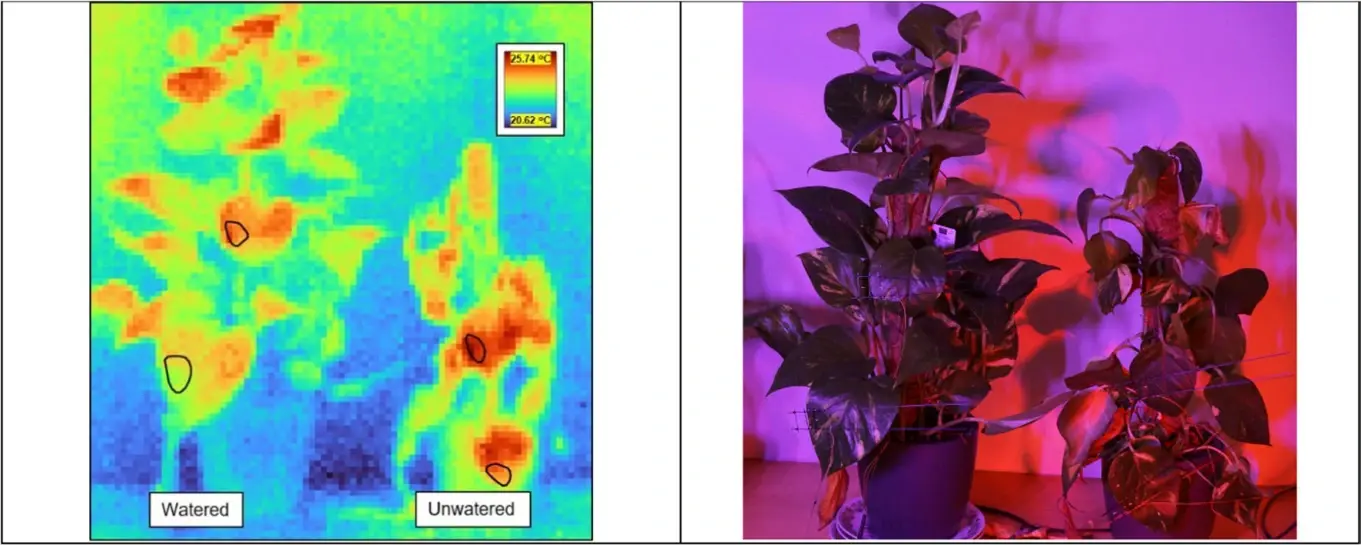
Рис. 6. Слева — тепловой снимок двух растений, полученный камерой MicaSense Altum в помещении. На поливаемом растении слева отмечены листья 1 (внизу) и 2 (вверху), на неполиваемом справа — листья 3 и 4. Во втором испытании около датчиков температуры выделили полигоны примерно по десять пикселей и извлекали среднюю температуру с интервалом 2 с. Справа — RGB-снимок растений с датчиками и воздействием нагревательных ламп.
Watered — с поливом, Unwatered — без полива.
Таблица 3. Средняя разность температур в трёх испытаниях. Лучший результат получен примерно по десяти пикселям. При трёх и менее пикселях ошибка существенно больше.
| Испытание | Метод | Средняя разность, К |
|---|---|---|
| 1 | Весь лист | 0,11 |
| 2 | 10 пикселей | 0,02 |
| 3 | 3 пикселя | 1,18 |
Во втором испытании для листа 1 поливаемого растения RMSE составила 0,55 К, MAE — 0,42 К, а для листа 2 — 0,53 и 0,40 К. Для обоих листьев R² было около 0,9. На растении без полива RMSE составила 0,66 К для листа 3 и 0,74 К для листа 4 по тексту статьи (0,73 К в табл. 4). MAE также увеличилась до 0,53 и 0,59 К, а R² составило соответственно 0,88 и 0,87. Метрики приведены в табл. 4. На рис. 7 для четырёх листьев показана полиномиальная регрессия второго порядка. Сходство кривых объясняется одинаковыми искусственными воздействиями ламп и вентилятора. Для неполиваемого растения наблюдался больший разброс, особенно у листа 4.
Таблица 4. Погрешности измерения температуры листьев. В исходной подписи указано, что около десяти пикселей обеспечили наилучшую точность, а три пикселя или меньше дали существенно большую ошибку.
| Объект | RMSE, К | MAE, К | R² | Вариант |
|---|---|---|---|---|
| Лист 1 | 0,55 | 0,42 | 0,9 | С поливом |
| Лист 2 | 0,53 | 0,40 | 0,91 | С поливом |
| Лист 3 | 0,66 | 0,53 | 0,88 | Без полива |
| Лист 4 | 0,73 | 0,59 | 0,87 | Без полива |
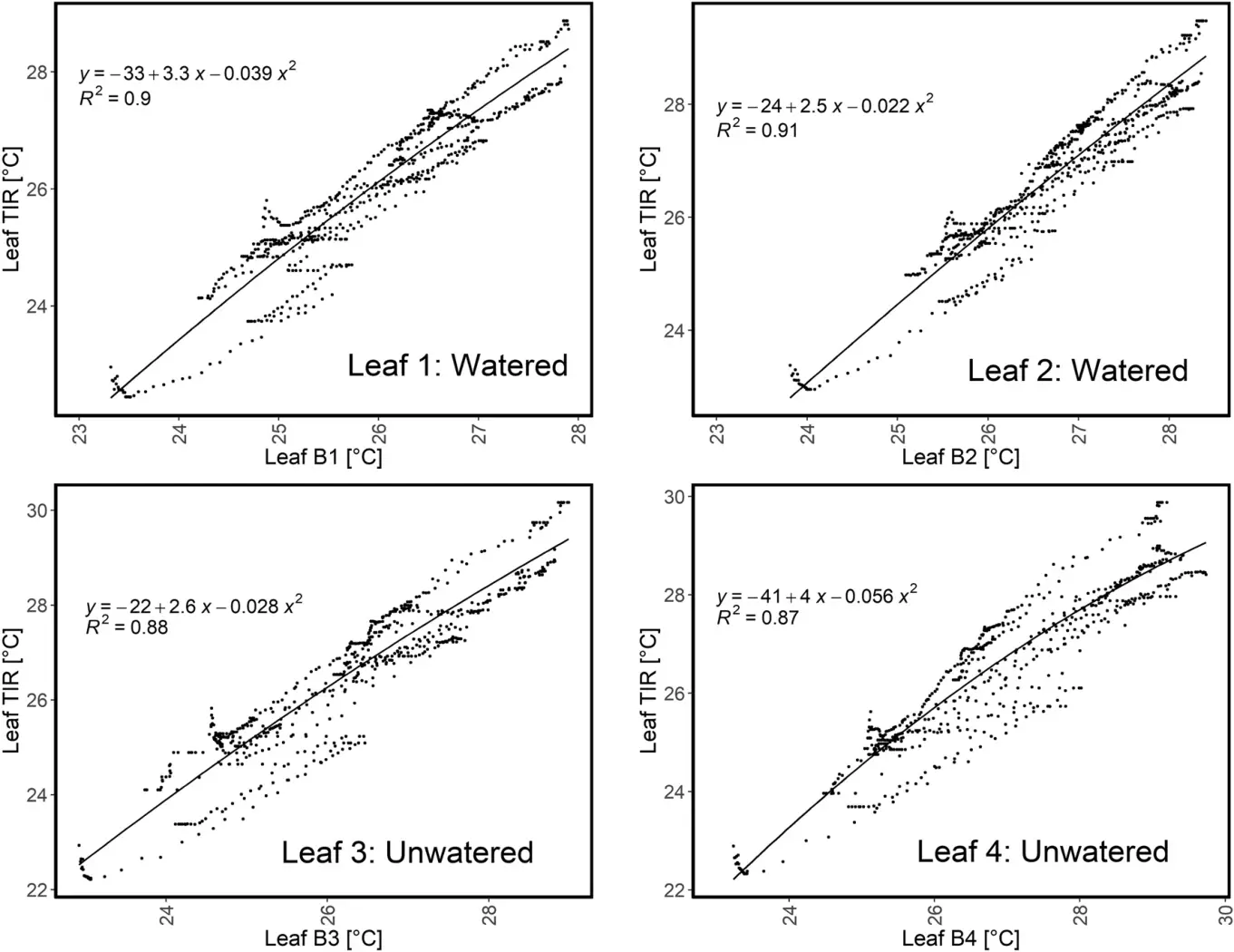
Рис. 7. Результаты опыта в помещении с полиномиальной регрессией второго порядка. У растения без полива R² ниже, а разброс больше, особенно для листа 4. Группы точек могут отражать изменения режима ламп и вентилятора и дрейф датчика.
Оси графиков: температура по датчику листа и ТИК-температура листа (°C). Watered — с поливом, Unwatered — без полива.
Второе испытание длилось около 50 мин. За это время растения и датчик подвергались воздействию ламп и вентилятора разной интенсивности. На рис. 8 сравниваются тепловые значения пикселей листа 4 с показаниями установленного на листе датчика. Ближний ИК-канал Altum показывает моменты изменения работы ламп. Всплески на тепловых данных листа 4, вероятно, вызваны NUC, которая, по данным изготовителя, автоматически выполняется каждые пять минут или при изменении температуры камеры на 2 К [45].
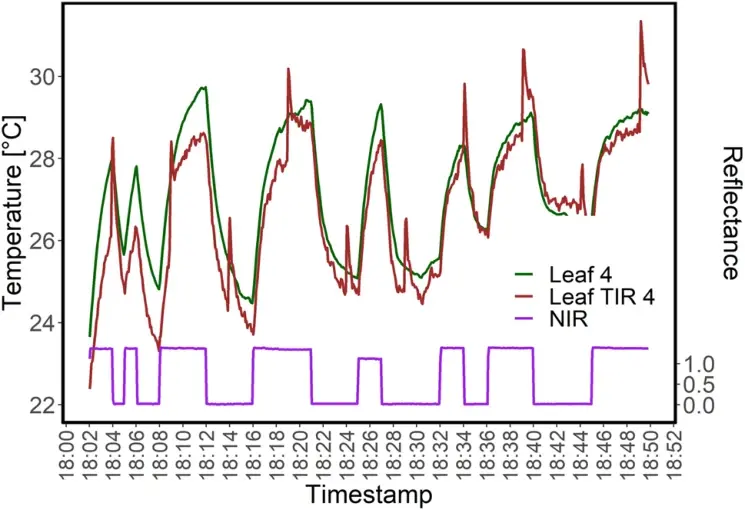
Рис. 8. Сопоставление тепловых значений пикселей листа 4 и показаний датчика температуры листа. Всплески в ТИК-ряду, вероятно, связаны с автоматической коррекцией неоднородности с пятиминутным интервалом.
Оси: время, температура (°C) и коэффициент отражения. Leaf 4 — температура листа 4 по контактному датчику, Leaf TIR 4 — его ТИК-температура, NIR — ближний инфракрасный канал.
3.1.2 Полевые эксперименты
В поле сравнили среднюю температуру крон двух деревьев, в верхней части каждой из которых стоял датчик температуры листа. Один датчик на дерево давал приближённую оценку и служил контролем реакции поверхности листа на погоду. На рис. 9 приведены линейная регрессия и временные ряды. За 13 дней съёмки для дерева 328 получены RMSE 3,31 К, MAE 2,95 К и R² = 0,89, а для дерева 347 — RMSE 3,12 К, MAE 2,78 К и R² = 0,93. Во временных рядах обоих деревьев видно систематическое занижение температуры листьев.
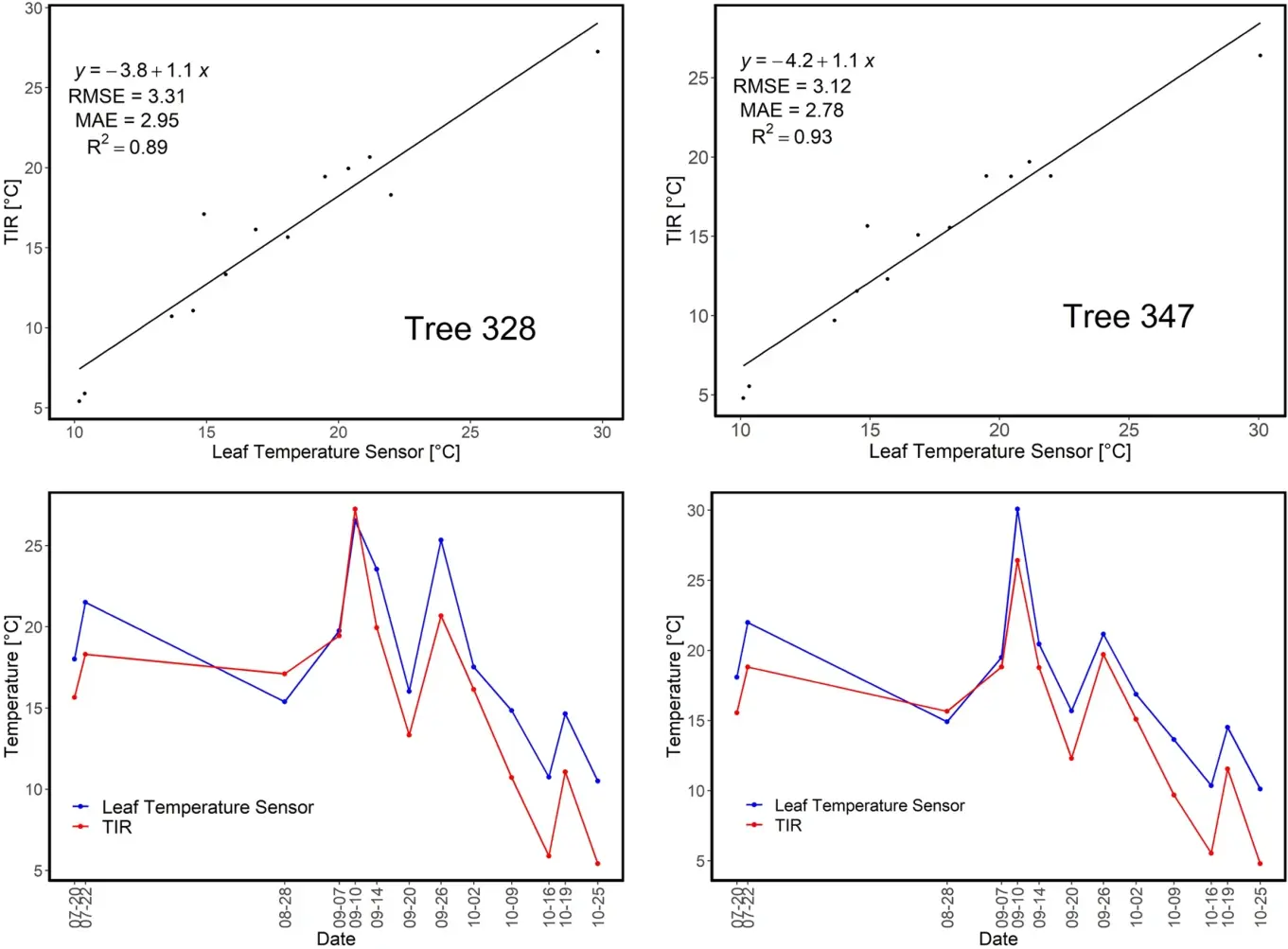
Рис. 9. Линейная регрессия и показатели точности (вверху) и временные ряды (внизу) для деревьев 328 (слева) и 347 (справа).
На верхних графиках сопоставлены показания датчика листа и TIR (°C), на нижних показаны оба температурных ряда по датам.
Для оценки требований к точности датчика рассчитали средние абсолютные различия за весь временной ряд (n = 13): 5,27 К для дерева 328 и 5,45 К для дерева 347. Следовательно, для учёта различий между днями на уровне насаждения может требоваться точность порядка 5 К.
Чтобы оценить различимость температур крон в пределах полёта, среднюю абсолютную разность рассчитали отдельно для каждой даты по пяти деревьям с точечными дендрометрами. Минимум составил 0,7 К, максимум — 1,3 К. На рис. 10 сопоставлены средние абсолютные различия ТИК-значений за сезон и почасовые метеоданные. AT и VPD умеренно коррелируют с различиями температуры крон между датами, RH и WS имеют слабую связь, влияние SR не проявилось. Маскирование до верхней части кроны с исключением затенённых нижних участков и грунта существенно не влияло на корреляции, кроме небольшого улучшения для RH. Сама средняя температура крон по тепловому датчику хорошо коррелирует с SR (0,68), умеренно — с RH (0,49) и почти не связана с WS. Для VPD и особенно AT корреляция с температурой крон составляет 0,88 и 0,98 соответственно.
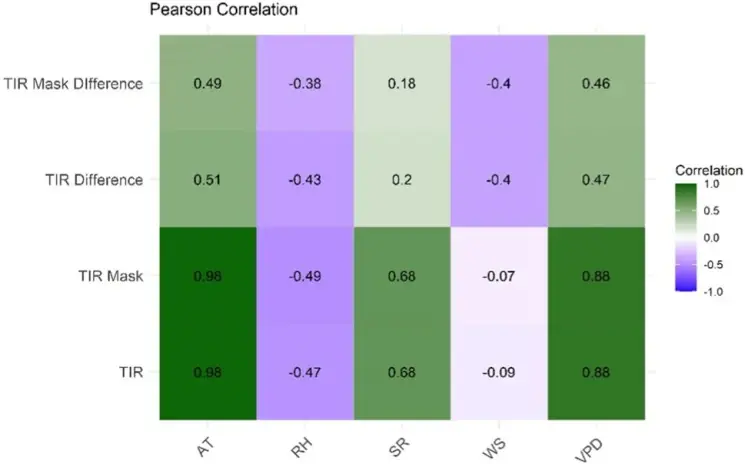
Рис. 10. Матрица корреляций Пирсона для извлечённых ТИК-значений всех крон (n = 9), обобщённых по дням съёмки (n = 13). TIR — значения без маски, TIR Mask — значения верхней части кроны после маскирования, Difference — средняя разность извлечённых значений за день съёмки.
Pearson correlation — корреляция Пирсона. AT — температура воздуха, RH — относительная влажность, SR — солнечная радиация, WS — скорость ветра, VPD — дефицит давления водяного пара.
3.2 Сопоставление способов съёмки
3.2.1 Маршрутная съёмка по сетке
Маршрутную съёмку и съёмку одиночными кадрами сравнивали для оценки влияния угла наблюдения и времени на согласованность ТИК-измерений. Выбрали четыре даты сезона. На рис. 11 приведены метеоданные, полученные в пределах часа от съёмки, и сопоставлены ТИК-изображения примерной кроны и облачность. Облачность менялась во все четыре дня. На 240-й день года она была наибольшей, SR — низкой, RH — высокой. На 250-й день VPD была максимальной, как и средняя абсолютная разность тепловых значений (mdTIR), а TWD была сравнительно высокой. На 257-й день при максимальной SR наблюдалась минимальная mdTIR.
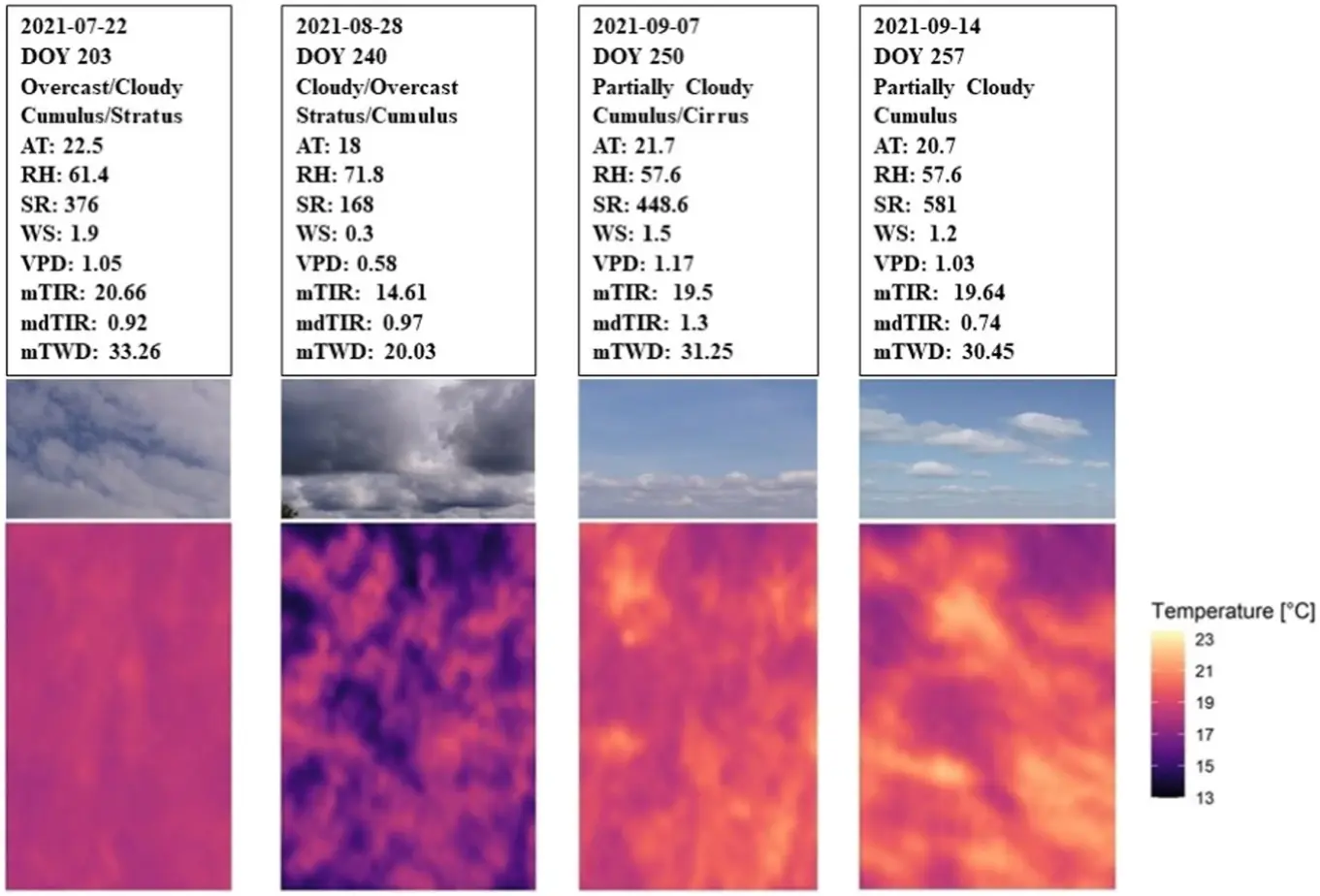
Рис. 11. Четыре даты вегетационного сезона. Overcast — сплошная облачность, Cloudy — облака закрывают солнце большую часть времени с короткими прояснениями, Partially cloudy — преимущественно ясное небо с временным затенением солнца. Показаны AT, RH, SR, WS, VPD, средняя TIR (mTIR), средняя абсолютная разность TIR (mdTIR) и средний TWD (mTWD) пяти деревьев с точечными дендрометрами в чистом буковом насаждении. DOY — день года.
Для каждой даты температуру выбранной кроны извлекали по трём галсам на высоте 75 м. Из-за изменения угла наблюдения расстояние от камеры до кроны различалось между кадрами. На первом галсе крона наблюдалась под углом около +20° от надира при полёте на северо-восток, на втором — в надир при полёте на юго-запад, на третьем — под углом −20° по оси X. На каждом галсе было пять кадров с интервалом 2 с. Средние и SD приведены в табл. 5. Максимальное SD (0,59 К) наблюдалось на 250-й день при +20°, минимальное (0,06 К) — на 257-й при −20°. Среднее SD по всем датам составило 0,25 К (n = 12). Максимум SD на 250-й день совпал с максимумами mdTIR и VPD. Средняя температура между галсами могла различаться почти на два градуса.
На рис. 12 температуры выбранной кроны на галсах сопоставлены с температурой листа соседнего дерева с датчиком. Температура соседнего дерева иллюстрирует влияние меняющейся облачности и не предназначена для прямого сопоставления абсолютных температур. Различия при трёх углах ожидаемы с учётом облачности и примерно минутного интервала между галсами. Это в целом подтверждается сходными колебаниями температуры соседнего листа. Кроме 240-го дня, наблюдался существенный разброс SD тепловых измерений. На 240-й день AT, SR, WS, VPD, mTIR и mTWD были минимальными, а RH — максимальной среди четырёх дат.
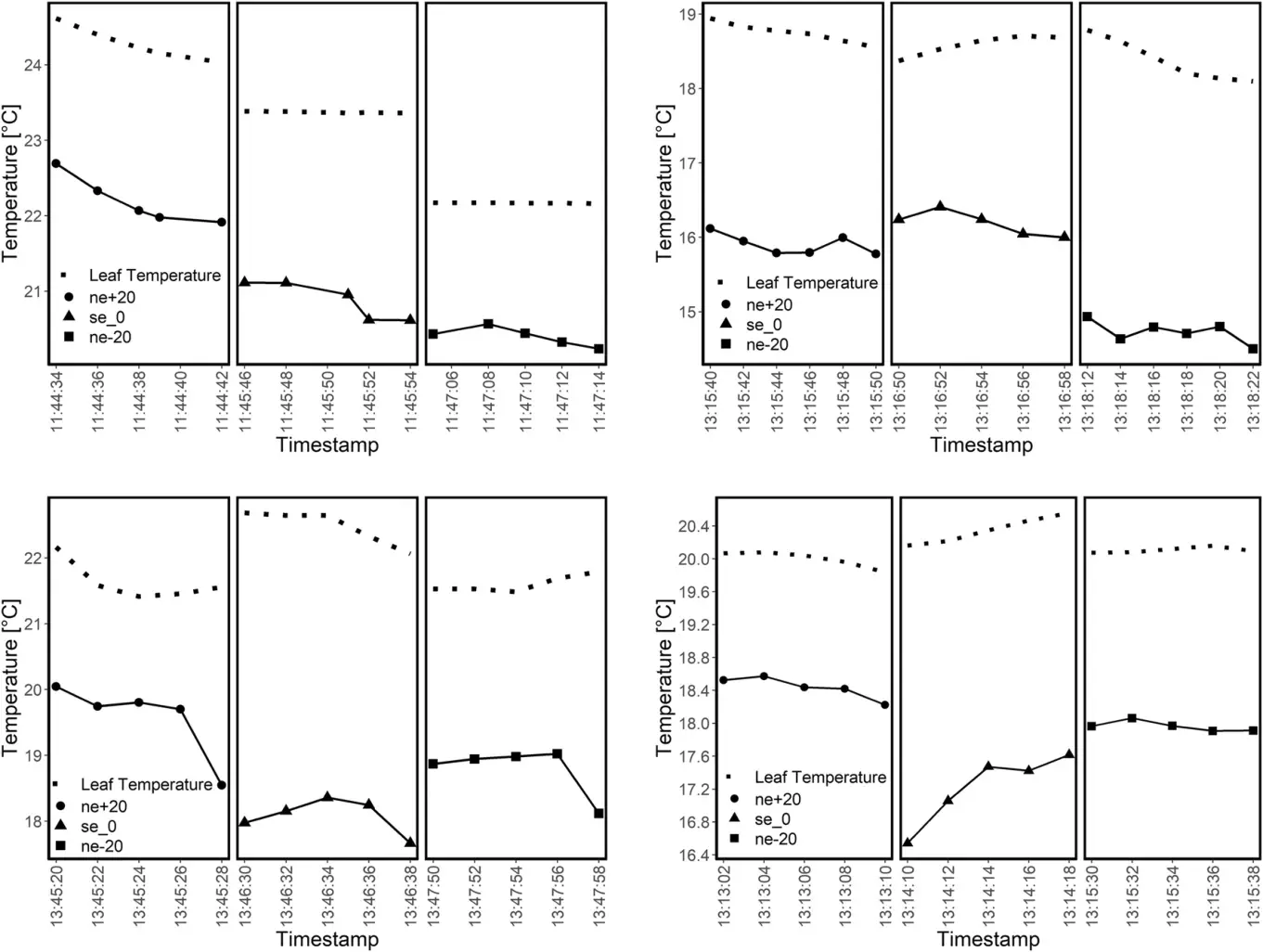
Рис. 12. Извлечённые ТИК-значения выбранной кроны на трёх галсах с указанием времени и температура листа соседнего дерева. Вверху справа — день 203, вверху слева — 240, внизу слева — 250, внизу справа — 257.
Оси: время и температура (°C). NE — северо-восточный галс, SW — юго-западный галс. Leaf temperature — температура листа соседнего дерева.
Таблица 5. Средняя температура и SD кроны на разных галсах на высоте 75 м. Повышенное SD при полёте на северо-восток может быть связано с увеличенным углом наблюдения и отражением солнечных бликов.
| Азимут и угол | 203 Среднее | 203 SD | 240 Среднее | 240 SD | 250 Среднее | 250 SD | 257 Среднее | 257 SD |
|---|---|---|---|---|---|---|---|---|
| СВ +20° | 22,09 | 0,32 | 15,9 | 0,14 | 19,57 | 0,59 | 18,43 | 0,13 |
| ЮЗ 0° | 20,88 | 0,25 | 16,19 | 0,17 | 18,08 | 0,27 | 17,22 | 0,43 |
| СВ −20° | 20,4 | 0,13 | 14,73 | 0,15 | 18,79 | 0,38 | 17,96 | 0,06 |
3.2.2 Съёмка одиночными кадрами
При съёмке отдельного дерева БПЛА зависал в маршрутной точке на 10 с и получал пять кадров с интервалом 2 с. В каждый день проводили два прохода с расстоянием около 10 м от кроны. Среднее SD, рассчитанное по табл. 6, составляет около 0,09 К (n = 8), диапазон — 0,05–0,18 К. За исключением второго прохода на 257-й день, низкий разброс сохранялся на всех датах. Разность средних температур между проходами могла достигать примерно двух градусов, например на 203-й день с наибольшей WS. На рис. 13 видно, что при зависании с близкого расстояния ТИК-значения внутри прохода согласуются, кроме второго прохода на 257-й день. При изменении облачности и сильном ветре средние между проходами могут различаться до двух градусов.
Таблица 6. Средняя температура и стандартное отклонение по одиночным тепловым кадрам в надир с расстояния около 10 м.
| Проход | 203 Среднее | 203 SD | 240 Среднее | 240 SD | 250 Среднее | 250 SD | 257 Среднее | 257 SD |
|---|---|---|---|---|---|---|---|---|
| 1 | 22,72 | 0,09 | 16,92 | 0,09 | 19,35 | 0,09 | 20,05 | 0,05 |
| 2 | 20,06 | 0,09 | 15,85 | 0,08 | 20,57 | 0,08 | 20,19 | 0,18 |
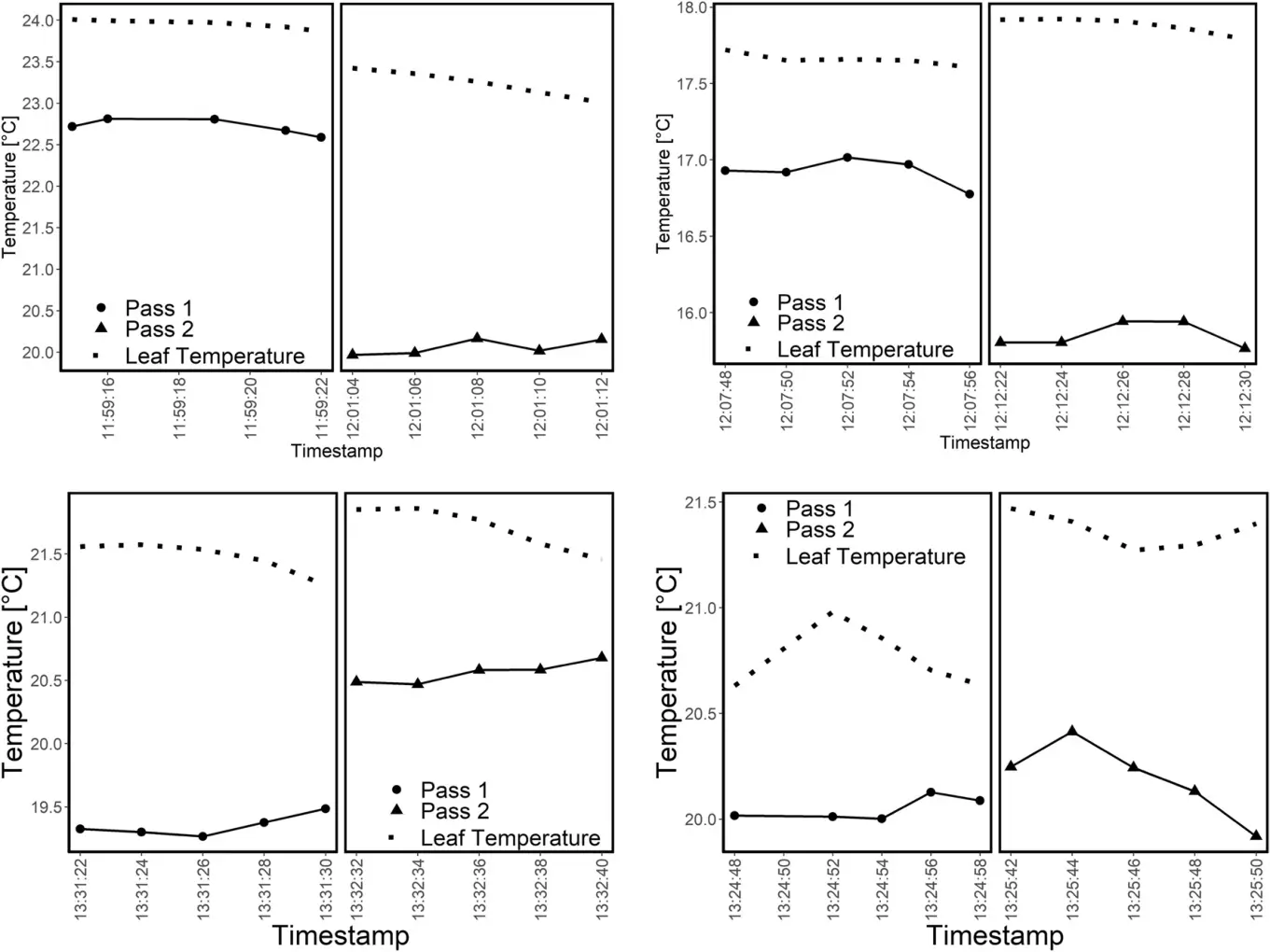
Рис. 13. Температуры по данным БПЛА на двух проходах с интервалом около минуты для четырёх дат и прямые измерения температуры листа. Вверху справа — день 203, вверху слева — 240, внизу слева — 250, внизу справа — 257.
Оси: время и температура (°C). Pass 1 и Pass 2 — первый и второй проходы. Leaf temperature — температура листа.
3.3 Проверка оценки засушливого стресса
3.3.1 Водный дефицит деревьев и метеоданные
Для моделирования и проверки отобрали пять из девяти доступных рядов точечных и ленточных дендрометров. TWD за весь сезон сравнили с показаниями метеостанции на открытом участке примерно в 170 м от буковой площадки. Тест Шапиро — Уилка для почасового ряда (n = 2928) отверг гипотезу нормальности. Поэтому решили с помощью GAM определить, какие метеорологические признаки и их комбинации лучше описывают TWD. В табл. 7 приведены скорректированные R² для девяти моделей. Каждую проверили с запаздыванием TWD относительно погоды на ноль, один и два часа. Это позволяет оценить сдвиг между факторами транспирации (VPD, WS, SR) и колебаниями нижней части ствола. Максимальные R² показывают, что физиологическую задержку обычно лучше описывает лаг в один час. Наибольшее R² = 0,667 получено для комбинации WS, SR и VPD. Для отдельных WS и SR несколько лучше оказался двухчасовой лаг. На рис. 14 девять моделей упорядочены по AIC. Наименьший AIC также у комбинации WS, SR и VPD.
Таблица 7. Обобщённые аддитивные модели прогноза TWD по метеорологическим признакам в сезоне 2021 г. (n = 2928). Выделены наибольшие значения R² для каждой модели.
| Признаки GAM | Скорр. R², лаг 0 ч | Скорр. R², лаг 1 ч | Скорр. R², лаг 2 ч |
|---|---|---|---|
| AT | 0,514 | 0,587 | 0,586 |
| RH | 0,557 | 0,622 | 0,606 |
| WS | 0,102 | 0,146 | 0,172 |
| SR | 0,15 | 0,282 | 0,402 |
| VPD | 0,585 | 0,659 | 0,649 |
| AT + RH | 0,585 | 0,657 | 0,646 |
| WS + VPD | 0,591 | 0,663 | 0,653 |
| SR + VPD | 0,636 | 0,663 | 0,657 |
| WS + SR + VPD | 0,643 | 0,667 | 0,66 |
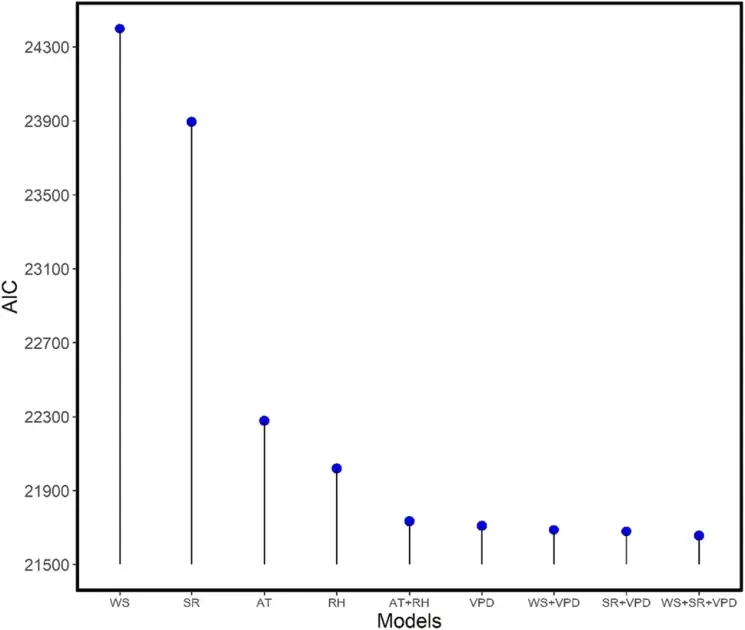
Рис. 14. Сопоставление девяти моделей по информационному критерию Акаике (AIC). Лучший результат получен при сочетании WS, SR и VPD.
По оси абсцисс — модели, по оси ординат — AIC. Меньшее значение AIC соответствует предпочтительной модели по этому критерию.
3.3.2 Связь водного дефицита с отдельными признаками
Тепловые данные около солнечного полудня (±90 мин) собраны за 13 вылетов 2021 г. по пяти кронам деревьев с точечными дендрометрами (n = 65). Распределение было ненормальным, поэтому для каждого дерева рассчитали матрицу корреляций Спирмена между TWD, средней ТИК-температурой кроны, метеоданными и производными признаками (рис. 15). Матрицы соответствуют лагам ноль, один и два часа. Цель — определить физиологическое запаздывание между факторами транспирации и температуры листьев во время съёмки и колебаниями ствола. Также оценивали, можно ли различать водное состояние деревьев и неоднородность между ними в пределах одной даты. У некоторых деревьев корреляции слабее и зависят от лага. В отдельных случаях разные признаки связаны с TWD при разных задержках.
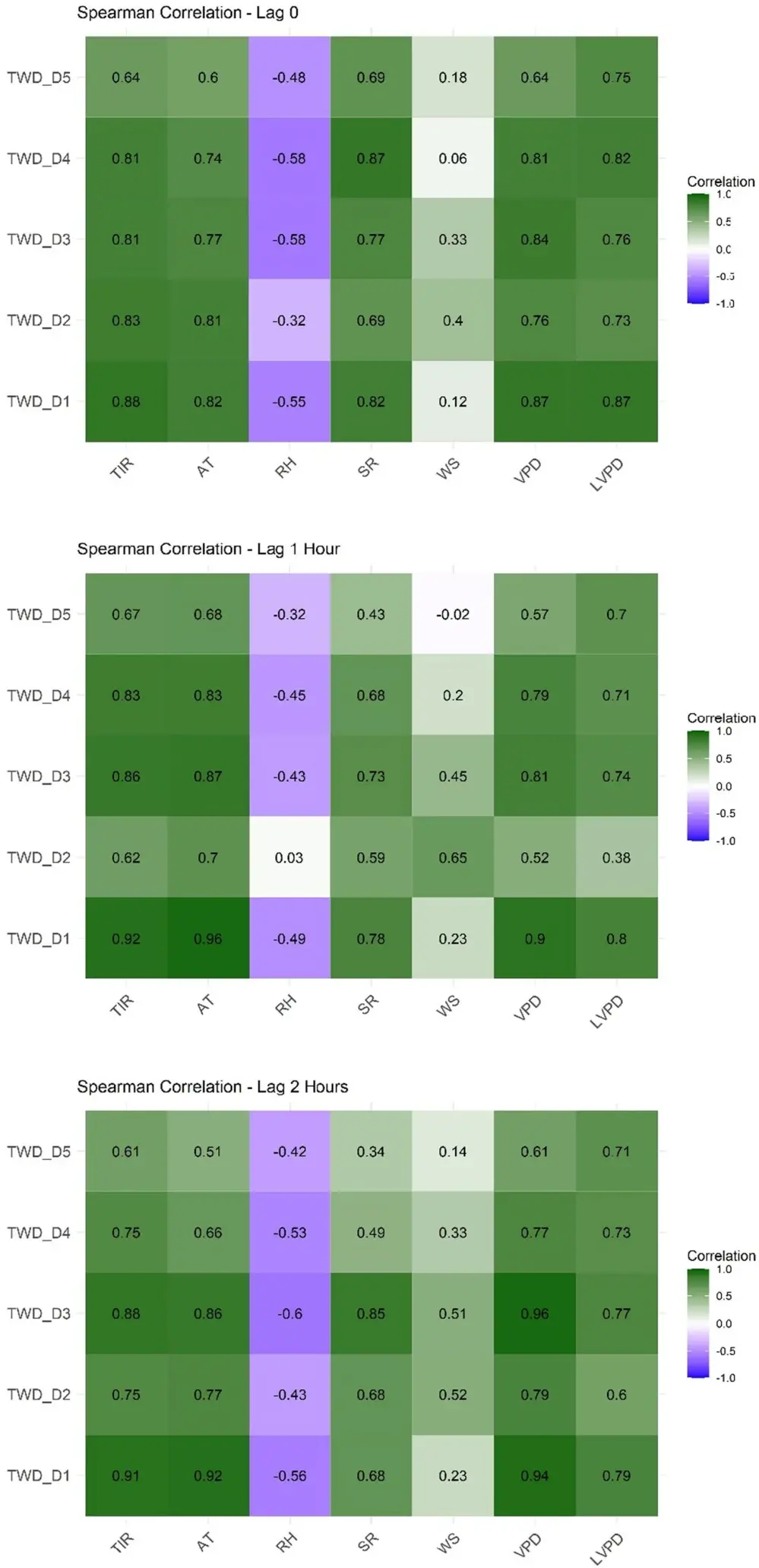
Рис. 15. Матрица корреляций Спирмена для TWD пяти деревьев с точечными дендрометрами, тепловых снимков, метеоданных и производных показателей. Сверху вниз показаны результаты без лага, с лагом один и два часа.
Цвет показывает коэффициент корреляции. Tree — идентификатор дерева, Lag — временной лаг.
Для сопоставления задержек рассчитали средние коэффициенты по каждому признаку (табл. 8). Перед усреднением применили преобразование Фишера Z для уменьшения смещения, особенно важного на малой выборке [65]. Единого лага, дающего лучшие корреляции для всех признаков, нет. Для тепловых снимков наибольшая корреляция наблюдается при часовом лаге, однако различия с соседними часами незначительны. Заметнее всего то, что SR лучше коррелирует с TWD без лага. Отдельный LVPD также лучше коррелирует без задержки.
Таблица 8. Средние корреляции признаков с TWD для трёх лагов. В исходной подписи указана матрица Пирсона, в тексте — матрица Спирмена. До усреднения выполнено преобразование Фишера Z. Полужирным обозначены выделенные в оригинале корреляции.
| Лаг | TIR | AT | RH | SR | WS | VPD | LVPD | Среднее |
|---|---|---|---|---|---|---|---|---|
| 0 ч | 0,81 | 0,8 | −0,53 | 0,74 | 0,34 | 0,81 | 0,83 | 0,54 |
| 1 ч | 0,83 | 0,84 | −0,42 | 0,64 | 0,28 | 0,8 | 0,77 | 0,53 |
| 2 ч | 0,82 | 0,81 | −0,54 | 0,46 | 0,38 | 0,82 | 0,81 | 0,51 |
3.3.3 Моделирование водного дефицита деревьев
Набор 13 полётов 2021 г. разделили на обучающую и проверочную части в отношении 70:30. Обучили три GAM по признакам LVPD, TIR + RH + AT и TIR + VPD с лагами 0, 1 и 2 ч (табл. 9). Затем прогнозировали TWD для проверочных данных и вычисляли RMSE, MAE и R². За пределами букового участка Бритц модели не проверяли из-за отсутствия точечных дендрометров и соответствующих тепловых данных крон. По R² для всех трёх моделей лучший результат дал часовой лаг. Для TIR + RH + AT получены R² = 0,87, RMSE 4,92 мкм и MAE 4 мкм (табл. 9, рис. 16). У VPD + TIR при часовом лаге высокий R² = 0,81 сочетался с большими ошибками: RMSE 9,76 мкм и MAE 7,01 мкм. Для LVPD при часовом лаге RMSE составила 6,87 мкм, MAE — 5 мкм по тексту (5,1 мкм в табл. 9), R² = 0,71. Для большинства признаков зависимости почти линейны, кроме RH (рис. 16).
Таблица 9. Результаты GAM при трёх вариантах временного лага.
| Лаг | Показатель | LVPD | TIR + RH + AT | VPD + TIR |
|---|---|---|---|---|
| 0 ч | RMSE | 6,21 | 4,56 | 7,53 |
| 0 ч | MAE | 5,1 | 3,95 | 5,72 |
| 0 ч | R² | 0,48 | 0,75 | 0,26 |
| 1 ч | RMSE | 6,87 | 4,92 | 9,76 |
| 1 ч | MAE | 5,1 | 4 | 7,01 |
| 1 ч | R² | 0,71 | 0,87 | 0,81 |
| 2 ч | RMSE | 6,84 | 7,32 | 6,37 |
| 2 ч | MAE | 5,65 | 6,02 | 4,99 |
| 2 ч | R² | 0,46 | 0,37 | 0,53 |
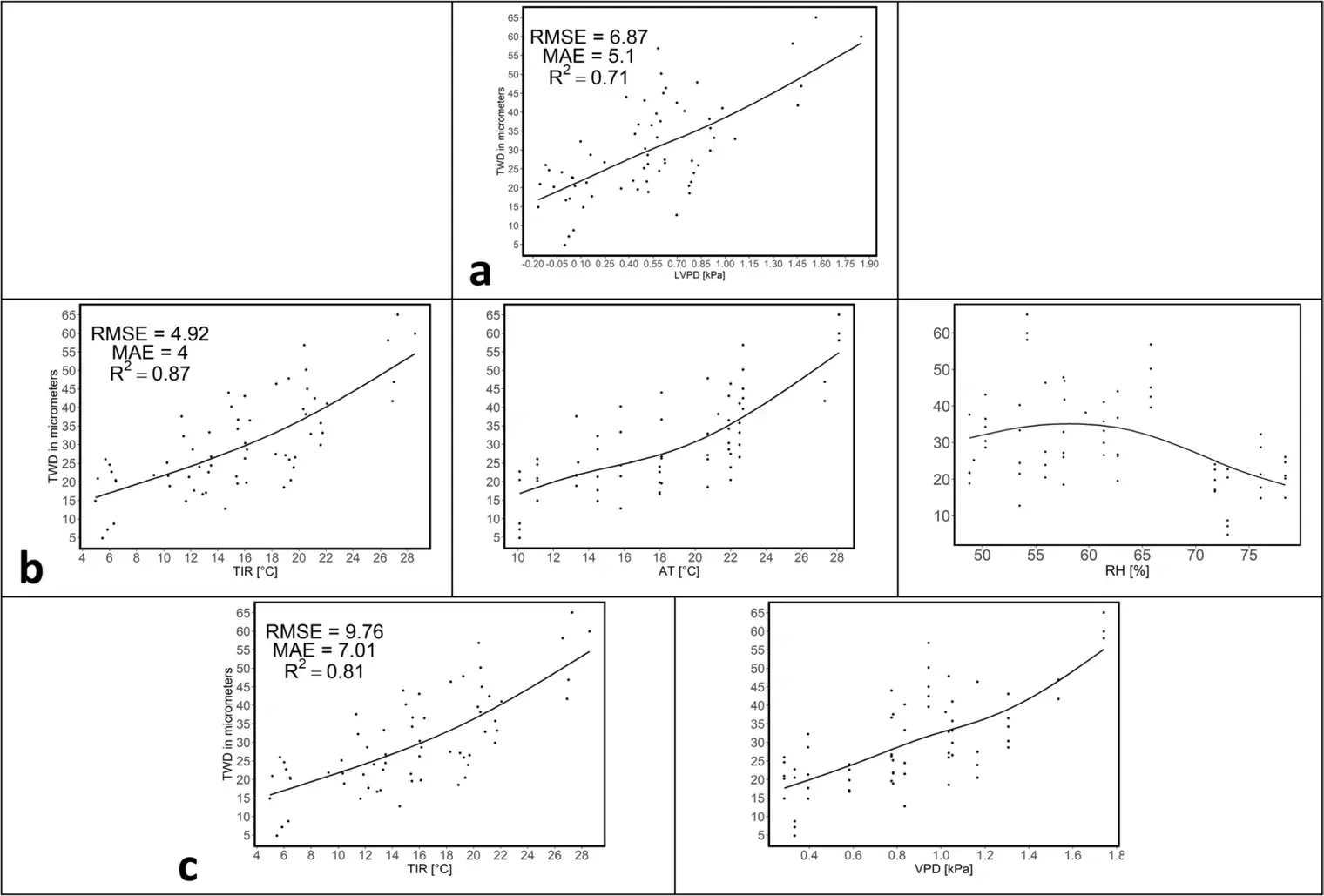
Рис. 16. Три GAM при часовом лаге. a — модель с LVPD, b — с TIR, AT и RH, c — с TIR и VPD.
Вертикальная ось показывает TWD (мкм). На горизонтальных осях — входные признаки соответствующих GAM. RMSE — среднеквадратическая ошибка, MAE — средняя абсолютная ошибка.
4 Обсуждение
4.1 Оценка теплового датчика
Опыт в помещении показал, что использование малого числа пикселей (< 3), даже непосредственно рядом с датчиком температуры листа, может давать ошибку более 1 К. Опыт с комнатными растениями даёт лишь представление о потенциальной ошибке. У бука результаты могут отличаться в силу морфологии и физиологии листьев, однако опыт подтверждает важность минимального размера измерительного пятна [66, 67]. Эффект возникает при извлечении температуры по нескольким пикселям: на показания могут влиять соседние поверхности [66] и дефектные пиксели. По данным изготовителей, доля дефектных пикселей в ТИК-матрицах составляет порядка 0,37–1 % [68, 69]. Для матрицы 160 × 120 это может означать до 192 дефектных пикселей. Поэтому измерительная область должна содержать достаточно исправных пикселей для усреднения. В опыте мы проверили минимум десять пикселей внутри полигона. FLIR [66] рекомендует пятно диаметром десять пикселей, а его площадь соответствует большему числу пикселей.
В помещении значения RMSE составляли порядка 0,53–0,73 К по табл. 4 (в обсуждении оригинала указан диапазон 0,55–0,73 К). Для более сухих листьев растения без полива точность была ниже. Это согласуется с типичной более низкой излучательной способностью сухих листьев (табл. 10) и её влиянием на точность измерений [66, 68, 69, 71]. В целом RMSE в помещении была менее 1 К, что ниже типичной паспортной погрешности коммерческих тепловых датчиков ±2 К или ±2 % по Vollmer и Möllmann [69]. В поле точность была хуже и труднее поддавалась оценке.
Таблица 10. Диапазоны излучательной способности здоровой зелёной и сухой растительности [70].
| Материал | Коэффициент излучения ε в диапазоне 8–14 мкм |
|---|---|
| Зелёная растительность | 0,96–0,99 |
| Сухая растительность | 0,88–0,94 |
В поле возможности определения и проверки температуры листьев верхней части кроны были ограничены. За 13 дат средняя RMSE двух деревьев составила 3,22 К, что выше типичных 2 К. Полёты проводили при сильном ветре, экстремальных полуденных температурах, переменной облачности и начале осеннего старения листвы в конце кампании. И в помещении, и в поле TIR систематически занижал эталонную температуру. Это указывает на возможность коррекции смещения и дополнительной калибровки по метеоданным высокого временного разрешения. Единственный датчик в верхней части кроны давал только приближённую оценку и не может считаться надёжным источником валидации. В дальнейшем планируется установить хотя бы четыре датчика в верхней части каждой кроны с учётом практических ограничений. Датчики следует размещать в репрезентативных точках, температуру которых регистрирует и тепловизор. Вклад затенённых листьев нижней части кроны в оценку TWD пока неясен. Дополнительные испытания могут помочь улучшить маскирование пикселей.
Для использования датчиков температуры листьев в кронах в целях проверки и калибровки нужны дальнейшие исследования. На станции Бритц планируется добавить два контрольных дерева и установить в верхней части каждой кроны не менее четырёх датчиков. Кроме того, предполагается разработать доступный полевой эталон абсолютно чёрного тела, чтобы изучать дрейф, предварительный прогрев и периодическую внутреннюю коррекцию неоднородности [38, 42].
4.2 Оценка способов съёмки
Маршрутная съёмка по сетке — стандартный способ получения тепловых снимков с БПЛА. Для области интереса строят мозаику. Часто одновременно снимают RGB для лучшего совмещения и позиционной точности. Для повышения точности также применяют наземные опорные точки [72] или бортовой RTK [73]. Совмещённые RGB- или мультиспектральные данные помогают выделять кроны, которые на одних тепловых снимках могут быть неразличимы. Полёт по сетке занимает время и требует предварительного знания рельефа. При длительных полётах может понадобиться замена аккумулятора, а ограничения прямой видимости могут препятствовать съёмке [74]. По нашим результатам SD температур в пределах галса достигает 0,59 К. Между галсами при интервале порядка минуты или более температура может различаться на несколько кельвинов. При смене батареи расхождения могут усиливаться из-за изменения погоды.
Подход с одиночными кадрами, показанный в работе, сравнительно нов. В традиционных методах используется восстановление структуры по движению (SfM), а в предложенном способе отдельные кадры MicaSense Altum радиометрически калибруются и преобразуются аффинно. Мультиспектральные каналы помогают сегментировать кроны и различать освещённые и затенённые листья, древесные части и пиксели грунта. Метод сокращает обработку и длительность полётов. По центру кадра, высоте, азимуту и внутренним параметрам камеры можно оценить область покрытия на земле [75] и использовать её для сопоставления с наземными наблюдениями.
Меньшее SD при одиночной съёмке может объясняться близостью к кроне, снижающей атмосферное влияние, особенно в тёплые влажные дни при высокой RH [66]. С близкого расстояния крона занимает больше пикселей. Это расширяет выборку для усреднения и позволяет применять более сложные маски. Постоянство угла наблюдения также может уменьшать выбросы, ограничивая изменчивость излучательной способности.
В дальнейшем следует выявлять и уменьшать источники полевых ошибок. По моделированию Minkina и Dudzik [71], наибольшие ошибки часто возникают при сочетании погрешностей излучательной способности, RH и расстояния от камеры до объекта (табл. 11). Влияние излучательной способности можно уменьшить, сокращая углы наблюдения, особенно крайние. Сокращение дистанции уменьшает влияние RH и увеличивает число пикселей для усреднения, снижая влияние выбросов от дефектных элементов матрицы или солнечных бликов. Синхронизация оперативных локальных RH, AT и WS с тепловой съёмкой может помочь калибровать изображения в переменных условиях. Основная трудность — надёжно получать такие данные в поле.
Таблица 11. Диапазоны возможных ошибок при моделировании по [71].
| Входной параметр | Диапазон ошибок |
|---|---|
| Коэффициент излучения объекта (εₒᵦ) | ±30 % |
| Температура окружения (Tₒ, К) | ±3 % |
| Температура атмосферы (Tₐₜₘ, К) | ±3 % |
| Относительная влажность (ω) | ±30 % |
| Расстояние от камеры до объекта (d) | ±30 % |
4.3 Проверка оценки засушливого стресса
Выявление засушливого стресса у бука требует воспроизводимой тепловой съёмки и практического надёжного способа проверки выраженности стресса. TWD за сезон достаточно хорошо объясняется VPD и составляющими её показателями RH и AT (в тексте оригинала для обоих случаев указано R² > 0,659, а значения отдельных моделей приведены в табл. 7). Drew и др. [49] установили, что суточные изменения TWD определялись главным образом доступностью воды в почве, хотя в некоторые периоды вклад вносили RH и AT. Влажность почвы важна для оценки TWD, но её не включили из-за сложностей сбора данных в поле. Она будет учтена в дальнейших опытах.
Лучший результат обычно дал часовой лаг, кроме отдельных WS и SR, для которых R² было выше при двухчасовом лаге. Zweifel и др. [59] также сообщали о задержке связи TWD с VPD у ели, сосны и ясеня. Эффективность моделей была максимальной при сдвиге VPD с шагом 30 мин. У бука они такой закономерности не наблюдали, что расходится с нашими результатами. Синхронная регистрация RH и AT с высоким временным разрешением может помочь подобрать лаг. Из-за порывов ветра и переменной облачности важно получать тепловые и метеорологические данные, репрезентативные для соответствующего дня. Редкий всплеск SR и VPD при внезапном прояснении может не отразиться на TWD дня или часа, но существенно изменить тепловое измерение. В 13 полётах этот эффект учитывался ограниченно, а компенсация не всегда осуществима из-за времени и ресурса батареи. Тем не менее TWD тесно коррелировал с ТИК-съёмкой (r > 0,81) независимо от лага и погоды. Это перспективно для выявления засухи в масштабе насаждения, но неоднородность между деревьями по одной дате пока нельзя считать надёжно определяемой.
Для отдельных деревьев корреляции TWD с признаками меняются в зависимости от лага (рис. 15). Некоторые особи могут медленнее реагировать на внешние переменные. Другая возможность — дендрометр установлен там, где колебания ствола слабо выражены. Это особенно важно для крупных стволов, для которых рекомендуют несколько дендрометров с учётом возможных различий [76]. Разные временные задержки для отдельных признаков требуют дальнейшего изучения. Модели могут переобучаться, особенно при учёте конкретного микроклимата.
Полученные модели следует интерпретировать осторожно. В 2021 г. станция Бритц не испытала выраженной засухи, особенно по сравнению с 2018–2020 гг. Полный диапазон TWD, особенно для бука, не охвачен: значения 2021 г. не превышали 60 мкм. Zweifel и др. [50] приводят для дуба значения до 500 мкм. В засушливый год значения у бука могут превысить 60 мкм и расширить диапазон. До тех пор оценивать полученные RMSE трудно. Если результаты подтвердятся на более широких данных, их можно использовать для определения неоднородности внутри насаждения. GAM выбрали ради простых кривых, более пригодных для экстраполяции [77], чем обычные деревья решений. Тем не менее экстраполяции следует избегать [78]. Для улучшения моделей нужны данные, прежде всего за периоды засухи.
В моделях избегали дублирования признаков [51]. Например, при использовании VPD не включали RH и AT, поскольку VPD рассчитывается по ним. При моделировании TWD может потребоваться ограничить конструирование признаков. Сложные преобразования вроде VPD или LVPD способны скрыть индивидуальные веса признаков и различия в задержках, которые могли бы быть найдены алгоритмами машинного обучения. LVPD показал умеренное качество в модели TWD. Его также можно рассматривать как самостоятельный индекс, если для бука определённого региона будет установлен абсолютный диапазон, количественно характеризующий засушливый стресс.
5 Заключение
Предложен способ съёмки одиночными тепловыми кадрами для расчёта LVPD и оценки TWD. Даже при отсутствии выраженной засухи удалось смоделировать изменчивость TWD за вегетационный сезон 2021 г. по тепловым кадрам с близкого расстояния и синхронным метеоданным. Съёмка одиночными кадрами с близкого расстояния позволяет уменьшить влияние вариаций RH и излучательной способности за счёт меньших углов наблюдения и дистанции и большего числа доступных для анализа пикселей. Необходимы дальнейшие полевые испытания, в частности с синхронными метеоданными высокого временного разрешения для калибровки. Следует также улучшить проверку точности тепловых измерений, увеличив число датчиков температуры листьев в кронах и используя в поле эталон абсолютно чёрного тела. Работа создаёт основу для использования тепловой съёмки при количественной оценке засушливого стресса и в других задачах на участках интенсивного мониторинга.
Благодарности
Авторы благодарят Marco Natkhin и Andreas Bahr с исследовательской станции Бритц за помощь в полевых работах.
Вклад авторов
S.K. и T.S. спланировали эксперименты. S.K. провёл эксперимент и анализ и написал рукопись. T.S. внесла вклад в окончательную редакцию и руководила проектом.
Финансирование
Открытый доступ профинансирован и организован Projekt DEAL. Исследование поддержал проект FirSt 2.0 (код 19F2127E).
Доступность данных
Данные, полученные или проанализированные в ходе исследования, предоставляются автором для переписки по обоснованному запросу.
Заявления
Конфликт интересов. Авторы заявляют об отсутствии конкурирующих интересов.
Открытый доступ. Статья распространяется по международной лицензии Creative Commons Attribution 4.0. Разрешены использование, распространение, адаптация, передача и воспроизведение на любом носителе при условии указания авторов и источника, ссылки на лицензию и сведений об изменениях. Изображения и другие сторонние материалы входят в область действия лицензии статьи, если в подписи не указано иное. Если материал не охвачен лицензией и предполагаемое использование не допускается законом либо выходит за пределы разрешённого, необходимо получить разрешение непосредственно у правообладателя. Текст лицензии: http://creativecommons.org/licenses/by/4.0/. В данном документе представлен русский перевод.
Примечания к данным оригинала
В координатах станции в оригинале после долготы напечатано «S». По местоположению станции в Германии в переводе указана восточная долгота. Для съёмки одиночными кадрами в § 3.2.2 оригинала приведены среднее SD 0,9 К и минимум 0,6 К при максимуме 0,18 К. В переводе § 3.2.2 использованы значения по табл. 6. Указанный в аннотации максимум 0,1 К сохранён. В § 4.1 оригинала для матрицы 160 × 120 приведено общее число 32 768 пикселей. Произведение 160 × 120 составляет 19 200. Число до 192 дефектных пикселей соответствует 1 % от 19 200. Обозначения и коэффициенты в формулах сохранены по опубликованной статье.
Список литературы
[1] Mocko K, Nicotra A, Jones C (2017) Extent of solar tracking dif- fers between two co-occurring congeneric geophytes that differ in leaf shape. Int J Plant Sci 179:000–000. https://doi.org/10.1086/695698
[2] Nobel P (2020) Physicochemical and environmental plant physiol- ogy. Elsevier
[3] Choat B, Jansen S, Brodribb TJ, Cochard H, Delzon S, Bhaskar R, Bucci SJ, Feild TS, Gleason SM, Hacke UG, Jacobsen AL, Lens F, Maherali H, Martínez-Vilalta J, Mayr S, Mencuccini M, Mitch- ell PJ, Nardini A, Pittermann J et al (2012) Global convergence in the vulnerability of forests to drought. Nature 491(7426):752–755. https://doi.org/10.1038/nature11688
[4] van Mantgem PJ, Stephenson NL (2007) Apparent climatically induced increase of tree mortality rates in a temperate forest. Ecol Lett 10(10):909–916. https://doi.org/10.1111/j.1461-0248.2007.01080.x
[5] Brzostek E, Dragoni D, Schmid H, Rahman F, Sims D, Wayson C, Johnson D, Phillips R (2014) Chronic water stress reduces tree growth and the carbon sink of deciduous hardwood forests. Glob Chang Biol 20. https://doi.org/10.1111/gcb.12528
[6] Nathalie B, Huc R, Granier A, Dreyer E (2006) Temperate forest trees and stands under severe drought: a review of ecophysiologi- cal responses, adaptation processes and long-term consequences. Ann For Sci 63. https://doi.org/10.1051/forest:2006042
[7] Allen, C. D., Macalady, A. K., Chenchouni, H., Bachelet, D., McDowell, N., Vennetier, M., Kitzberger, T., Rigling, A., Bres- hears, D. D., Hogg, E. H. (Ted), Gonzalez, P., Fensham, R., Zhang, Z., Castro, J., Demidova, N., Lim, J.-H., Allard, G., Run- ning, S. W., Semerci, A., & Cobb, N. (2010). A global overview of drought and heat-induced tree mortality reveals emerging climate change risks for forests. For Ecol Manag, 259(4), 660–684. https:// doi.org/10.1016/j.foreco.2009.09.001
[8] Leuschner C (2020) Drought response of European beech (Fagus sylvatica L.)—a review. Perspect Plant Ecol Evol Syst 47:125576. https://doi.org/10.1016/j.ppees.2020.125576
[9] Senf C, Seidl R (2021) Persistent impacts of the 2018 drought on forest disturbance regimes in Europe. Biogeosciences 18(18):5223–5230. https://doi.org/10.5194/bg-18-5223-2021
[10] Moran E, Lauder J, Musser C, Stathos A, Shu M (2017) The genetics of drought tolerance in conifers. New Phytol 216. https:// doi.org/10.1111/nph.14774
[11] Schuldt B, Buras A, Arend M, Vitasse Y, Beierkuhnlein C, Damm A, Gharun M, Grams TEE, Hauck M, Hajek P, Hartmann H, Hilt- brunner E, Hoch G, Holloway-Phillips M, Körner C, Larysch E, Lübbe T, Nelson DB, Rammig A et al (2020) A first assessment of the impact of the extreme 2018 summer drought on Central European forests. Basic Appl Ecol 45:86–103. https://doi.org/10.1016/j.baae.2020.04.003
[12] Kutsch WL, Wirth C, Kattge J, Nöllert S, Herbst M, Kappen L (2009) Ecophysiological characteristics of mature trees and stands—consequences for old-growth forest productivity. In: Old- growth forests, 57-79 (2009), vol 207, pp 57–79. https://doi.org/10.1007/978-3-540-92706-8_4
[13] Delaporte A, Bazot S, Damesin C (2016) Reduced stem growth, but no reserve depletion or hydraulic impairment in beech suffer- ing from long-term decline. Trees 30(1):265–279. https://doi.org/10.1007/s00468-015-1299-8
[14] Martinez del Castillo E, Zang CS, Buras A, Hacket-Pain A, Esper J, Serrano-Notivoli R, Hartl C, Weigel R, Klesse S, Resco de Dios V, Scharnweber T, Dorado-Liñán I, van der Maaten-Theunissen M, van der Maaten E, Jump A, Mikac S, Banzragch B-E, Beck W, Cavin L et al (2022) Climate-change-driven growth decline of European beech forests. Commun Biol 5(1):1–9. https://doi.org/10.1038/s42003-022-03107-3
[15] Tomasella M, Beikircher B, Häberle K-H, Hesse B, Kallenbach C, Matyssek R, Mayr S (2018) Acclimation of branch and leaf hydraulics in adult Fagus sylvatica and Picea abies in a forest through-fall exclusion experiment. Tree Physiol 38(2):198–211. https://doi.org/10.1093/treephys/tpx140
[16] van der Werf GW, Sass-Klaassen UGW, Mohren GMJ (2007) The impact of the 2003 summer drought on the intra-annual growth pattern of beech (Fagus sylvatica L.) and oak (Quercus robur L.) on a dry site in the Netherlands. Dendrochronologia 25(2):103– 112. https://doi.org/10.1016/j.dendro.2007.03.004
[17] Pretzsch H, Grams T, Häberle KH, Pritsch K, Bauerle T, Rötzer T (2020) Growth and mortality of Norway spruce and European beech in monospecific and mixed-species stands under natural episodic and experimentally extended drought. Results of the KROOF throughfall exclusion experiment. Trees 34(4):957–970. https://doi.org/10.1007/s00468-020-01973-0
[18] Hartmann H, Link R, Schuldt B (2021) A whole-plant perspective of isohydry: Stem-level support for leaf-level plant water regula- tion. Tree Physiol. https://doi.org/10.1093/treephys/tpab011
[19] Raspe S, Schulz C, Kroll F (2004) Wenn schon im Sommer ton- nenweise Blätter fallen. Baumentwicklung und Streufall. LWF Aktuell 43:11–13
[20] Roloff A (1988) Morphologie der Kronenentwicklung von Fagus sylvatica L. (Rotbuche) unter besonderer Berücksichtigung neu- artiger Veränderungen: II. Strategie der Luftraumeroberung und Veränderungen durch Umwelteinflüsse. Flora 180(3):297–338. https://doi.org/10.1016/S0367-2530(17)30325-0
[21] Garcia-Forner N, Biel C, Savé R, Martínez-Vilalta J (2017) Isohy- dric species are not necessarily more carbon limited than anisohy- dric species during drought. Tree Physiol 37(4):441–455. https:// doi.org/10.1093/treephys/tpw109
[22] Hartmann H (2011) Will a 385 million year-struggle for light become a struggle for water and for carbon? – how trees may cope with more frequent climate change-type drought events. Glob Chang Biol 17(1):642–655. https://doi.org/10.1111/j.1365-2486.2010.02248.x
[23] Berger-Landefeldt U (1936) Der Wasserhaushalt der Alpenpflanzen. Schweizerbart’sche Verlagsbuchhandlung https:// www.schweizerbart.de/publications/detail/artno/144011500/Bibli otheca_Botanica_Heft_115
[24] Klein T (2014) The variability of stomatal sensitivity to leaf water potential across tree species indicates a continuum between iso- hydric and anisohydric behaviours. Funct Ecol 28(6):1313–1320. https://doi.org/10.1111/1365-2435.12289
[25] Sade N, Gebremedhin A, Moshelion M (2012) Risk-taking plants. Plant Signal Behav 7(7):767–770. https://doi.org/10.4161/psb.20505
[26] Burkhardt J, Pariyar S (2015) How does the VDP response of isohydric and anisohydric plants depend on leaf surface particles. Plant Biol 18. https://doi.org/10.1111/plb.12402
[27] Yi K, Dragoni D, Phillips RP, Roman DT, Novick KA (2017) Dynamics of stem water uptake among isohydric and aniso- hydric species experiencing a severe drought. Tree Physiol, treephys;tpw126v1. https://doi.org/10.1093/treephys/tpw126
[28] Bolte A, Ammer C, Löf M, Madsen P, Nabuurs G-J, Schall P, Spathelf P, Rock J (2009) Adaptive forest management in cen- tral Europe: Climate change impacts, strategies and integrative concept. Scand J For Res 24(6):473–482. https://doi.org/10.1080/02827580903418224
[29] Lapenis A, Shvidenko A, Shepaschenko D, Nilsson S, Aiyyer A (2005) Acclimation of Russian forests to recent changes in climate. Glob Chang Biol 11(12):2090–2102. https://doi.org/10.1111/j.1365-2486.2005.001069.x
[30] Reich PB, Sendall KM, Stefanski A, Wei X, Rich RL, Montgom- ery RA (2016) Boreal and temperate trees show strong accli- mation of respiration to warming. Nature 531(7596):633–636. https://doi.org/10.1038/nature17142
[31] Cohen Y, Alchanatis V, Meron M, Saranga Y, Tsipris J (2005) Estimation of leaf water potential by thermal imagery and spatial analysis. J Exp Bot 56(417):1843–1852. https://doi.org/10.1093/jxb/eri174
[32] Feller U (2016) Drought stress and carbon assimilation in a warm- ing climate: reversible and irreversible impacts. J Plant Physiol 203:84–94. https://doi.org/10.1016/j.jplph.2016.04.002
[33] Grant OM, Chaves MM, Jones HG (2006) Optimizing thermal imaging as a technique for detecting stomatal closure induced by drought stress under greenhouse conditions. Physiol Plant 127(3):507–518. https://doi.org/10.1111/j.1399-3054.2006.00686.x
[34] Gómez-Candón D, Virlet N, Labb S, Jolivot A, Regnard J-L (2016) Field phenotyping of water stress at tree scale by UAV- sensed imagery: new insights for thermal acquisition and cali- bration. Precis Agric 17(6):786–800. https://doi.org/10.1007/s11119-016-9449-6
[35] Simpson JE, Holman FH, Nieto H, El-Madany TS, Migliavacca M, Martin MP, Burchard-Levine V, Cararra A, Blöcher S, Fiener P, Kaplan JO (2022) UAS-based high resolution mapping of evap- otranspiration in a Mediterranean tree-grass ecosystem. Agric For Meteorol 321:108981. https://doi.org/10.1016/j.agrformet.2022.108981
[36] Acorsi M, Gimenez L, Martello M (2020) Assessing the perfor- mance of a low-cost thermal camera in proximal and aerial condi- tions. Remote Sens 12:3591. https://doi.org/10.3390/rs12213591
[37] Aragon B, Johansen K, Parkes S, Malbeteau Y, AlMashharawi S, Al-Amoudi T, Andrade CF, Turner D, Lucieer A, McCabe M (2020) A calibration procedure for field and UAV-based uncooled thermal infrared instruments. Sensors 20. https://doi.org/10.3390/s20113316
[38] Kelly J, Kljun N, Olsson P-O, Mihai L, Liljeblad B, Weslien P, Klemedtsson L, Eklundh L (2019) Challenges and best practices for deriving temperature data from an uncalibrated UAV thermal infrared camera. Remote Sens 11. https://doi.org/10.3390/rs110 50567
[39] Perich G, Hund A, Anderegg J, Roth L, Boer M, Walter A, Liebi- sch F, Aasen H (2020) Assessment of multi-image unmanned aerial vehicle based high-throughput field phenotyping of canopy temperature. Front Plant Sci 11:150. https://doi.org/10.3389/fpls.2020.00150
[40] Ribeiro-Gomes K, Hernández-López D, Ortega JF, Ballesteros R, Poblete T, Moreno MA (2017) Uncooled thermal camera calibration and optimization of the photogrammetry process for UAV applications in agriculture. Sensors 17(10):2173. https://doi.org/10.3390/s17102173
[41] Smigaj M, Gaulton R, Suarez Minguez J, Barr S (2017) Use of miniature thermal cameras for detection of physiological stress in conifers. Remote Sens 9:957. https://doi.org/10.3390/rs9090957
[42] Wan Q, Brede B, Smigaj M, Kooistra L (2021) Factors influenc- ing temperature measurements from miniaturized thermal infrared (TIR) cameras: a laboratory-based approach. Sensors 21:8466. https://doi.org/10.3390/s21248466
[43] Zakrzewska A, Kopeć D, Krajewski K, Charyton J (2022) Canopy temperatures of selected tree species growing in the forest and outside the forest using aerial thermal infrared (3.6–4.9 μm) data. Eur J Remote Sens 55(1):313–325. https://doi.org/10.1080/22797 254.2022.2062055
[44] Krause S, Sanders TGM, Mund J-P, Greve K (2019) UAV-based photogrammetric tree height measurement for intensive forest moni- toring. Remote Sens 11(7):758. https://doi.org/10.3390/rs11070758
[45] Altum Integration Guide. (2020). MicaSense Knowledge Base. https://support.micasense.com/hc/en-us/articles/360010025413-Altum-Integration-Guide
[46] R Core Team (2022) R: A language and environment for statisti- cal computing. R Foundation for Statistical Computing, Vienna, Austria http://www.R-project.org/
[47] Ecomatik. (2022). Startseite | Ecomatik GmbH. https://ecomatik.de/
[48] Thies. (2022). thiesclima.com—Produkte. https://www.thiesclima.com/de/Produkte/Sonstige-Geraete-Wetterstationen/
[49] Drew D, Richards A, Downes G, Cook G, Baker P (2011) The development of seasonal tree water deficit in Callitris intratropica. Tree Physiol 31:953–964. https://doi.org/10.1093/treephys/tpr031
[50] Zweifel R, Zimmermann L, Newbery DM (2005) Modeling tree water deficit from microclimate: an approach to quantifying drought stress. Tree Physiol 25(2):147–156. https://doi.org/10.1093/treephys/25.2.147
[51] Kuhn M, Johnson K (2019) Feature engineering and selection: a practical approach for predictive models. CRC Press
[52] Grossiord C, Buckley TN, Cernusak LA, Novick KA, Poulter B, Siegwolf RTW, Sperry JS, McDowell NG (2020) Plant responses to rising vapor pressure deficit. New Phytol 226(6):1550–1566. https://doi.org/10.1111/nph.16485
[53] Massmann A, Gentine P, Lin C (2019) When does vapor pressure deficit drive or reduce evapotranspiration? J Adv Model. Earth Syst 11. https://doi.org/10.1029/2019MS001790
[54] Noh H, Lee J (2022) The effect of vapor pressure deficit regulation on the growth of tomato plants grown in different planting environ- ments. Appl Sci 12(7):3667. https://doi.org/10.3390/app12073667
[55] Dai Z, Edwards GE, Ku MSB (1992) Control of photosynthe- sis and stomatal conductance in Ricinus communis L. (Cas- tor Bean) by leaf to air vapor pressure deficit. Plant Physiol 99(4):1426–1434
[56] Day M (2000) Influence of temperature and leaf-to-air vapor pres- sure deficit on net photosynthesis and stomatal conductance in red spruce (Picea rubens). Tree Physiol. https://doi.org/10.1093/TREEPHYS/20.1.57
[57] Furtak A, Nosalewicz A (2022) Leaf-to-air vapor pressure deficit differently affects barley depending on soil water availability. S Afr J Bot 146:497–502. https://doi.org/10.1016/j.sajb.2021.11.043
[58] Zweifel R, Häsler R (2000) Frost-induced reversible shrinkage of bark of mature subalpine conifers. Agric For Meteorol 102:213– 222. https://doi.org/10.1016/S0168-1923(00)00135-0
[59] Zweifel R, Haeni M, Buchmann N, Eugster W (2016) Are trees able to grow in periods of stem shrinkage? New Phytol 211. https://doi.org/10.1111/nph.13995
[60] Micasense.com. (2022). https://micasense.com/
[61] Hijmans, R. J., Bivand, R., Forner, K., Ooms, J., Pebesma, E., & Sumner, M. D. (2022). terra: Spatial Data Analysis (1.5-34) [Computer software]. https://CRAN.R-project.org/package=terra
[62] JoshOBrien. (2021). ExifTool functionality from R [R]. https:// github.com/JoshOBrien/exiftoolr (Original work published 2018)
[63] Signorell, A. (2022). DescTools: tools for descriptive statistics version 0.99.45 from CRAN. https://rdrr.io/cran/DescTools/
[64] Corey D, Dunlap W, Burke M (1998) Averaging Correlations: expected values and bias in combined Pearson rs and Fisher’s z transformations. J Gen Psychol 125:245–261. https://doi.org/10.1080/00221309809595548
[65] Silver NC, Dunlap WP (1987) Averaging correlation coeffi- cients: should Fisher’s z transformation be used? J Appl Psychol 72(1):146–148. https://doi.org/10.1037/0021-9010.72.1.146
[66] FLIR. (2018). Radiometric temperature measurements: surface characteristics and atmospheric compensation. https://www.flir.com/globalassets/guidebooks/suas-radiometric-tech-note-en.pdf
[67] Playà-Montmany N, Tattersall GJ (2021) Spot size, distance and emissivity errors in field applications of infrared thermography. Methods Ecol Evol 12(5):828–840. https://doi.org/10.1111/2041-210X.13563
[68] Holst, G. C. (2000). Common sense approach to thermal imaging. SPIE. 10.1117/3.2588945
[69] Vollmer M, Möllmann K-P (2018) Infrared thermal imaging: fun- damentals, research and applications. John Wiley & Sons
[70] Lillesand T, Kiefer RW, Chipman J (2015) Remote sensing and image interpretation. John Wiley & Sons
[71] Minkina W, Dudzik S (2009) Infrared thermography: errors and uncertainties. John Wiley & Sons
[72] Gerke M (2018) Developments in UAV-photogrammetry. Wich- mann Verlag http://gispoint.de/fileadmin/user_upload/paper_gis_open/DLA_2018/537642028.pdf
[73] Przybilla, H.-J., & Baeumker, M. (2020). RTK and PPK: GNSS- Technologies for direct georeferencing of UAV image flights.
[74] EASA. (2022). EASA. https://www.easa.europa.eu/domains/civil-drones
[75] McGlone JC, Lee GYG (2013) Manual of photogrammetry, (6th ed.). edn. American Society for Photogrammetry and Remote Sensing http://www.worldcat.org/oclc/856568615
[76] Tomst. (2022). https://tomst.com/web/en/
[77] Wood, S. N. (2017). Generalized additive models 497.
[78] McCartney M, Häringer M, Polifke W (2019) Comparison of machine learning techniques in the interpolation and extrapola- tion of flame describing functions. J Eng Gas Turbines Power 142. https://doi.org/10.1115/1.4045516
Примечание издателя
Springer Nature сохраняет нейтралитет в отношении юрисдикционных притязаний на опубликованных картах и в сведениях об организациях, с которыми связаны авторы.
24 ноября 2026