
Оставить заявку
Для заказа и получения более подробной информации оставьте заявку, наш менеджер свяжется с Вами!
Нажимая на кнопку, вы даете согласие на обработку персональных данных и соглашаетесь c политикой конфиденциальности
Связь физиологических механизмов со спектральным отражением позволяет выявлять вилт дуба и засушливый стресс до появления видимых симптомов
Gerard Sapesᵃ˒ᵇ˒¹, Lucy Schroederᶜ, Allison Scottᵃ, Isaiah Clarkᵃ, Jennifer Juzwikᵈ, Rebecca A. Montgomeryᵉ, J. Antonio Guzmán Qᵃ и Jeannine Cavender-Baresᵃ˒¹
Редактор: James Ehleringer, Университет Юты, Солт-Лейк-Сити, Юта. Получено 17 сентября 2023 г., принято 11 декабря 2023 г., опубликовано 5 февраля 2024 г.
¹ Для переписки: gsapes@ufl.edu или cavender@umn.edu.
Дополнительные материалы: https://www.pnas.org/lookup/suppl/doi:10.1073/pnas.2316164121/-/DCSupplemental.
PNAS 2024 · Том 121 · № 7 · e2316164121
https://doi.org/10.1073/pnas.2316164121
Исследовательская статья · Науки об окружающей среде
Значимость
Возбудитель вилта дуба — одна из самых разрушительных угроз для дубов Северной Америки. Ежегодно миллионы долларов направляются на борьбу с болезнью и ограничение её распространения. Засушливый стресс также входит в число основных причин гибели деревьев и разрушения экосистем с преобладанием дуба. Оба нарушения одновременно затрагивают леса на больших территориях, что крайне затрудняет раннее выявление и принятие мер. Мы разработали средства дистанционного зондирования, позволяющие выявлять вилт дуба и засуху до появления видимых симптомов и различать эти два стресса. Для этого объединили анатомические, физиологические и спектроскопические данные на уровнях от клетки до кроны. Обнаружение вилта до появления видимых симптомов и последующее оперативное вмешательство позволят уменьшить частоту, распространение и последствия болезни в лесных ландшафтах.
Аннотация
Гибель деревьев вследствие глобальных изменений, включая расширение ареалов инвазивных вредителей и патогенов, — одна из главных угроз лесным экосистемам. Дубовые леса относятся к наиболее распространённым и ценным экосистемам США как в экологическом, так и в экономическом отношении. Растёт интерес к мониторингу ослабления и гибели дубов вследствие засухи и поражения возбудителем вилта дуба (Bretziella fagacearum). Мы объединили анатомические и экофизиологические измерения со спектроскопией листьев и крон и данными воздушной съёмки, чтобы различать вилт и засуху и выявлять их до появления видимых симптомов. В опыте на открытом воздухе молодые деревья Quercus rubra, выращиваемые в контейнерах, подвергали воздействию засухи, искусственному заражению либо обоим воздействиям. Модели на основе спектрального отражения точно прогнозировали экофизиологические показатели ослабления при вилте и засухе как в контейнерном опыте, так и в полевом эксперименте с естественно выросшими деревьями. При вилте и засухе нарушался перенос воды по сосудам ксилемы. Однако при вилте сосуды закупоривались в отдельных участках ксилемы из-за образования тил, тогда как при засухе возникали эмболии. Локальное образование тил приводило к большей неоднородности фотосинтеза и содержания воды в кронах больных деревьев по сравнению с деревьями, испытывавшими засуху. Спектральные признаки фотосинтеза, содержания воды и повреждения клеток позволяли выявлять вилт и засуху за 12 суток до видимых симптомов. Модели спектрального отражения листьев позволяют прогнозировать экофизиологические процессы, важные для обнаружения и различения болезни и засухи. Объединение спектральных моделей физиологических изменений с пространственной информацией улучшает различение стрессов растений, таких как вилт дуба и засуха.
Ключевые слова: засуха, вилт дуба, выявление до видимых симптомов, спектральное отражение, гибель деревьев.
Введение
Леса обеспечивают жизненно важные экосистемные услуги: служат средой обитания организмов, регулируют климат и качество воздуха, сдерживают эрозию и поддерживают глобальные биогеохимические циклы (1). Различные факторы глобальных изменений угрожают состоянию этих экосистем, усиливая абиотический и биотический стресс (2). Продолжающееся потепление повышает смертность деревьев вследствие сочетанного воздействия жары и засухи (3), делая леса более уязвимыми к биотическим факторам (4). Рост мобильности людей в мире увеличил подверженность биотическому стрессу из-за более частого контакта с инвазивными видами (5). В лесах Северной Америки инвазивные вредители и патогены серьёзно повлияли на древесные виды на фоне потепления, засухи и роста торговли. Защита лесных экосистем от нынешних и будущих абиотических и биотических угроз — одна из наиболее насущных задач (1). Точное раннее выявление ослабления деревьев важно для лесоуправления и входит в международную работу по объединению дистанционных и наземных средств мониторинга изменений биоразнообразия в целях охраны планеты (6).
Леса с преобладанием дуба — наиболее распространённый тип леса в континентальной части США без Аляски. Они важны для поддержания экосистемных услуг в Северной Америке, однако сталкиваются с сочетанием усиливающейся жары, засухи, вредителей и патогенов деревьев (7). Местные, региональные и федеральные органы США ежегодно выделяют сотни миллионов на борьбу с этими угрозами и уменьшение их последствий. Ввиду экологического и экономического значения дубовых лесов необходимо знать, где они подвержены массовому ослаблению из-за засухи и болезней, особенно в условиях более тёплой и сухой атмосферы, чтобы ограничить распространение патогенов и их последствия. Для этого нужны (1) основанные на физиологических механизмах средства ДЗЗ, способные оценивать состояние леса в разных местах, в разные сроки и в разных условиях, (2) средства оперативного раннего выявления абиотических и биотических стрессоров и (3) возможность различать типы стресса.
Среди инвазивных патогенов дубовых лесов возбудитель вилта Bretziella fagacearum считается одной из наиболее разрушительных угроз для дубов на востоке США (8). Болезнь зарегистрирована в 24 восточных штатах (9), в поражённых регионах ежегодно отслеживают её развитие (8). Патоген нанёс серьёзный ущерб уязвимым красным дубам (Quercus, секция Lobatae) по всему ареалу болезни. После заражения эти виды не способны эффективно защищаться и сдерживать болезнь (10–12). Возбудитель распространяется под землёй через сросшиеся корни соседних деревьев, а над землёй — с помощью насекомых-переносчиков, жуков-блестянок и дубовых короедов, разносящих споры на разные расстояния (10). Перенос на большие расстояния затрудняет отслеживание и прогнозирование продвижения болезни. Для ограничения распространения необходимо раннее выявление по всему ландшафту. Требуется также отличать симптомы вилта от проявлений других стрессоров, таких как засуха (13). Спектральное отражение уже применяли для выявления вилта у взрослых деревьев (14) и его различения с засухой у сеянцев в теплице (13), однако досимптомное выявление и различение с засухой на открытом воздухе ещё не были показаны. Мы связываем физиологию с дистанционным зондированием на нескольких пространственных уровнях. В контейнерном опыте на открытом воздухе использовали спектральные данные ближней съёмки и БПЛА для выявления обоих типов стресса до видимых симптомов и их различения. Подход проверили в полевом эксперименте на естественно выросших молодых деревьях, заражённых патогеном.
Дистанционные измерения спектрального отражения растений всё чаще используют для выявления абиотического и биотического стресса в локальном и ландшафтном масштабах. Метод применяли для выявления болезней и повреждений насекомыми, включая быстрое отмирание охии, поражение ясеневой изумрудной златкой и короедами, усыхание оливы из-за Xylella fastidiosa, ослабление каменного дуба из-за Phytophthora и вилт дуба (15–23). Засушливый стресс также можно обнаруживать спектрально в масштабах от листа до ландшафта (24–29). Число исследований растёт, однако раннее обнаружение при ограниченных симптомах в кронах показано лишь в нескольких работах (26, 30), а обнаружение до видимых симптомов — ещё реже (19, 31). Причина — нехватка спектральных данных о переходе от здорового к слабо стрессированному состоянию и о лежащих в его основе процессах: снижении фотосинтеза, потере тургора, обезвоживании, утечке клеточного содержимого и гибели клеток (4, 32–35). Изучение начала стресса необходимо, чтобы выяснить, по каким физиологическим процессам, прогнозируемым по спектрам, можно выявить стресс до видимых проявлений. Из процессов, связанных со стрессом и гибелью, ранее со спектральными признаками связали только снижение фотосинтеза и обезвоживание (29, 36). Потерю тургора, утечку содержимого клеток и их гибель, вероятно, тоже можно выявить спектрально за счёт изменений структуры и химического состава клеток и тканей и использовать для обнаружения стресса в масштабах кроны, насаждения и ландшафта.
Для построения моделей досимптомного обнаружения данные должны отвечать двум требованиям. Во-первых, необходимо часто наблюдать и документировать видимые симптомы на всём протяжении ослабления растений. Тогда время можно отсчитывать от первого видимого симптома, а не от заражения или начала опыта. Такой отсчёт позволяет определить, какие физиологические процессы нарушаются до видимых проявлений. Биологически обоснованная временная шкала также уменьшает нерелевантную для досимптомного выявления межиндивидуальную вариабельность, учитывая различия в сроках появления симптомов из-за размеров растения, онтогенеза, морфологии или неоднородности среды (37). Во-вторых, потенциальные предикторы нужно измерять часто и на больших выборках до, во время и после появления симптомов, чтобы точно смоделировать переход от здорового состояния к ослаблению. Выявлять засуху и вилт до видимых симптомов потенциально можно по специфичным для стресса физиологическим механизмам. Однако физиологические измерения трудоёмки и часто разрушают образцы, что исключает частый отбор на больших выборках. Быстрая неразрушающая оценка физиологического состояния по спектральному отражению может преодолеть эти ограничения.
При вилте и засухе у дубов сходная динамика симптомов, поскольку оба воздействия нарушают работу проводящих тканей. При почвенной или атмосферной засухе перенос воды по ксилеме уменьшается, снижая тургор, устьичную проводимость и транспирацию (38–40). Сильная засуха вызывает образование эмболий, затем обезвоживание тканей, повреждение клеток, утечку их содержимого и гибель растения (4, 41–43). При заражении B. fagacearum перенос воды тоже уменьшается, но из-за образования тил. Тилы — пузыревидные защитные структуры, необратимо закупоривающие сосуды в ответ на присутствие гриба (10, 12). Они замедляют распространение гриба внутри дерева, однако закупоренные сосуды утрачивают функцию, нарушая дальний перенос воды к листьям. Фотосинтез и транспирация снижаются, как при засухе. Сходство физиологических процессов затрудняет различение стрессоров. Мы предположили, что их можно различить по причинам дисфункции ксилемы (эмболии или тилы) и механизмам её возникновения (натяжение воды в ксилеме или грибное заражение).
Пространственное распределение нарушений ксилемы, вероятно, различается. При сосудистом вилте сосуды закупориваются вслед за заражением (44, 45): тилы образуются по мере контакта сосудов с грибом. Нарушение развивается от места проникновения патогена внутрь и образует скопления закупоренных сосудов. При засухе сосуды закупориваются эмболиями, образование которых зависит от уязвимости к натяжению и обычно начинается в более крупных сосудах (46). У кольцесосудистых дубов размеры сосудов меняются от больших к малым в радиальном направлении внутри годичного кольца по всему срезу ствола. Поэтому нарушение при засухе обычно распространяется в радиальном направлении, а при вилте сосредоточено около колонизированного участка. Картина ослабления кроны, вероятно, отражает распределение нарушений ксилемы, поскольку зависит от потери транспорта воды в сосудах, питающих листья. У поражённых вилтом деревьев ослабление может группироваться в кроне: одни ветви поражены, другие здоровы. Внутрикроновая изменчивость симптомов тогда велика. При засухе ослабление может быть распространено по кроне более равномерно. Поскольку ослабление можно выявлять по отражению, мы проверяем, позволяют ли пространственные спектральные данные недорогих мультиспектральных камер на БПЛА отличить вилт от засухи. Связи между механизмами, физиологическими процессами и спектральным отражением в разных масштабах, необходимые для оценки таких систем, пока не установлены.
Цели работы: (1) определить, какие физиологические процессы нарушаются при утрате функций растения и какие из них оцениваются по спектральному отражению (рис. 1, O1), (2) выявить процессы, позволяющие обнаруживать вилт и засуху до видимых симптомов (O2), и (3) найти совместимые с недорогими мультиспектральными датчиками БПЛА индексы, использующие физиологически информативные длины волн для выявления и различения вилта и засухи (O3). Мы предположили, что (i) обезвоживание, гибель клеток и утечку клеточного содержимого можно выявить спектрально по изменениям структуры и химии тканей, (ii) показатели, связанные с гибелью клеток, позволят выявлять оба стресса до видимых симптомов и (iii) заражённые деревья будут отличаться от засушенных большей внутрикроновой физиологической изменчивостью по спектральным индексам повреждения и гибели клеток, полученным с БПЛА.
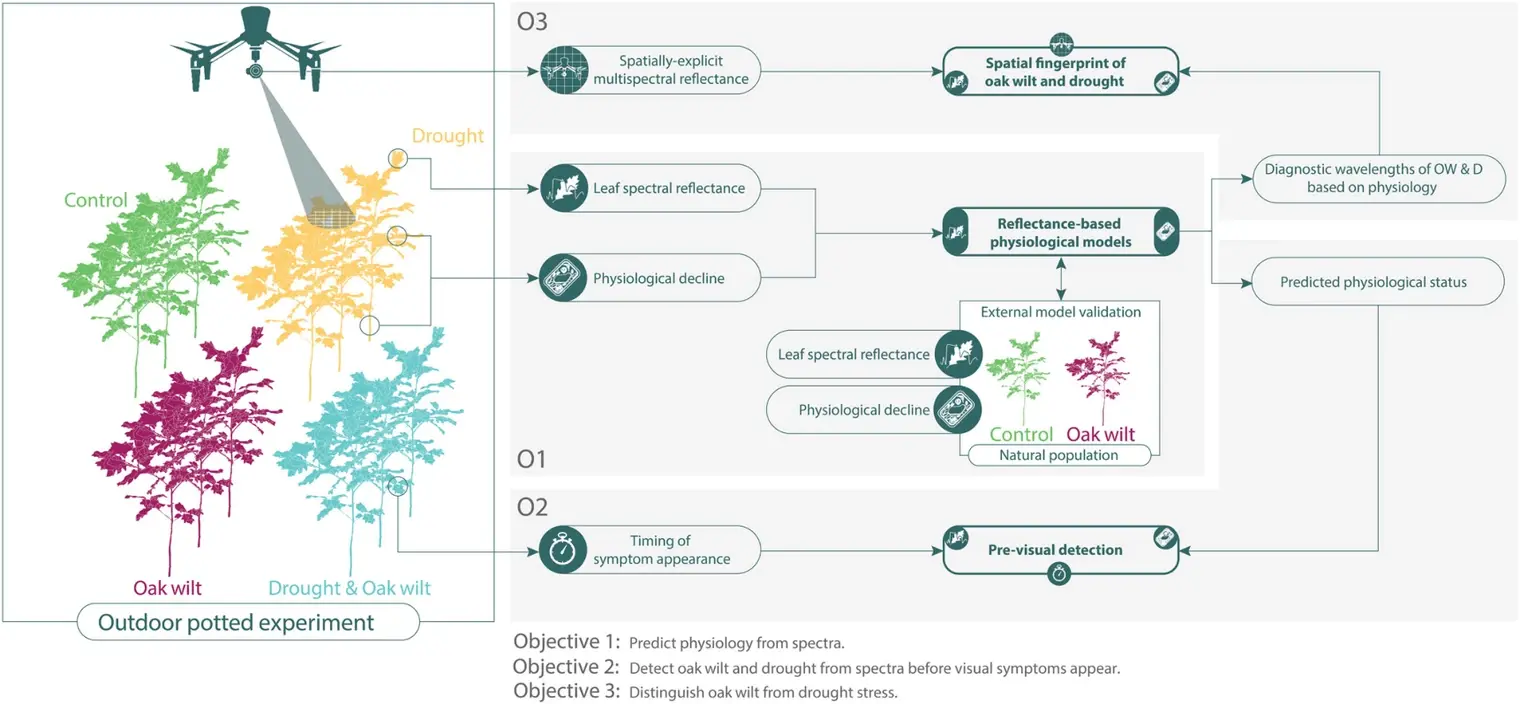
Рис. 1. Схема экспериментального дизайна, задач и методики. Слева показаны варианты опыта и методы спектральной съёмки кроны и листа. В серых блоках обозначены подходы к трём задачам: O1 — прогнозировать физиологию по спектрам, O2 — выявлять вилт и засуху до видимых симптомов, O3 — отличать вилт от засушливого стресса.
Результаты
Динамика физиологических показателей при вилте дуба и засухе
Во всех вариантах контейнерного опыта физиологическое состояние оставалось близким к контролю (C, зелёные скрипичные диаграммы на рис. 2) до появления видимых симптомов (вертикальная линия в день 0). Незадолго до этого наблюдались небольшие увеличения утечки электролитов (EL, рис. 2A) и потери способности к регидратации (LRC, рис. 2F) и небольшие снижения относительного и объёмного содержания воды (RWC и VWC, рис. 2D, E) во всех вариантах стресса. Полуденный водный потенциал (рис. 2G) немного снижался до видимых симптомов только при засухе (D) и засухе в сочетании с вилтом (D×OW). Максимальная эффективность фотосистемы II (Fᵥ/Fₘ, рис. 2C) снизилась раньше остальных измеренных показателей. Однако интервалы неопределённости (CI) для всех переменных были слишком широкими, чтобы подтвердить досимптомное выявление. После появления симптомов в вариантах D, OW и D×OW резко выросли EL и LRC и резко снизились RWC, VWC и водный потенциал (p от 0,022 до <0,001). Значимых различий в физиологической динамике между D, OW и D×OW не обнаружено.
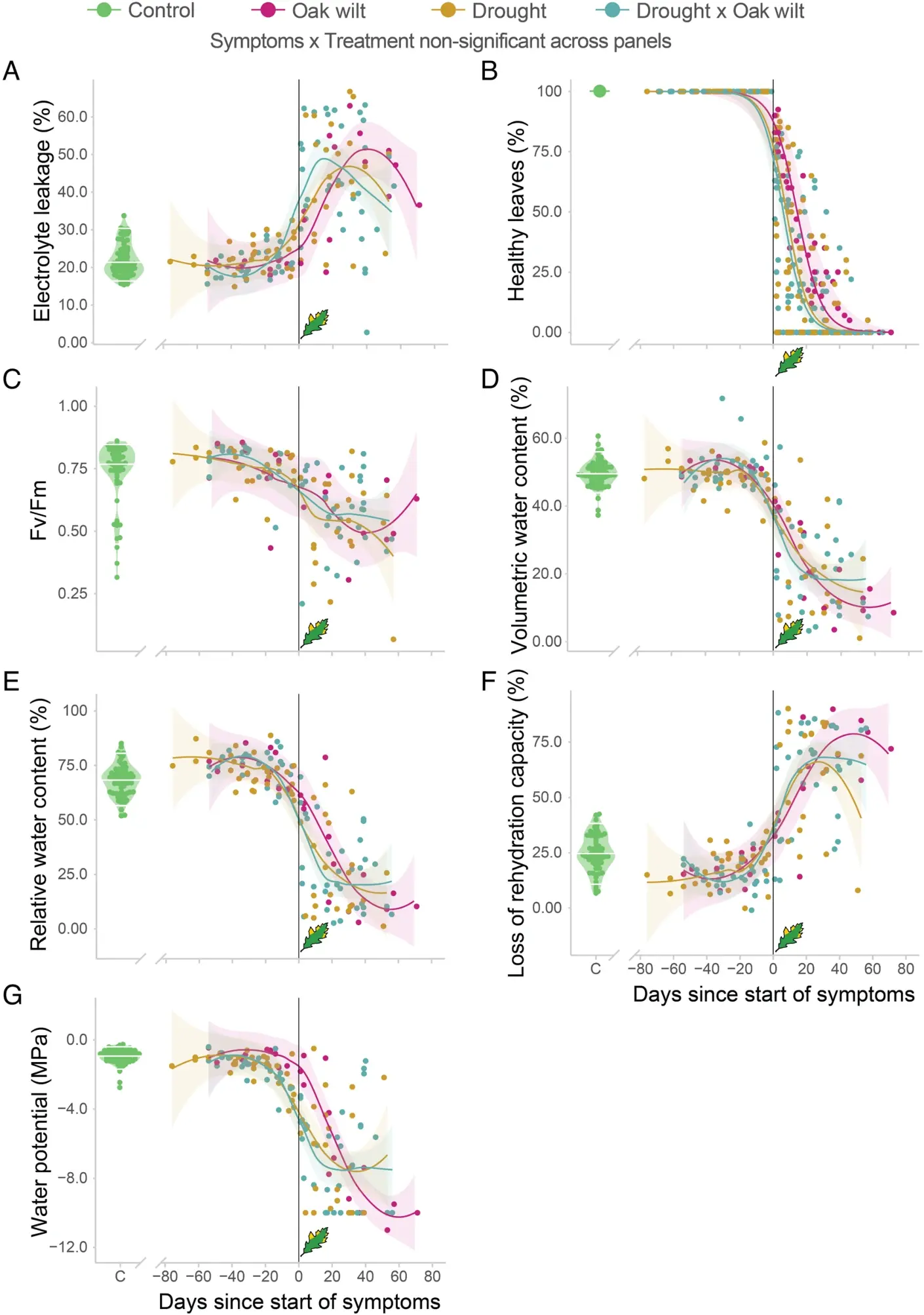
Рис. 2. Динамика физиологических симптомов при вилте (OW), засухе (D) и их совместном воздействии (D×OW). Зелёные скрипичные диаграммы показывают медиану и диапазон состояния контроля (C) за время опыта. Чёрная вертикальная линия и значок листа в день 0 отмечают начало видимых симптомов. Утечка электролитов (A) увеличивается до появления увядших, побуревших по краям или высохших листьев, что видно по снижению доли здоровых листьев (B). До появления симптомов снижаются Fᵥ/Fₘ (C), объёмное (D) и относительное (E) содержание воды, увеличивается потеря способности к регидратации (F) и снижается водный потенциал (G). Во всех панелях число дней от начала симптомов значимо влияет на отклик. Различий наклонов между вариантами не выявлено.
Динамика спектрального отражения при вилте и засухе
В контейнерном опыте по мере усиления видимых симптомов изменения отражения кроны становились значимыми во всё большем числе спектральных областей (рис. 3A, B и приложение S6). Первые изменения появились через 33 дня от начала воздействий. При OW отражение кроны сначала выросло в области 1400–1500 нм коротковолнового ИК-диапазона (SWIR, p < 0,01). В области красного края (700–750 нм) отражение снизилось на 48-й день (p < 0,01). К 62-му дню от контроля отличался почти весь спектр, за исключением зелёной области видимого диапазона (VIS), отдельных участков красного края и SWIR около 1600 нм. При D отражение кроны сначала снизилось примерно при 1150 нм в ближнем ИК-диапазоне (NIR, p < 0,01). К 33-му дню отмечались также изменения на длинах волн, выявленных при OW. На 48-й день значимые изменения наблюдались в синей и красной областях VIS и при 1000–1270, 1400–1500 и 1950–2200 нм (p < 0,01). К 62-му дню, как и при OW, различался почти весь спектр (p < 0,01). При D×OW изменения также выявлены на 33-й день на длинах волн, характерных для D и OW, и дополнительно в области 1600–1750 нм (p < 0,01). К 48-му дню изменения при D×OW охватывали весь спектр (p < 0,01) и по направлению и величине были сходны с изменениями при OW на 62-й день.
Изменения спектров листьев запаздывали относительно изменений крон. Хотя форма спектров менялась уже к 33-му дню, при установленном уровне значимости 0,01 различия при OW не были значимыми до 62-го дня. В этот день отражение выросло в VIS, снизилось в VNIR и за его пределами (750–1300 нм) и выросло в SWIR (p < 0,01, рис. 3, IV-A). При засухе отражение листьев сначала выросло в красной области VIS на 33-й день (p < 0,01). К 48-му дню отражение выросло в синей области и снизилось около 750 нм (p < 0,01), а также выросло в водных полосах SWIR (p < 0,01). К 62-му дню от контроля отличался почти весь спектр D. Листья D×OW, изначально не отличавшиеся от контроля, внезапно стали наиболее отличными по спектру: к 62-му дню значимые различия отмечались почти во всех областях (p < 0,01).
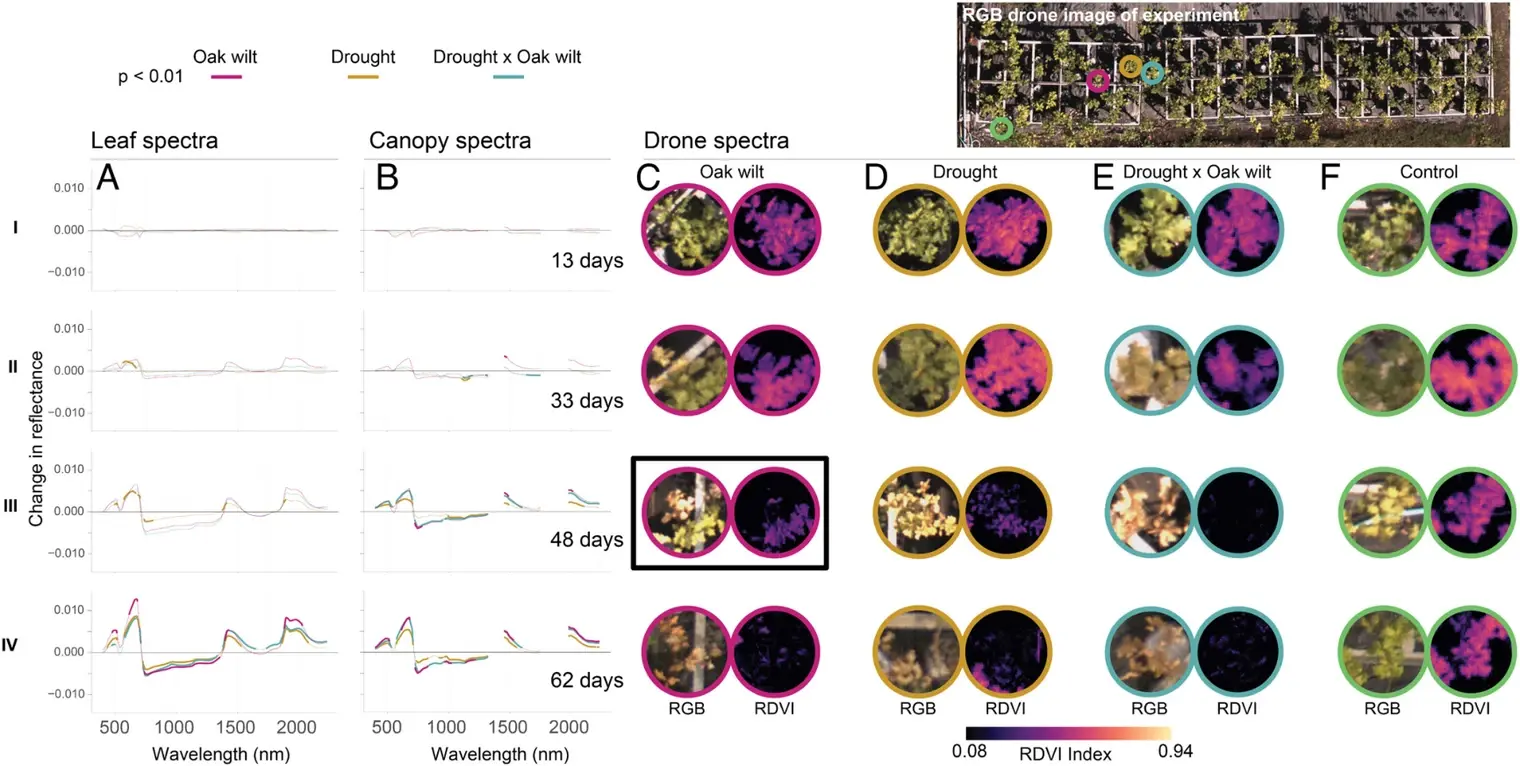
Рис. 3. Повторные измерения спектров листьев (A), крон (B) и съёмка с БПЛА (C–F) по мере развития стресса позволили определить длины волн, характерные для вилта дуба (OW) и засухи (D) на разных стадиях ослабления. Неоднородность раннего ослабления кроны при вилте отчётливо видна на изображениях перенормированного разностного вегетационного индекса (RDVI) на 48-й день и заметна уже на 33-й день (чёрная рамка). День 33 соответствует появлению видимых симптомов у выделенного дерева. Колонки A и B показывают разность нормированного отражения между контролем и опытными деревьями на 13-й, 33-й, 48-й и 62-й день. Утолщённые участки линий обозначают длины волн со значимыми изменениями (p < 0,01).
Прогнозирование физиологических показателей по спектрам
Модели регрессии методом частичных наименьших квадратов (PLSR) по отражению листьев прогнозировали относительное и объёмное содержание воды (RMSEP соответственно 11,47 и 10,76 %), потерю способности к регидратации и утечку электролитов (11,98 и 13,09 %), водный потенциал (19,77 %) и максимальную эффективность фотосистемы II (16,16 %). Это справедливо при использовании всех деревьев и при исключении контроля (приложение S7). При перекрёстной проверке на данных контейнерного опыта, не использованных для обучения, наклоны зависимостей измеренных и прогнозируемых значений были сходными для разных вариантов (рис. 4A, C, E, G). Это указывает на сходное смещение оценок независимо от вида стресса.
При независимой проверке в естественной популяции красных дубов, искусственно заражённых B. fagacearum в Сидар-Крик, спектральные прогнозы VWC и Fᵥ/Fₘ хорошо соответствовали измерениям и у контрольных, и у заражённых деревьев (рис. 4B, D). У больных деревьев VWC и Fᵥ/Fₘ расходились с контролем ещё до видимых симптомов, появившихся на 22-й день после заражения. Интервалы не перекрывались и для измерений, и для прогнозов. Прогнозы также отразили слабое восстановление после дождя примерно на 70-й день. Успешная проверка моделей VWC и Fᵥ/Fₘ позволила применить к данным Сидар-Крик две другие модели, LRC и EL, показавшие хорошие результаты перекрёстной проверки. Эти показатели в Сидар-Крик не измеряли, однако их прогнозы отчётливо различались между больными и контрольными деревьями (рис. 4F, H).
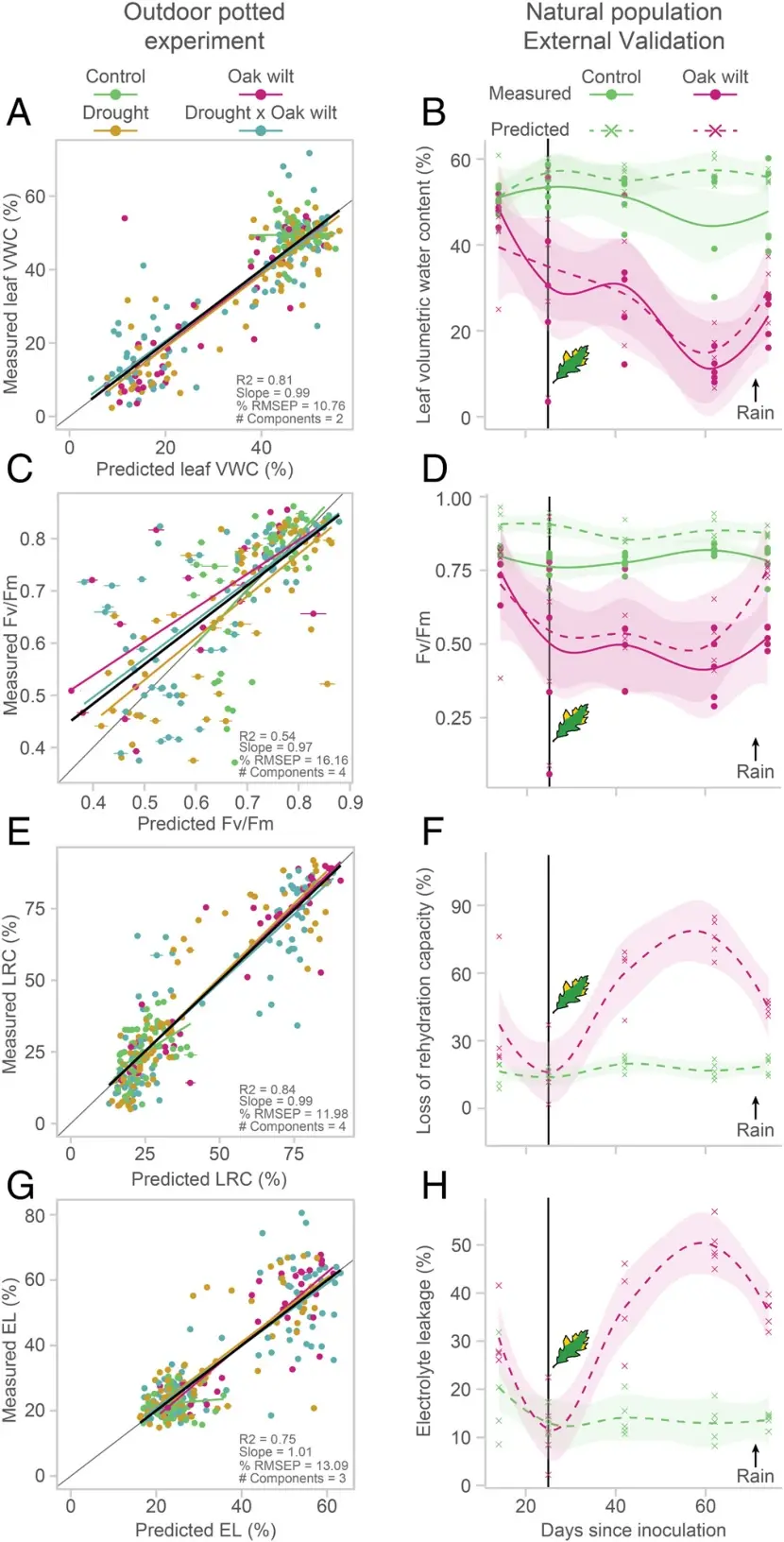
Рис. 4. Прогноз физиологии по спектральному отражению с помощью PLSR. Слева — измеренные и прогнозируемые значения, справа — независимая проверка для объёмного содержания воды (A, B), Fᵥ/Fₘ (C, D), потери способности к регидратации (E, F) и утечки электролитов (G, H). Тонкая серая линия — соответствие 1:1, чёрная — общая аппроксимация, цветные — аппроксимации по вариантам: контроль зелёный, вилт фиолетовый, засуха золотистая, засуха с вилтом синяя. Справа использованы независимые данные естественной популяции Сидар-Крик. Кружки — измерения, кресты — прогнозы. Значок листа и вертикальная линия — дата видимых симптомов, стрелка — дождь, после которого функции частично восстановились.
Различение вилта и засухи по ксилеме и кронам
У заражённых деревьев без видимых симптомов к концу опыта оставалась функциональная ксилема, но её доля была ниже контроля (p < 0,05). Симптоматические деревья утратили всю функциональную ксилему (p < 0,001, приложение S9). Закупорку тилами нельзя было устранить промывкой, тогда как вызванные засухой эмболии устранялись промывкой (p < 0,05, рис. 5C). При вилте распределение гидравлических нарушений соответствовало переносу патогена с током транспирации от места заражения к смежным участкам ксилемы. При засухе такой закономерности не было (p < 0,001, рис. 5C). При D×OW уровень закупорки был промежуточным и значимо не отличался ни от D, ни от OW (p > 0,05, рис. 5C и приложение S9). Наблюдались как смежные, так и разобщённые нарушения, покрывавшие диапазоны обоих вариантов. Статистически пространственный рисунок был наиболее близок к D.
Среднее по пикселям кроны значение RDVI, полученное с БПЛА по информативным длинам волн, определённым спектральными моделями физиологии (приложение S7), снижалось при OW, D и D×OW по мере развития стресса (рис. 3C–F, I–IV). Однако при развитии вилта и появлении видимых симптомов внутрикроновое стандартное отклонение RDVI увеличивалось относительно D (p = 0,02, рис. 5B).
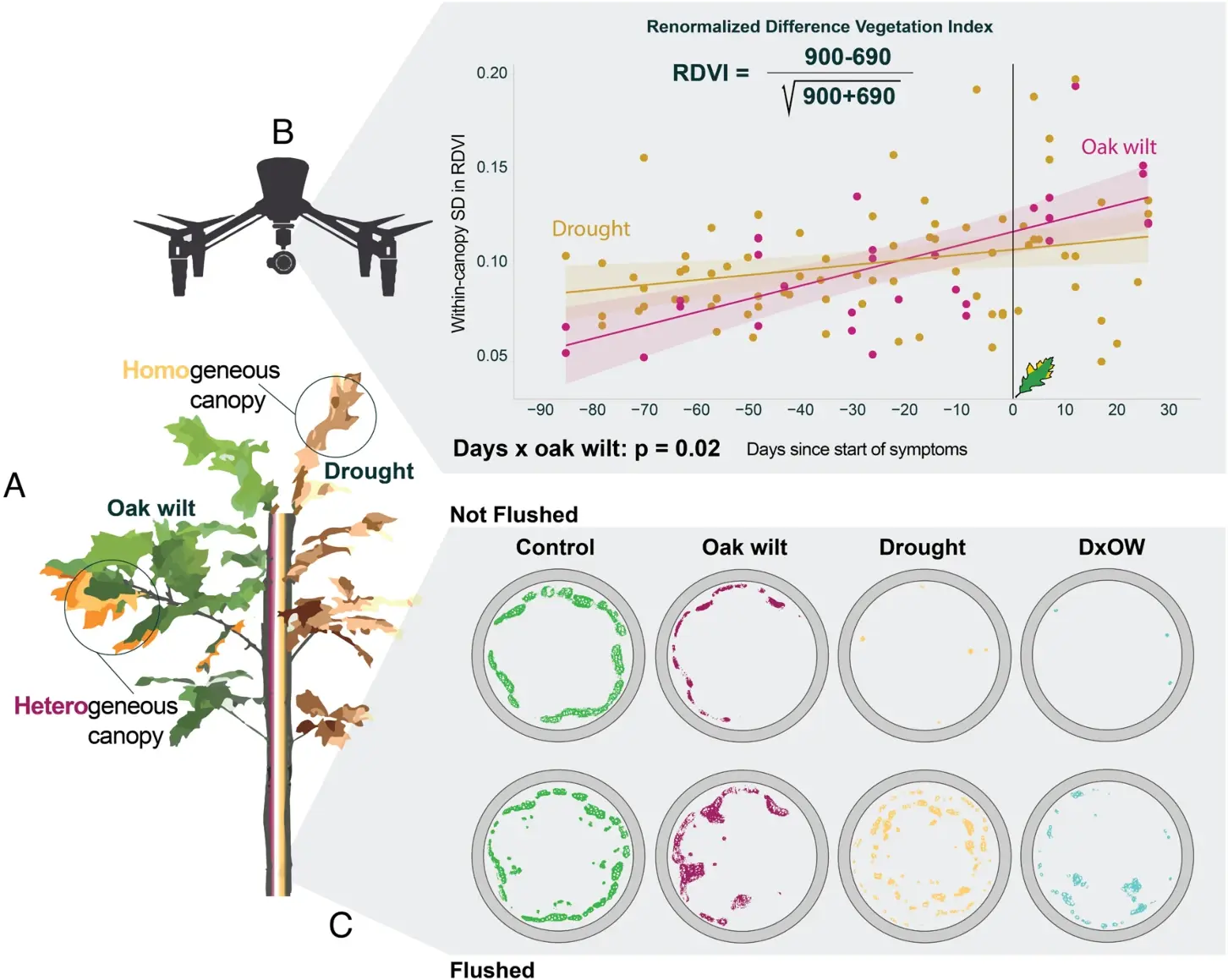
Рис. 5. При вилте кроны физиологически неоднороднее, чем при засухе (A). Неоднородность выявляют по пространственному разбросу индексов физиологического ослабления, например RDVI, по данным БПЛА (B). При распространении возбудителя по проводящей системе ствола сосуды закупориваются локально. На поперечных срезах эти области не окрашены, тогда как функционирующие участки показаны красным (C, до промывки). На ранних стадиях нарушения ксилемы вызывают локальное ослабление кроны: некоторые ветви и листья соединены с закупоренными сосудами, большинство — с функционирующими. При засухе снижение водного потока зависит от размера сосудов: широкие сосуды уязвимее к образованию пузырьков и кавитации. Поэтому потеря функции распределена менее локально. Жёлтым показаны немногочисленные функционирующие сосуды при засухе, синим — ещё меньшее их число при сочетании засухи и вилта (C, до промывки). Образовавшиеся при засухе пузырьки удаляются при промывке окрашенной водой под давлением, тогда как закупорка вследствие вилта сохраняется (C, после промывки).
Выявление вилта и засухи до видимых симптомов
Байесовские сегментированные регрессии выявили точки изменения, соответствующие дню, когда спрогнозированные по спектрам физиологические показатели начали меняться в ответ на стресс (рис. 6A). Наибольшую способность к досимптомному выявлению показал Fᵥ/Fₘ. Его снижение выявлялось при D, OW и D×OW примерно за 11, 12 и 6 дней соответственно и до 27, 24 и 12 дней до видимых симптомов (рис. 6B, приложение S10). Повышение LRC также позволяло выявлять оба стресса. В среднем изменения выявлялись за 8, 6 и 5 дней соответственно, а в отдельных случаях — за 15, 11 и 9 дней. Водный потенциал, VWC, RWC и EL позволяли выявить D и D×OW до симптомов примерно в те же сроки, что и LRC. Однако в варианте OW их порог выявления значимо не отличался от дня появления видимых симптомов.
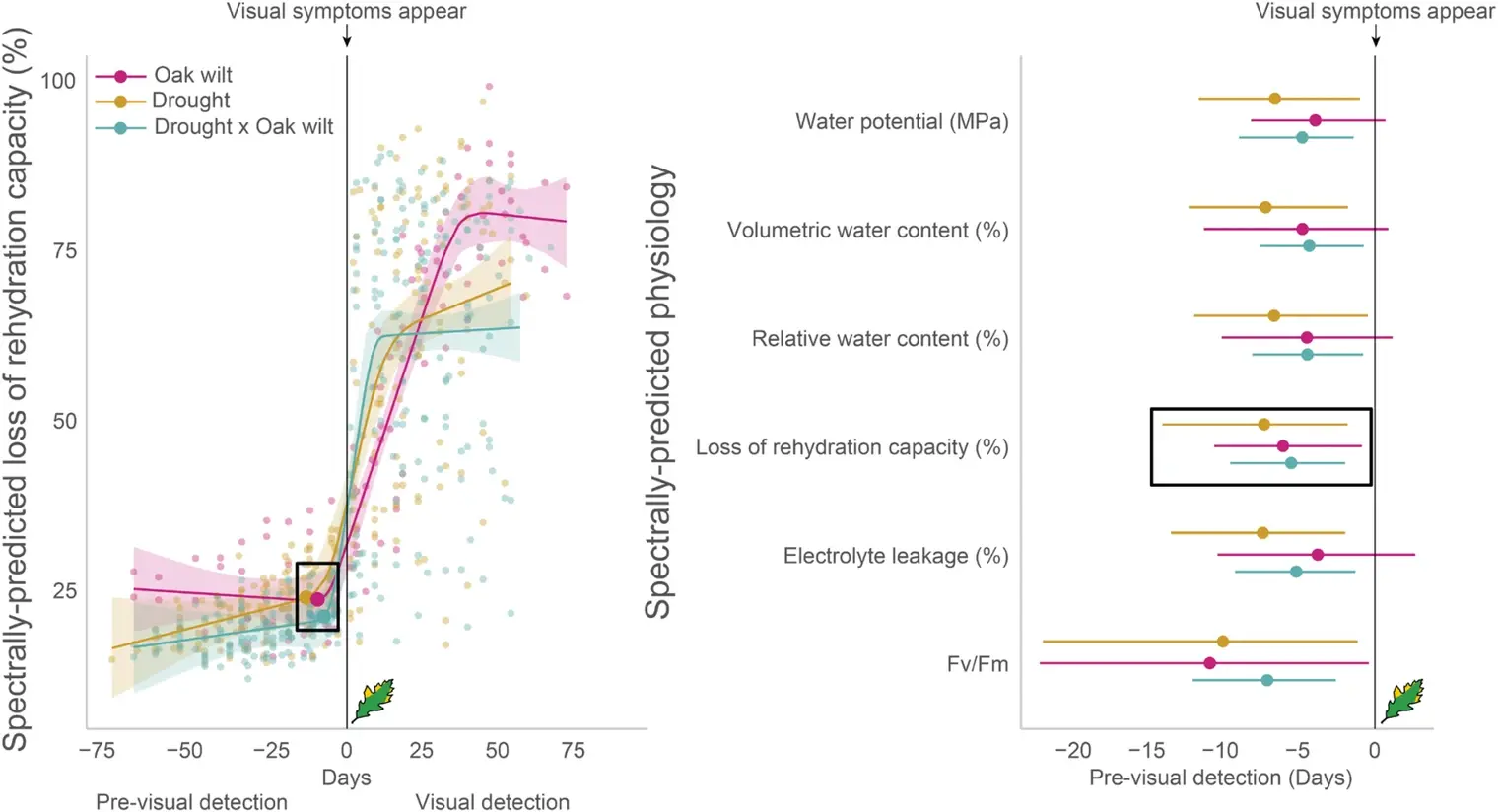
Рис. 6. Слева — байесовские сегментированные регрессии выявили точки изменения (чёрная рамка), соответствующие началу прогнозируемого по спектрам физиологического ослабления, например потери способности к регидратации при повреждении клеток. День 0 — появление видимых симптомов. Отрицательные значения — дни до симптомов, положительные — после. Точка до дня 0 означает способность процесса выявлять стресс досимптомно. Справа — точки изменения и интервалы неопределённости для каждого показателя и стресса. Все спектральные прогнозы обнаружили засуху и сочетанный стресс до видимых симптомов (интервалы не пересекают день 0). При вилте это удалось только по LRC и Fᵥ/Fₘ. LRC выявляла вилт за 11–2 дня (в среднем за 7), Fᵥ/Fₘ — за 26–1 день. Другие изменения при вилте происходили не всегда до симптомов, однако обнаруживались уже в течение трёх дней после их появления.
Обсуждение
Одна из давних задач дистанционного зондирования — достаточно рано выявлять стресс растений и различать его причины, чтобы повысить эффективность мер борьбы с болезнями на месте. Наши результаты показывают, что отражение листьев позволяет выявить вилт и засуху более чем за неделю до видимых симптомов и различить эти воздействия. Для точного различения нужно связать спектры листьев с физиологическими процессами и механизмами обеих причин, чтобы определить длины волн, связанные с ранним ослаблением. Пространственное распределение спектральных индексов, чувствительных к вилту и засухе, помогает отличать их по данным сравнительно недорогих мультиспектральных датчиков на БПЛА. Результаты подчёркивают важность связи дистанционных признаков с физиологическими механизмами для мониторинга состояния леса.
Выявление вилта и засухи физиологическими моделями по спектральному отражению
По спектральному отражению листьев можно прогнозировать процессы, связанные с фотосинтезом, обезвоживанием и гибелью клеток. Утрата тургора и закрытие устьиц — первые процессы у молодых дубов при вилте и засухе (13). При заражении B. fagacearum они обусловлены закупоркой сосудов (рис. 5C) (10), при засухе — снижением водного потенциала из-за дефицита воды (4). Длительное закрытие устьиц влияет на концентрации хлорофилла, что проявляется ростом отражения на красных и синих длинах волн (47). Эти изменения возникают одними из первых при обоих воздействиях (рис. 3A, приложение S6) и хорошо прогнозируют связанные с фотосинтезом процессы, прежде всего максимальную квантовую эффективность фотосистемы II (Fᵥ/Fₘ, приложение S8). После подавления фотосинтеза и потери тургора листья продолжают обезвоживаться, а их клеточные стенки необратимо повреждаются из-за схлопывания клеток — циторриза, который приводит к потере способности к регидратации (42). Содержимое клеток выходит через повреждённые мембраны, и клетки гибнут (приложение S8). Обезвоживание, циторриз и утечка содержимого повышали отражение в полосах поглощения воды и снижали его на длинах волн, чувствительных к структуре мезофилла и содержанию пигментов (приложения S6, S8). Циторриз и утечка возникают почти одновременно вследствие обезвоживания (42), поэтому и при вилте, и при засухе их сроки относительно начала видимых симптомов сходны (рис. 2).
Модели прогнозирования по отражению обучали в контролируемом эксперименте на одном виде Quercus rubra. Они всё же выявили физиологический стресс от вилта в полевых условиях, несмотря на естественную неоднородность возраста и видового состава — в данном случае двух красных дубов, Q. rubra и Q. ellipsoidalis (рис. 4). Сопоставление прогнозов и измерений показало разброс в средней части физиологического диапазона. Это может объясняться несовершенством отражения как предиктора физиологии или изменчивостью физиологии и спектров в пределах листа. Малое поле зрения волоконно-оптического зонда отражает локальную изменчивость, тогда как физиологические измерения относятся к целому листу. Широкий диапазон обучающих значений позволил удержать наклон зависимости вблизи линии 1:1 и точно прогнозировать промежуточные значения. В Сидар-Крик спектральные прогнозы согласовывались с измерениями и в средней части проверочного диапазона (рис. 4B, D). Модели LRC и EL также позволили различить заражённые и здоровые деревья, хотя этих показателей в поле не измеряли (рис. 4F, H). При переносе на другие места, периоды или виды модели с физиологической основой, вероятно, дают меньший риск ошибочной экстраполяции и большую вероятность успеха. Спектроскопические модели, основанные на механизмах и процессах при вилте и засухе, позволяют получить обобщаемые результаты.
Выявление более чем за неделю до видимых симптомов
Все физиологические показатели, прогнозируемые по спектрам, позволяли досимптомно выявлять засуху, однако при вилте это удалось только по Fᵥ/Fₘ и LRC (рис. 6). Эти показатели позволяют обнаружить оба стресса более чем за неделю до симптомов на листьях. Вероятно, это связано с ранним снижением фотосинтеза и потерей тургора (48, 49). Хотя досимптомное выявление вилта обеспечили только два показателя, его обнаруживали по всем показателям в течение трёх дней после появления первого симптоматического листа (рис. 6). Наземные обследования, выполняемые специалистами по видимым признакам кроны и сопутствующим признакам участка, медленны и трудоёмки и опираются на развитые симптомы, например поражение более 30 % кроны (10). Для различения вилта и засухи требуется детально осматривать подозрительные деревья. Авиаобследование охватывает ландшафты быстрее, но при одновременном присутствии больных и засушенных деревьев подозрительные участки также проверяют на земле, поскольку с воздуха их трудно различить. Борьба с вилтом может оказаться запоздалой: к моменту правильного диагноза и обработки возбудитель нередко уже перенесён насекомыми на соседние деревья (10). Наши данные показывают, что спектральное отражение с платформ ДЗЗ позволяет выявить оба стресса значительно раньше. Это даст возможность меньшим числом специалистов обследовать большие площади и принимать меры до дальнейшего распространения возбудителя. Досимптомная съёмка также может помочь ограничивать распространение через сросшиеся корни. Например, она позволяет точнее очертить границу очага и буферную зону, которые сейчас определяются по опыту или статистическим моделям (50) и иногда не охватывают заражённые деревья без симптомов.
В настоящее время лесоводы Menominee Tribal Enterprises используют БПЛА с RGB-датчиками для выявления отдельных деревьев с симптомами вилта в лесных кварталах округа Меномини, штат Висконсин, США. Разработано быстрое вмешательство, предотвращающее распространение возбудителя вниз в корневую систему и затем в соседние деревья: на нижней части ствола дерева с начальными симптомами делают два кольцевых надреза в наружной ксилеме на расстоянии 15–25 см и наносят жидкий гербицид на свежие надрезы. Недорогие мультиспектральные системы увеличили бы период эффективности этой обработки. Раннее выявление засухи также поможет прогнозировать и поддерживать состояние лесов в будущем более сухом климате, например повышать устойчивость к биотическим факторам и уменьшать пожарную опасность, связанную с повышенной воспламеняемостью обезвоженной древесины.
Различение вилта и засухи по сочетанию физиологии и отражения
Физиологические процессы на уровне листа при вилте и засухе сходны (рис. 2), поскольку непосредственная причина одна — утрата гидравлической проводимости ксилемы (рис. 5C). По физиологии листьев этих стрессов не различить. Однако пространственное распределение потери проводимости в ксилеме различается. При вилте дисфункция образует скопления, которых при засухе нет (рис. 5C). Это различие можно выявить окрашиванием ксилемы, однако метод непрактичен на больших территориях. Пространственные различия дают физиологический механизм для различения в более крупном масштабе. Ветви соединены с разными группами сосудов у основания ствола. На ранних стадиях вилта фотосинтез, содержание воды и жизнеспособность клеток снижаются только на ветвях, связанных с закупоренными сосудами (рис. 3C). По мере появления симптомов это создаёт большой разброс состояния в кроне (рис. 5B). Связав физиологию со спектральным отражением, мы определили чувствительные длины волн и выбрали индексы, доступные недорогим системам БПЛА, включая RDVI, ранее показавший высокую чувствительность к вилту (14). Используемые в индексе 900 и 690 нм связаны с фотосинтезом и сохранностью структуры листа (51), что подтверждено моделями PLSR (приложение S8) и объясняет чувствительность индекса.
Этот междисциплинарный подход позволил обнаружить пространственные различия физиологического состояния и отличить ранний вилт от засухи (рис. 3C, D и 5B). При механистическом подходе важно учитывать пространственное распределение на уровне ткани, органа и дерева. Совместный учёт ксилемы, листьев и кроны был необходим для различения вилта и засухи. Пространственное распределение важно и при выявлении вилта в масштабе дерева и насаждения: оно снижает ошибки классификации и позволяет выявлять очаги (14). Поскольку вилт проявляется сходным образом по всему современному ареалу красных дубов (Quercus, секция Lobatae) (52), мы рассчитываем, что наблюдения и подход окажутся широко применимыми.
Заключение
На протяжении десятилетий исследователи стремились измерять стресс растений дистанционно, с воздуха, одним нажатием кнопки (53), однако практическое решение появлялось медленно. Одна из возможных причин в том, что методам ДЗЗ часто недостаёт описания механизмов, позволяющего переносить их между территориями, периодами и биологическими системами (54). Экофизиология растений давно предлагает механистическую основу для общей оценки выраженности стресса (55), однако собирать экофизиологические данные на больших территориях с необходимым временным и пространственным разрешением непрактично. В нашем исследовании объединение этих дисциплин, которое можно назвать спектральной экофизиологией, позволило рано выявить и различить биотический и абиотический факторы вилта и засухи. Экофизиология показывает, какие процессы следует оценивать по дистанционным данным отражения. ДЗЗ позволяет быстро получать пространственно детальные оценки. Спектрально прогнозируемые экофизиологические показатели и физиологически обоснованные спектральные индексы опираются на фундаментальные биологические процессы и, вероятно, обладают большей переносимостью, чем сигналы без такой связи. Мы надеемся, что работа побудит исследовать связи экофизиологии и спектрального отражения и выяснять, какие параметры, в какие сроки и в каких растительных системах поддаются измерению.
Методы
План экспериментов
Весной 2019 и 2021 гг. провели два эксперимента: полевой на естественно возобновившихся молодых красных дубах, искусственно заражённых B. fagacearum в научном заповеднике Сидар-Крик (45,396° с. ш., 93,183° з. д., приложение S1), и контейнерный на открытом воздухе с Quercus rubra, где сочетали засуху и искусственное заражение в полном факторном плане. Второй опыт проведён на территории комплекса для выращивания растений Университета Миннесоты в Сент-Поле (44,988° с. ш., 93,177° з. д.).
В Сидар-Крик отобрали 40 естественно выросших молодых Q. ellipsoidalis и Q. rubra с полностью развитыми листьями. Использовали оба вида, поскольку в молодом возрасте их трудно различить и между ними свободно происходит интрогрессия. Оба одинаково восприимчивы к вилту. Высота деревьев составляла 63–240 см, в среднем 134 см. Диаметр у поверхности земли — 1,2–5,4 см, в среднем 2,8 см. 27 июня 2019 г. половину деревьев (OW) заразили B. fagacearum: 1 мл гомогенизированной водной суспензии спор (2,1 × 10⁵ спор/мл) внесли пипеткой в одно свежее отверстие диаметром 1 мм и радиальной глубиной 4 см, расположенное на 4 см выше корневой шейки. Рану прикрывали стерильной влажной ватой и закрепляли её парафильмом. Остальные деревья служили необработанным контролем. Физиологию и спектры OW и C регистрировали через 14, 25, 42, 62 и 74 дня после заражения. В каждую дату случайно выбирали пять деревьев OW и пять ближайших к ним контрольных, чтобы уменьшить пространственную изменчивость, не связанную с воздействиями.
В контейнерном опыте посадили 100 молодых деревьев с открытой корневой системой. Высота составляла 27–133 см (средняя 96 см), диаметр у земли, вычисленный по окружности ствола, — 0,64–1,81 см (средний 1,00 см). 13–14 апреля 2021 г. деревья в состоянии покоя пересадили в конические контейнеры объёмом 9,63 л, окрашенные в белый цвет для предотвращения перегрева корней. Субстрат состоял из грунта и песка в отношении 2:1. Деревья оставили на открытом воздухе, где листья распустились до начала воздействий. 15 июля половину деревьев заразили инокулятом той же концентрации, что и в Сидар-Крик. Делали небольшой надрез с отгибом коры, ниже наносили кольцо замазки, вносили водную суспензию инокулята и закрывали рану, как описано выше. У половины заражённых и половины незаражённых деревьев основание закрыли белой плёнкой, чтобы исключить осадки и вызвать засуху. Получились четыре варианта: контроль (C), засуха (D), вилт (OW), засуха с вилтом (D×OW). Варианты распределили случайно, расстояние между деревьями составляло около 0,5 м. После заражения каждую неделю отслеживали физиологические изменения у пяти разных случайно отобранных деревьев каждого варианта. Во все даты отбора у всех деревьев измеряли отражение в диапазоне 400–2400 нм на уровне листьев и кроны. Каждые три дня осматривали кроны, чтобы определить день первых видимых симптомов у каждого дерева.
Отбор образцов
В обоих опытах определяли долю листьев на каждой из четырёх стадий: зелёные, поникшие с изменённой окраской, поникшие с побуревшими краями и полностью бурые и сухие. Для физиологических и спектральных измерений выбирали репрезентативные листья каждой стадии, присутствующей у дерева. Это обеспечивало представительность всего диапазона спектральной и физиологической изменчивости для обучения устойчивых моделей. Для каждого типа выбирали освещённый солнцем лист и адаптировали его к темноте на ночь светонепроницаемым зажимом Hansatech (PP Systems). На следующий день утром измеряли флуоресценцию, около полудня — спектры. Листья помещали в герметичные пакеты Ziploc с влажным бумажным полотенцем, частично закрытым алюминиевой фольгой, чтобы предотвратить высыхание без переноса влаги при прямом контакте с полотенцем (56). Образцы в холодильном контейнере доставляли в лабораторию для измерения водного состояния.
Флуоресценция хлорофилла и спектральные измерения
В оба эксперимента в 9:00 каждой даты отбора измеряли Fᵥ/Fₘ у адаптированных к темноте листьев флуориметром Hansatech (PP Systems, Нарборо, Великобритания). Fᵥ/Fₘ характеризует максимальную квантовую эффективность фотосинтеза после темновой адаптации и отражает жизнеспособность и стресс тканей листа (32, 57). Около полудня (11:00–13:00) измеряли отражение листа в диапазоне 400–2400 нм прибором PSR+ 3500 (Spectral Evolution, Хейверилл, Массачусетс, США) с листовым зажимом, охватывавшим около 1 см². Отражение крон измеряли на 1 м выше кроны, заменяя волоконно-оптический зонд объективом с полем зрения 4°. Перед измерением каждого дерева выполняли привязку к условиям освещения по диффузному эталону Spectralon, размещённому прямо под волоконной оптикой. В R 3.5 (58) и пакете spectrolab (59) исходные спектры импортировали, пересчитывали с шагом 1 нм в диапазоне 400–2400 нм и нормировали к единичному вектору.
Только в контейнерном опыте выполняли полёты DJI Inspire 2 на 13-й, 33-й, 48-й и 62-й день с модифицированной мультиспектральной камерой Sentera 6X, разработанной совместно с Sentera (Сент-Пол, Миннесота). Камера регистрировала отражение на длинах волн 690 (±20), 720 (±10), 760 (±10), 900 (±20) и 970 (±40) нм и в RGB-канале. Ширины полос приведены по уровню половины максимума. Длины волн выбраны как важные по работе (14) с учётом ограничений датчика VNIR (400–990 нм). Цифровые отсчёты преобразовывали в отражение методом эмпирической линии по поверхностям с известным коэффициентом отражения. Для каждой даты по RGB-снимкам БПЛА вручную обводили кроны в QGIS (60), исключая просветы, и формировали полигоны. По ним извлекали отражение каждого пикселя на каждой длине волны. Затем рассчитывали перенормированный разностный вегетационный индекс (RDVI) (51), ранее показавший высокую чувствительность к вилту (14):
Для каждого полёта рассчитывали среднее и стандартное отклонение RDVI в пределах каждой кроны.
Водный режим
Собранные листья измеряли в лаборатории камерой давления (PMS Instrument Company, Корваллис, Орегон, США) для определения полуденного водного потенциала, характеризующего натяжение воды в ксилеме при дефиците влаги, по методике (61). На тех же листьях определяли VWC, RWC и процент потери способности к регидратации (LRC). С каждого дерева брали дополнительный лист каждого типа для измерения EL. Уменьшение VWC и RWC и увеличение EL связаны со стрессом, вызывающим гибель растений (34, 35, 43). LRC связана с необратимой потерей тургора и повреждением листьев (49), также способствующими стрессу и гибели. Методы описаны в приложении S1.
Окрашивание ксилемы
В конце контейнерного опыта для оценки функциональной и нефункциональной ксилемы отбирали со срезанием сегменты ствола на 30 см выше точки заражения у части деревьев (9 C, 14 D, 14 OW и 22 D×OW). Использовали метод активного окрашивания ксилемы (62), описанный в приложении S1. Окрашивание проводили до и после промывки стволов под высоким давлением, чтобы отличить эмболизированные участки от заполненных тилами. После промывки сосуды с тилами оставались неокрашенными. Часть деревьев OW замедляла колонизацию, поэтому заражённые деревья разделили на симптоматические и бессимптомные. В ImageJ (63) измеряли процент функциональной площади ксилемы до промывки и процент закупоренной площади после неё. Каждый поперечный срез также делили на 16 секторов и подсчитывали смежные закупоренные секторы для количественной оценки локальности нарушений.
Статистический анализ
Переход от листьев к целой кроне
Измеренные и прогнозируемые физиологические значения переносили на уровень целого растения, вычисляя средние, взвешенные по доле соответствующих типов листьев в кроне. Это позволяло учесть пространственную изменчивость физиологии и спектрального отражения между листьями и внутри кроны.
Физиологическая и спектральная динамика вилта и засухи
Во всех вариантах контейнерного опыта у деревьев с бо́льшим обхватом основания ствола видимые симптомы появлялись раньше (p < 0,001, приложение S3), вероятно, из-за более высокой транспирации. Влияние размеров было наибольшим у заражённых деревьев с достаточным поливом (OW). Внутри вариантов сроки симптомов и физиологического ослабления существенно различались (приложение S3). Чтобы выделить влияние воздействий без вариации размеров, время выражали числом дней от первых видимых симптомов (рис. 2B). Так можно оценить физиологию до и после появления симптомов. Для сравнения вилта, засухи и сочетанного стресса строили обобщённые линейные (GLM) и линейные (LM) модели (64). Откликами служили VWC, RWC, LRC, EL, водный потенциал и Fᵥ/Fₘ, предиктором — взаимодействие варианта и числа дней от появления симптомов. GLM применяли, если отклик нельзя преобразовать для выполнения предпосылок LM. Дополнительная модель с долей здоровых листьев в качестве отклика позволяла проверить различия сроков и скорости развития симптомов.
Влияние стресса на спектры оценивали сравнением листьев и крон опытных и контрольных деревьев на даты мультиспектральной съёмки БПЛА (дни 13, 33, 48 и 62). Чтобы не увеличивать риск ложноположительных результатов, сравнивали подмножество длин волн. Разработанная функция (приложение S4) вычисляла величину шага пропуска по разности отражения между соседними длинами волн. Если отражение было сходным, соседнюю длину волны пропускали, чтобы выбрать более удалённую с менее сходным отражением. Минимальная и максимальная дистанции между кандидатами составляли 5 и 40 нм. Число длин волн сократилось с 2000 до 94 с сохранением общей формы спектра в диапазоне 400–2400 нм. Для снижения ложноположительных результатов различия считали значимыми при p < 0,01.
Спектральное прогнозирование физиологии
Построили модели PLSR (65), чтобы определить, можно ли выявлять по отражению обезвоживание, гибель клеток и утечку клеточного содержимого. Для данных контейнерного опыта использовали 100 итераций с десятикратной перекрёстной проверкой. Каждый физиологический показатель (VWC, RWC, LRC, EL, водный потенциал, Fᵥ/Fₘ) служил откликом, все длины волн с шагом 1 нм — предикторами. В каждой итерации данные случайно делили на десять групп, обучали на девяти и проверяли на оставшейся. Оценивали RMSEP в процентах, R², наклон и смещение. Число компонент оптимизировали по RMSE, а общую прогностическую способность оценивали по медианам RMSEP и R² ста итераций. Значимость длин волн определяли по важности переменной в проекции (VIP, 66), рассчитывая для каждой длины волны медиану по всем итерациям. Каждую модель также независимо проверяли на данных Сидар-Крик, чтобы оценить устойчивость к различиям участков, условий и причин стресса. Каждую итерацию каждой модели проверяли на полном наборе Сидар-Крик. Итоговую точность оценивали по медианам RMSEP, R², наклона и смещения ста итераций. Модели с RMSEP не выше 20 % считали пригодными для прогноза физиологических процессов.
Выявление вилта и засухи до видимых симптомов
На данных контейнерного опыта определяли способность спектрально прогнозируемых процессов выявлять стресс до симптомов с помощью байесовских сегментированных регрессий пакета mcp (67). Регрессии определяют точки изменения состояния и их положения по оси времени с интервалами неопределённости. Откликами были прогнозы PLSR с RMSEP ≤ 20 %, включая VWC, RWC, LRC, EL, Fᵥ/Fₘ и водный потенциал (WP). Поскольку отражение листьев измеряли у всех деревьев в каждую дату, модели расширяли физиологические данные с нескольких деревьев до всех деревьев для каждой даты. Это позволяло охватить изменчивость и уменьшить неопределённость точки изменения. Время отсчитывали в днях от первых видимых симптомов, чтобы определить, начинались ли изменения до дня 0. Использовали настройки априорных распределений по умолчанию, основанные на минимуме, среднем, максимуме и изменчивости x и y, для надёжной оценки параметров. Параметр adapt меняли до сходимости трёх цепей по показателю Гельмана — Рубина (Rhat), близкому к 1 (67). Точки изменения и интервалы для каждого варианта и признака использовали, чтобы проверить, было ли начало ослабления значимо раньше дня 0.
Физиологическое и спектральное различение вилта и засухи
Для проверки различий механизмов сравнивали распределение функциональной ксилемы между вариантами до и после удаления эмболий промывкой в конце опыта. OW разделили на деревья с видимыми симптомами и без них для различения ранних и поздних стадий. Долю функциональной ксилемы до промывки, долю закупоренной после неё и число смежных закупоренных секторов после промывки сравнивали ранговым критерием Уилкоксона с учётом ненормальности распределения. Чтобы проверить большую внутрикроновую физиологическую неоднородность OW по сравнению с D, строили линейные модели со стандартным отклонением RDVI внутри кроны в качестве отклика и взаимодействием варианта и числа дней от появления симптомов в качестве предиктора. D×OW не включали, поскольку проверяли гипотезу о различении засухи и вилта.
Доступность данных, материалов и программного обеспечения
Физиологические, анатомические и спектральные данные размещены в репозитории DRUM (68).
Благодарности
Проект финансировали Центр по инвазивным наземным растениям и вредителям Миннесоты (Legislative-Citizen Commission on Minnesota Resources, проект 00050727), Интеграционный институт биологии NSF ASCEND (DBI 2021898), программа биоразнообразия NASA (80NSSC21K1349) и программа долгосрочных экологических исследований Сидар-Крик (DEB 1831944). Университет Миннесоты, включая заповедник Сидар-Крик, находится на исторических, традиционных и современных землях народа дакота. Благодарим C. Lapadat за помощь в посадке деревьев, C. Godoy, D. Sannerud и A. Villaseñor за помощь в полевых кампаниях Сидар-Крик. G.S. благодарит W.M. Hammond за финансовую поддержку представления работы на конференции Gordon Research Conference по сосудистой биологии растений в 2022 г. Благодарим S. Kothari, A. Castillo-Castillo и анонимных рецензентов за замечания к предыдущим версиям рукописи.
Вклад авторов
G.S., J.J., R.A.M. и J.C.-B. разработали план исследования. G.S., L.S., A.S., I.C., J.J., J.A.G.Q. и J.C.-B. провели исследование. G.S. и J.A.G.Q. анализировали данные. J.C.-B., J.J. и R.A.M. получили финансирование. G.S., L.S., J.J., R.A.M., J.A.G.Q. и J.C.-B. написали статью.
Сведения об авторах
ᵃ Кафедра экологии, эволюции и поведения, Университет Миннесоты, Сент-Пол, Миннесота 55108, США. ᵇ Кафедра агрономии, Университет Флориды, Гейнсвилл, Флорида 32611, США. ᶜ Кафедра биологии растений и микроорганизмов, Университет Миннесоты, Сент-Пол, Миннесота 55108, США. ᵈ Северная исследовательская станция Лесной службы Министерства сельского хозяйства США, Сент-Пол, Миннесота 55108, США. ᵉ Кафедра лесных ресурсов, Университет Миннесоты, Сент-Пол, Миннесота 55108, США.
Заявления
Авторы заявляют об отсутствии конкурирующих интересов. Статья подана непосредственно в PNAS.
© Авторы, 2024. Опубликовано PNAS. Статья распространяется по лицензии Creative Commons Attribution–NonCommercial–NoDerivatives 4.0 (CC BY-NC-ND). В настоящем файле представлен русский перевод.
Список литературы
1. IPBES, Summary for policymakers of the global assessment report on biodiversity and ecosystem services. Zenodo (2019). https://doi.org/10.5281/ZENODO.3553579 (17 June 2023)
2. IPCC, “Summary for Policymakers” in Climate Change 2023: Synthesis Report.A Report of the Intergovernmental Panel on Climate Change. Contribution of Working Groups I, II and III to the SixthAssessment Report of the Intergovernmental Panel on Climate Change,Core WritingTeam, H.Lee,J. Romero, Eds. (IPCC, Geneva, Switzerland, 2023), pp. 1–34.
3. W. M. Hammond et al., Global field observations of tree die-off reveal hotter-drought fingerprint for Earth’s forests. Nat. Commun. 13, 1761 (2022).
4. N. G. McDowell et al., Mechanisms of woody-plant mortality under rising drought, CO2 and vapour pressure deficit. Nat. Rev. Earth Environ. 3, 41–44 (2022).
5. A. Findlater, I. I. Bogoch, Human mobility and the global spread of infectious diseases: A focus on air travel. Trends Parasitol. 34, 772–783 (2018).
6. A. Gonzalez et al.,A global biodiversity observing system to unite monitoring and guide action. Nat. Ecol. Evol. 7, 1947–1952 (2023). 10.1038/s41559-023-02171-0.
7. J.Cavender-Bares et al.,The hidden value of trees: Quantifying the ecosystem services of tree lineages and their major threats across the contiguous US.PLoS Sustain.Transform. 1,e0000010 (2022).
8. S. Frankel,J.Juzwik, D. M. Rizzo, “North American oaks” in Global Plant Health Assessment, (International Society of Plant Pathology, ed. 1, 2022), pp. 152–158.
9. J.Juzwik, D. N.Appel,W. L. MacDonald, S. Burks, Challenges and successes in managing oak wilt in the United States. Plant Dis. 95, 888–900 (2011).
10. J.Juzwik, D. N.Appel, “Diseases of trees in the Great Plains: Oak Wilt” in Diseases of Trees in the Great Plains (USDA Forest Service, Rocky Mountain Forest and Range Station, 2016), pp. 129–133.
11. B. E. Struckmeyer, C. H. Beckman,J. E. Kuntz,A.J. Riker, Plugging of vessels by tyloses and gums in wilting oaks. Phytopathology 44, 148–153 (1954).
12. K.A.Yadeta, B. P.Thomma,The xylem as battleground for plant hosts and vascular wilt pathogens. Front. Plant Sci. 4, 1–12 (2013).
13. B. Fallon et al., Spectral differentiation of oak wilt from foliar fungal disease and drought is correlated with physiological changes. Tree Physiol. 40, 377–390 (2020).
14. G. Sapes et al., Canopy spectral reflectance detects oak wilt at the landscape scale using phylogenetic discrimination. Remote Sensing Environ. 273, 112961 (2022).
15. J.Pontius,M.Martin,L.Plourde,R.Hallett,Ashdeclineassessmentinemeraldashborer-infestedregions: Atestof tree-level,hyperspectraltechnologies.RemoteSensingEnviron.112,2665–2676(2008).
16. A.Lausch et al.,Forecasting potential bark beetle outbreaks based on spruce forest vitality using hyperspectral remote-sensing techniques at different scales.Forest Ecol.Managem. 308,76–89 (2013).
17. R. Ogaya,A. Barbeta, C. Başnou,J. Peñuelas, Satellite data as indicators of tree biomass growth and forest dieback in a Mediterranean holm oak forest. Ann. Forest Sci. 72, 135–144 (2015).
18. P.Asner et al.,A spectral mapping signature for the rapid ohia death (ROD) pathogen in Hawaiian Forests. Remote Sensing 10, 1–14 (2018).
19. P.J. Zarco-Tejada et al., Previsual symptoms of Xylella fastidiosa infection revealed in spectral plant-trait alterations. Nat. Plants 4, 432–439 (2018).
20. M.-D. Iordache,V. Mantas, E. Baltazar, K. Pauly, N. Lewyckyj,A machine learning approach to detecting pine wilt disease using airborne spectral imagery. Remote Sensing 12, 2280 (2020).
21. A. Hornero et al., Modelling hyperspectral-and thermal-based plant traits for the early detection of Phytophthora-induced symptoms in oak decline. Remote Sensing Environ. 263, 112570 (2021).
22. L. Cotrozzi, Spectroscopic detection of forest diseases: A review (1970–2020). J. For. Res. 33, 21–38 (2022).
23. J.A. Guzmán Q. et al., Mapping oak wilt disease from space using land surface phenology. Remote Sens. Environ. 298, 113794 (2023).
24. C. Bhuiyan, R. P. Singh, F. N. Kogan, Monitoring drought dynamics in the Aravalli region (India) using different indices based on ground and remote sensing data. Int.J.Appl. Earth Obs. Geoinf. 8, 289–302 (2006).
25. L. Cotrozzi et al., Using foliar spectral properties to assess the effects of drought on plant water potential. Tree Physiol. 37, 1582–1591 (2017).
26. P. D. Dao,Y. He, C. Proctor, Plant drought impact detection using ultra-high spatial resolution hyperspectral images and machine learning. Int.J.Appl. Earth Obs. Geoinf. 102, 102364 (2021).
27. W.Jiao, L.Wang, M. F. McCabe, Multi-sensor remote sensing for drought characterization: Current status, opportunities and a roadmap for the future. Remote Sensing Environ. 256, 112313 (2021).
28. D. Marusig et al., Correlation of field-measured and remotely sensed plant water status as a tool to monitor the risk of drought-induced forest decline. Forests 11, 77 (2020).
29. J. Penuelas, I. Filella, C. Biel, L. Serrano, R. Save,The reflectance at the 950–970 nm region as an indicator of plant water status. Int.J. Remote Sensing 14, 1887–1905 (1993), 10.1080/01431169308954010.
30. P.J. Zarco-Tejada et al., Divergent abiotic spectral pathways unravel pathogen stress signals across species. Nat. Commun. 12, 6088 (2021).
31. E.Weingarten et al., Early detection of a tree pathogen using airborne remote sensing. Ecol.Appl. 32, e2519 (2022).
32. C. R. Guadagno et al., Dead or alive? Using membrane failure and chlorophyll fluorescence to predict mortality from drought. Plant Physiol. 175, 223–234 (2017).
33. J. Martinez-Vilalta,W. R. L.Anderegg, G. Sapes,A. Sala, Greater focus on water pools may improve our ability to understand and anticipate drought-induced mortality in plants. New Phytol. 223, 22–32 (2019).
34. G. Sapes et al., Plant water content integrates hydraulics and carbon depletion to predict drought-induced seedling mortality. Tree Physiol. 39, 1300–1312 (2019).
35. M. Mantova, P. E. Menezes-Silva, E. Badel, H. Cochard,J. M.Torres-Ruiz,The interplay of hydraulic failure and cell vitality explains tree capacity to recover from drought. Physiol. Plant. 172, 247–257 (2021).
36. S. P. Serbin et al., Remotely estimating photosynthetic capacity, and its response to temperature, in vegetation canopies using imaging spectroscopy. Remote Sensing Environ. 167, 78–87 (2015).
37. A. Onofri, P. Benincasa, M. B. Mesgaran, C. Ritz, Hydrothermal-time-to-event models for seed germination. Eur.J.Agronomy 101, 129–139 (2018).
38. H. Lambers, F. S. Chapin III,T. L. Pons, Plant Physiological Ecology (Springer, ed. 2, 2009).
39. O. L. Lange, R. Lösch, E.-D. Schulze, L. Kappen, Responses of stomata to changes in humidity. Planta 100, 76–86 (1971).
40. H.A.Snyman,W.L.J.Van Rensburg,W.D.Venter,Transpiration and water-use efficiency in response to water stress inThemeda triandra and Eragrostis lehmanniana.SouthAfricanJ.Botany 63,55–59 (1997).
41. W. M. Hammond et al., Dead or dying? Quantifying the point of no return from hydraulic failure in drought-induced tree mortality. New Phytol. 223, 1834–1843 (2019).
42. M. Mantova, S. Herbette, H. Cochard,J. M.Torres-Ruiz, Hydraulic failure and tree mortality: from correlation to causation. Trends Plant Sci. 27, 335–345 (2022).
43. G. Sapes,A. Sala, Relative water content consistently predicts drought mortality risk in seedling populations with different morphology, physiology and times to death. Plant Cell Environ. 44, 3322–3335 (2021).
44. G. L. Beier, B.W. Held, C. P. Giblin,J. Cavender-Bares, R.A. Blanchette,American elm cultivars: Variation in compartmentalization of infection by Ophiostoma novo-ulmi and its effects on hydraulic conductivity. Forest Pathol. 47, e12369 (2017).
45. J. Oliva,J. Stenlid,J. Martinez-Vilalta,The effect of fungal pathogens on the water and carbon economy of trees: Implications for drought-induced mortality. New Phytol. 203, 1028–1035 (2014).
46. K. R. Hargrave, K.J. Kolb, F.W. Ewers, S. D. Davis, Conduit diameter and drought-induced embolism in Salvia-Mellifera Greene (Labiatae). New Phytol. 126, 695–705 (1994).
47. P. Fu, K. Meacham-Hensold, K. Guan,J.Wu, C. Bernacchi, Estimating photosynthetic traits from reflectance spectra: A synthesis of spectral indices, numerical inversion, and partial least square regression. Plant Cell Environ. 43, 1241–1258 (2020).
48. P.Trifilò, E.Abate, F. Petruzzellis, M.Azzarà,A. Nardini, Critical water contents at leaf, stem and root level leading to irreversible drought-induced damage in two woody and one herbaceous species. Plant Cell Environ. 46, 119–132 (2023).
49. S.Trueba et al.,Thresholds for leaf damage due to dehydration: Declines of hydraulic function, stomatal conductance and cellular integrity precede those for photochemistry. New Phytol. 223, 134–149 (2019).
50. J.Juzwik,J. O’Brien, C. Evenson, P. Castillo, G. Mahal, Controlling spread of the oak wilt pathogen (Ceratocystis fagacearum) in a Minnesota Urban Forest Park Reserve. AUF 36, 171–178 (2010).
51. J.-L. Roujean, F.-M. Breon, Estimating PAR absorbed by vegetation from bidirectional reflectance measurements. Remote Sensing Environ. 51, 375–384 (1995).
52. J.Juzwik,An oak wilt primer. Int. Oaks 11, 14–20 (2000).
53. A. Galieni et al., Past and future of plant stress detection: An overview from remote sensing to positron emission tomography. Front. Plant Sci. 11, 609155 (2021).
54. J. Cavender-Bares et al., Integrating remote sensing with ecology and evolution to advance biodiversity conservation. Nat. Ecol. Evol. 6, 506–519 (2022).
55. H. Hartmann et al., Research frontiers for improving our understanding of drought-induced tree and forest mortality. New Phytol. 218, 15–28 (2018).
56. N. Garcia-Forner,A. Sala, C. Biel, R. Savé,J. Martínez-Vilalta, Individual traits as determinants of time to death under extreme drought in Pinus sylvestris L. Tree Physiol. 36, 1196–1209 (2016).
57. J. Cavender-Bares, F.A. Bazzaz, Changes in drought response strategies with ontogeny in Quercus rubra: Implications for scaling from seedlings to mature trees. Oecologia 124, 8–18 (2000).
58. R CoreTeam,R:ALanguage and Environment for Statistical Computing (R version 3.5,R Foundation for Statistical Computing,Vienna,Austria,2020).https://www.R-project.org/.Accessed 1 October 2021.
59. J. E. Meireles,A. K. Schweiger,J. Cavender-Bares, spectrolab: Class and Methods for Hyperspectral Data. (R package version 0.0.2,The Comprehensive R Archive Network, 2017). https://CRAN.R-project.org/package=spectrolab.Accessed 1 October 2021.
60. QGIS Development Team, QGIS Geographic Information System (Version 3.22 LTR Codename “Białowieża”, QGIS Association, 2009). https://www.qgis.org.Accessed 1 October 2021.
61. M. Kaufmann, Evaluation of the pressure chamber technique for estimating plant water potential of forest tree species. Forest Sci. 14, 369–374 (1968).
62. A. L.Jacobsen, R. B. Pratt, F.W. Ewers, S. D. Davis, Cavitation resistance among 26 chaparral species of Southern California. Ecol. Monographs 77, 99–115 (2007).
63. C.A. Schneider,W. S. Rasband, K.W. Eliceiri, NIH Image to ImageJ: 25 years of image analysis. Nat. Methods 9, 671–675 (2012).
64. K.V. Mardia,J.T. Kent,J. M. Bibby, Multivariate Analysis (Academic Press, 1979).
65. S.Wold, M. Sjöström, L. Eriksson, PLS-regression: A basic tool of chemometrics. Chemometr. Intell. Lab. Syst. 58, 109–130 (2001).
66. M. Kuhn, Building predictive models in R using the caret Package. J. Statist. Softw. 28, 1–26 (2008).
67. J. K. Lindeløv, mcp: An R package for regression with multiple change points. Open Science Framework (2020), https://doi.org/10.31219/osf.io/fzqxv (26 March 2023).
68. G. Sapes et al., Data and Code for Mechanistic links between physiology and spectral reflectance enable pre-visual detection of oak wilt and drought stress. Data Repository for the University of Minnesota. https://doi.org/10.13020/0bt3-pd25. Deposited 21 December 2023.
24 ноября 2026