
Оставить заявку
Для заказа и получения более подробной информации оставьте заявку, наш менеджер свяжется с Вами!
Нажимая на кнопку, вы даете согласие на обработку персональных данных и соглашаетесь c политикой конфиденциальности
Тепловое инфракрасное дистанционное зондирование стрессовых реакций в лесных экосистемах: обзор достижений, проблем и перспектив
Magdalena Smigaj¹ · Avinash Agarwal² · Harm Bartholomeus¹ · Mathieu Decuyper³ · Ahmed Elsherif⁴ · Arjen de Jonge¹˒³ · Lammert Kooistra¹
Current Forestry Reports (2024), т. 10, с. 56–76. DOI 10.1007/s40725-023-00207-z
Дистанционное зондирование (редактор раздела — J. Suarez)
Принято 10 ноября 2023 г. · Опубликовано онлайн 8 декабря 2023 г. · © Авторы, 2023
Автор для связи — Magdalena Smigaj, magdalena.smigaj@wur.nl
¹ Лаборатория геоинформатики и дистанционного зондирования, Вагенингенский университет и исследовательский центр, Droevendaalsesteeg 3, 6708 PB, Вагенинген, Нидерланды.
² Школа естественных наук и наук об окружающей среде, Ньюкаслский университет, Ньюкасл-апон-Тайн NE1 7RU, Великобритания.
³ Группа экологии леса и лесоуправления, Вагенингенский университет и исследовательский центр, Droevendaalsesteeg 3, 6708 PB, Вагенинген, Нидерланды.
⁴ Инженерный факультет, Университет Танты, Танта, Египет.
Аннотация
Цель обзора. Успешное применение теплового инфракрасного (ТИК) дистанционного зондирования в сельском хозяйстве, во многом обусловленное появлением новых платформ и датчиков, которые существенно повысили разрешение и доступность тепловых данных, вызвало интерес к термографии как инструменту мониторинга состояния лесов. В этом обзоре мы рассматриваем, какие физиологические реакции отражаются в температуре листьев и полога, и обобщаем исследования по ТИК-дистанционному зондированию стрессовых реакций в лесных экосистемах, уделяя внимание современным методическим проблемам, открытым вопросам и перспективным направлениям.
Последние результаты. Систематический обзор литературы показал, что, хотя основное внимание по-прежнему уделяется спутниковым снимкам, беспилотные летательные аппараты (БПЛА) играют всё более важную роль в оценке возможностей метода и его чувствительности к началу стресса на уровне отдельных деревьев. До настоящего времени основным предметом исследований был стресс, вызванный засухой, главным образом из-за его прямой связи с функционированием устьиц на уровне листа. Вместе с тем растёт число исследований тепловых реакций на другие стрессоры, например патогены.
Резюме. Основным препятствием для более широкого применения ТИК-дистанционного зондирования остаётся выделение обусловленных стрессом изменений температуры полога на фоне влияния факторов среды и структуры насаждений. Чтобы установить, как ТИК-дистанционное зондирование может наиболее эффективно дополнять существующие методы мониторинга состояния лесов, необходимо продолжить разработку и проверку методов анализа тепловых данных, включая оценку их применимости к разным видам деревьев и чувствительности в разных климатических условиях.
Ключевые слова — тепловое инфракрасное дистанционное зондирование, термография, температура полога, состояние лесов, стрессовая реакция, растительность.
Введение
Давно известно, что аномальные отклонения температуры могут свидетельствовать о нарушениях в организме. В медицинской практике измерение температуры входит в стандартную проверку жизненно важных показателей и помогает оценить состояние здоровья и выявить инфекцию на ранней стадии. У растений отклонения температуры листьев аналогичным образом отражают физиологические изменения и могут служить ранними индикаторами нарушений жизнедеятельности. Связь температуры листа с его функционированием хорошо известна и давно изучается с помощью тепловых датчиков как в лаборатории, так и в полевых условиях. В ряде исследований сельскохозяйственных культур установлена связь между температурой листьев и устьичной проводимостью и показана возможность выявления стресса, вызванного засухой [1–4], и симптомов заболеваний до появления видимых признаков [5–8]. Вместе с тем применимость термографии для выявления начала стресса и мониторинга состояния лесных экосистем пока изучена мало.
Тепловые датчики измеряют излучение наблюдаемых поверхностей. Результаты измерений затем можно преобразовать в значения температуры. Такие датчики работают в тепловой инфракрасной (ТИК) области электромагнитного спектра, охватывающей длины волн от 3 до 14 мкм. Однако вследствие атмосферного поглощения эффективно использовать можно только два диапазона — 3–5 мкм (средневолновый инфракрасный диапазон, MWIR) и 8–14 мкм (длинноволновый инфракрасный диапазон, LWIR). В дистанционном зондировании обычно применяют второй диапазон, поскольку на дневные тепловые снимки в диапазоне MWIR может влиять отражённое солнечное излучение, что требует дополнительных поправок. История ТИК-дистанционного зондирования восходит к 1960-м гг., когда на орбиту был выведен спутник TIROS-2, оснащённый инфракрасным термометром [9]. С тех пор ТИК-дистанционное зондирование получило широкое распространение. Сейчас действует ряд спутниковых миссий с датчиками, оснащёнными тепловыми каналами (например, Landsat, MODIS и ECOSTRESS), а ряд частных компаний (например, Orora Technologies, Hydrosat и Contellr) начал работу над устранением ограничений существующих средств спутниковой ТИК-съёмки в ближайшем будущем.
ТИК-дистанционное зондирование применяется в самых разных областях, включая климатологию, гидрологию, агрономию и экологию. В лесных экосистемах основное внимание до настоящего времени уделялось обнаружению, изучению и контролю горения биомассы. За прошедшие годы был разработан ряд методов выявления активных пожаров [10–12]. Сегодня оперативные информационные продукты по активным пожарам доступны в режиме, близком к реальному времени, и используются для управления борьбой с пожарами (например, [13, 14]). Изучалась также возможность применения тепловых снимков для картирования выгоревших территорий, оценки влажности живых горючих материалов и оценки пожарной опасности [12, 15–17]. При оценке пожарной опасности полученную дистанционно температуру поверхности обычно используют как переменную, характеризующую наступление и наличие засушливых условий.
Появление новых платформ и датчиков, повысившее пространственное разрешение (от сотен метров до нескольких дециметров) и доступность тепловых данных, а также успешное применение этих данных в сельском хозяйстве (например, [18–22]) вызвали интерес к ТИК-дистанционному зондированию как к средству выявления и оценки стрессовых реакций лесных насаждений. Число работ по этой теме заметно увеличилось примерно с 2005 г. (рис. 1), причём многие ранние публикации представляли собой обзоры, в которых лишь отмечался потенциал метода. Хотя основное внимание исследователей по-прежнему сосредоточено на спутниковых снимках, БПЛА играют всё более значимую роль в проверке возможностей метода и оценке его чувствительности к началу стресса на уровне отдельных деревьев. При локальных исследованиях они позволяют получать данные высокого пространственного разрешения при существенно меньших затратах по сравнению с пилотируемой аэросъёмкой. На рис. 1 также видно, что на сегодняшний день основным предметом исследований в лесах был стресс, вызванный засухой, главным образом вследствие его непосредственной связи с функционированием устьиц на уровне листа. Вместе с тем появились исследования тепловых реакций на другие факторы стресса. Мы выявили 15 работ, посвящённых отдельным стрессорам, из которых в 14 изучались инфекции и поражения вредителями, а в одной — повреждения заморозками. Эти работы отражают стремление лучше понять возможности и практическую применимость ТИК-дистанционного зондирования и определить, как оно может дополнить существующие методы мониторинга состояния лесов.
В ответ на этот интерес мы рассматриваем, какие физиологические реакции отражаются в температуре листьев и полога, и обсуждаем, как ТИК-дистанционное зондирование применяется сегодня для обнаружения и мониторинга стресса в лесных экосистемах. Затем мы выделяем актуальные методические проблемы, открытые вопросы и перспективные направления дальнейших исследований в тепловом диапазоне. Применение термографии в задачах, связанных с лесными пожарами, выходит за рамки настоящего обзора. За подробным освещением этой темы читатель может обратиться к работам Szpakowski и Jensen [17], Leblon и соавт. [12] и Wooster и соавт. [11].
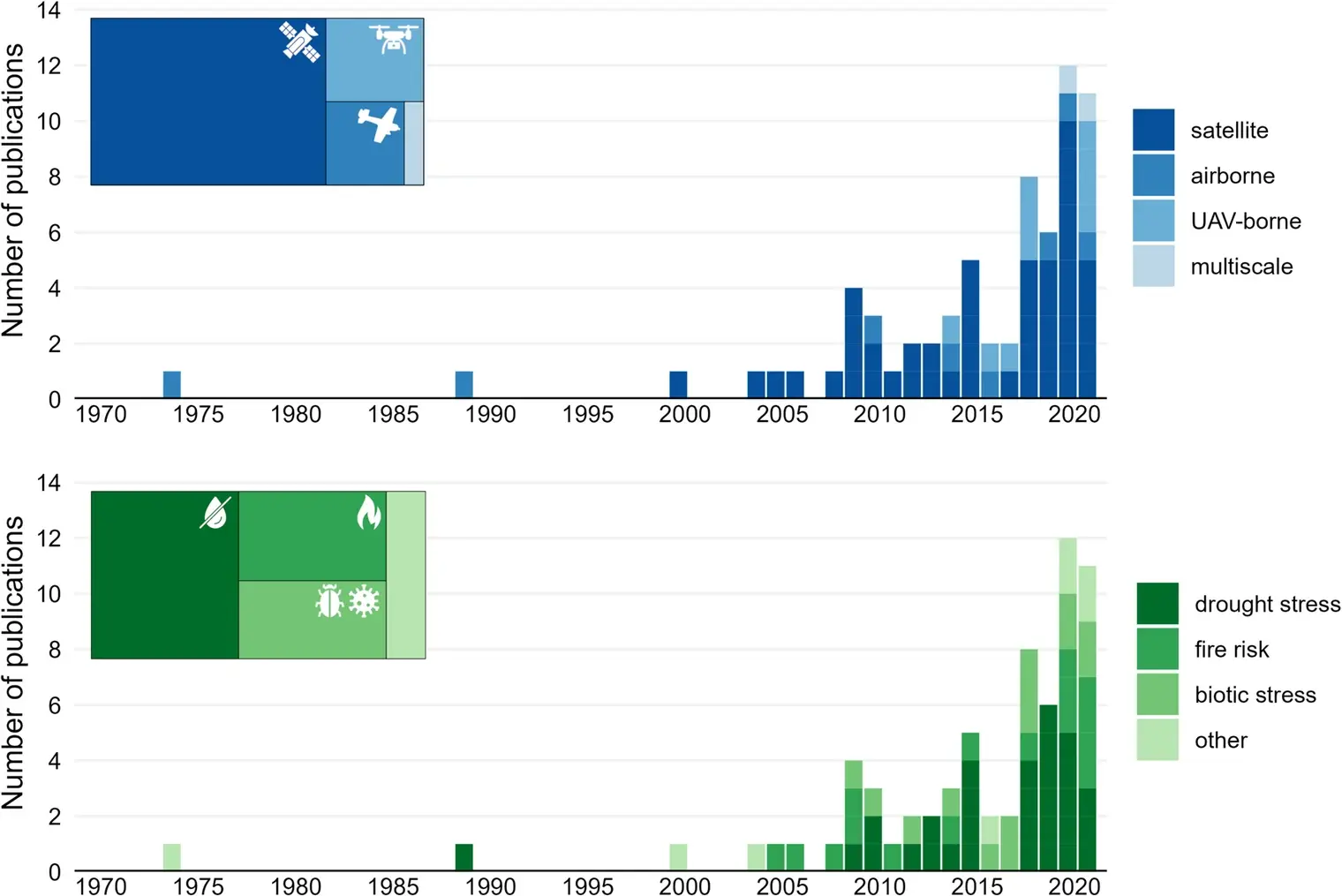
Рис. 1. Число публикаций по ТИК-дистанционному зондированию (до конца 2022 г.), посвящённых выявлению и оценке стрессовых реакций в лесах, с разбивкой по платформам съёмки (вверху) и тематике (внизу). Число публикаций определено по результатам систематического поиска литературы в Web of Science и Scopus. Краткое описание поиска и критерии исключения приведены в дополнительных материалах. Категория «многомасштабные» включает исследования, в которых использовались данные нескольких платформ, а категория «прочие» — обзорные публикации и работы, не отнесённые к другим категориям. При оценке пожарной опасности исключались публикации, в которых температура поверхности использовалась как переменная среды, а не как показатель состояния леса.
Физиологические реакции на начало стресса
Физические и физиологические аспекты терморегуляции
Растения непрерывно обмениваются теплом с окружающей средой. В зависимости от состояния теплового равновесия растения терморегуляция может сопровождаться поглощением или выделением энергии [23]. Основным источником тепловой энергии для растений считается поступающая солнечная радиация. В тепловом инфракрасном диапазоне она нагревает растение, а в отдельных диапазонах видимого спектра поглощается листьями в процессе фотосинтеза [24]. При последующем расщеплении продуктов фотосинтеза в ходе клеточного дыхания тепло выделяется в самих тканях растения [25]. Тепло также образуется в листьях при преобразовании избытка световой энергии в тепловую с участием определённых каротиноидов. Это обеспечивает фотозащиту за счёт нефотохимического тушения [26]. Перенос тепловой энергии между растением и окружающей средой также происходит при обмене длинноволновым излучением с соседними поверхностями [27]. Эти процессы происходят постоянно, однако их влияние на температуру растения маскируется переносом тепла за счёт транспирации и конвекции [27, 28]. Существенное влияние на температуру растения оказывает транспирация, интенсивность которой зависит от раскрытия устьиц в ответ на воздействия среды и факторы стресса (рис. 2а) [23]. Открытие устьиц для поглощения и выделения CO₂ и O₂ при фотосинтезе и дыхании также приводит к испарению воды из листа [29, 30].
При открытии устьиц молекулы воды вблизи устьичной щели поглощают энергию прилегающих тканей. Эта энергия расходуется на фазовый переход при транспирации, а водяной пар преодолевает сопротивление пограничного слоя листа и выходит наружу, вызывая быстрое охлаждение листа [27, 30]. Пограничный слой листа представляет собой тонкий слой малоподвижного воздуха у его поверхности. Он влияет на скорость обмена газами и энергией между листом и окружающим воздухом. Чем толще слой, тем слабее перенос тепла, CO₂ и водяного пара [31]. Поскольку толщина пограничного слоя обычно увеличивается с размером листа, тепло быстрее отводится от мелких листьев, равновесная температура которых ближе к температуре окружающего воздуха, чем у крупных листьев [32]. Это подтверждается существенными различиями теплообмена между широколиственными и хвойными деревьями [33]. Разность температур листа и воздуха у хвойных составляла 0,3–2,8 °C, у широколиственных — 4,5–4,8 °C [33]. Солнечное излучение, скорость ветра, влажность, температура воздуха и дыхание обусловливают динамические различия в интенсивности транспирационного охлаждения по кроне (рис. 2б). Например, открытые прямому солнечному излучению листья верхней части полога обычно подвергаются воздействию более высоких температур и охлаждаются транспирацией интенсивнее, чем частично затенённые листья нижней части кроны [34, 35]. Эти различия зависят и от структуры полога, которая влияет на аэродинамику и, следовательно, на конвективный теплообмен [36].
Конвективный теплообмен происходит пассивно. Воздух, непосредственно соприкасающийся с поверхностью растения, переносит тепло между растением и атмосферой, обеспечивая тепловое равновесие (рис. 2д). В этом процессе листья играют более значительную роль, чем ствол и одревесневшие ветви. Это объясняется теплоизолирующими свойствами древесины и коры, а также сформировавшейся в ходе эволюции цилиндрической формой ствола, при которой отношение площади поверхности теплообмена к объёму минимально [37]. Такие особенности строения полога, как плотность листвы, характер ветвления и вертикальное распределение листьев, играют важную роль в регуляции температуры за счёт конвективного теплообмена (рис. 2д) [33]. Исследования разных видов деревьев показали, что кроны с высокой плотностью листвы медленно рассеивают тепло и выглядят тёплыми на тепловых снимках, тогда как температура деревьев с относительно разреженными кронами обычно равна температуре воздуха или ниже неё [33, 38]. Эту закономерность конвективного теплообмена можно распространить на полог насаждения в целом.
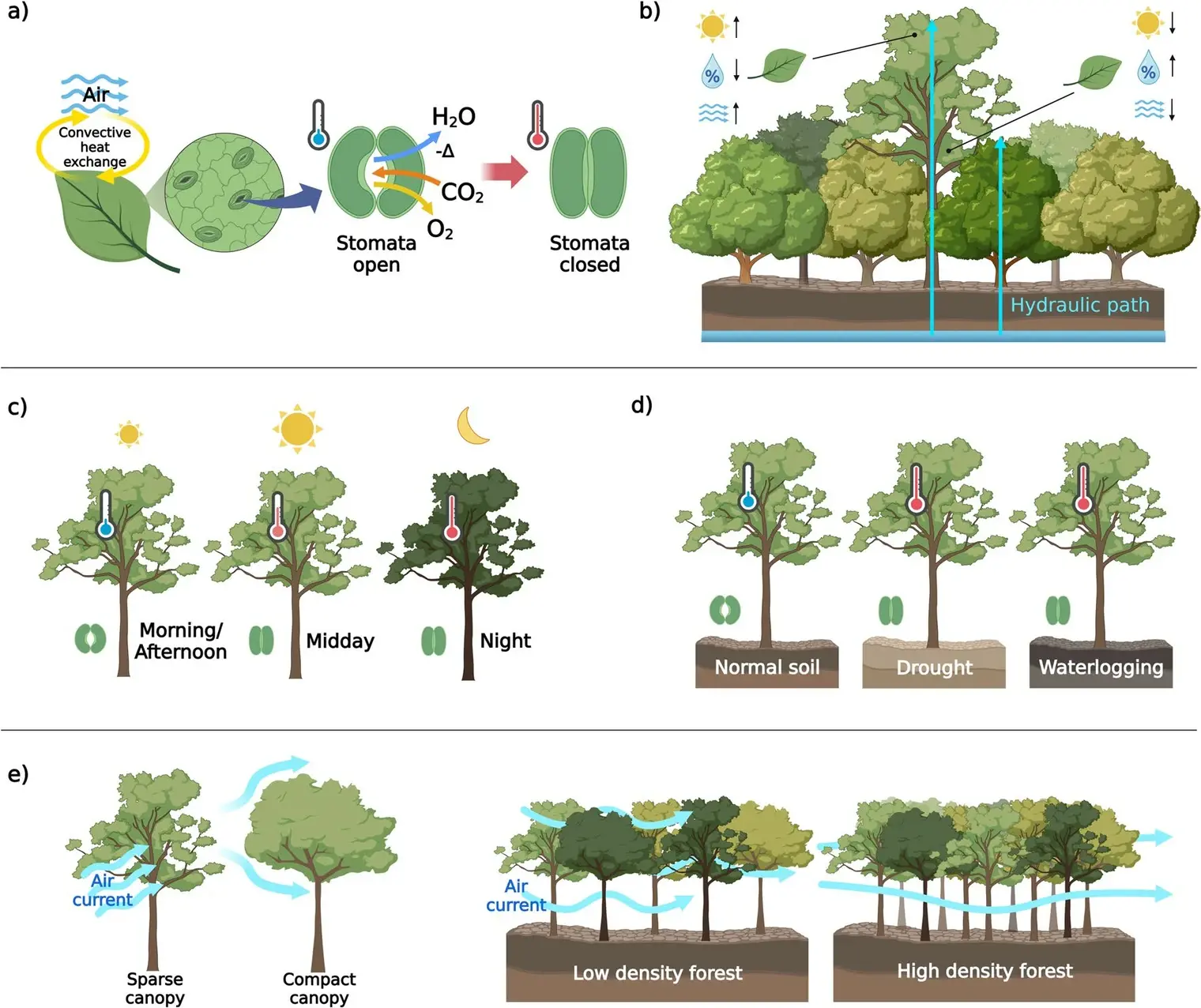
Рис. 2. Схема терморегуляции растений. а — листья обеспечивают большую площадь конвективного теплообмена и активно регулируют температуру растения, изменяя транспирацию в ответ на внешние воздействия. б — интенсивность транспирации варьирует внутри полога и между пологами в зависимости от степени воздействия факторов среды (солнечной радиации, влажности и температуры воздуха), например между листьями верхней и нижней частей полога и между деревьями, возвышающимися над пологом, и их соседями. в — в нормальных условиях устьица открываются под действием солнечного света. При высокой интенсивности излучения устьица обычно закрываются, что предотвращает фотоокислительный стресс при фотосинтезе и ослабляет транспирационное охлаждение. г — начало стресса обычно вызывает закрытие устьиц. При засухе это обусловлено снижением гидравлической проводимости, а при затоплении представляет собой системную реакцию на аноксию корней. д — строение полога и характеристики леса также влияют на температуру полога, поскольку напрямую определяют аэродинамику и тем самым влияют на регуляцию температуры посредством конвективного теплообмена.
В сомкнутом пологе из-за частичного затенения соседними деревьями меньшая часть кроны подвергается воздействию прямого солнечного излучения и движения воздуха. В более разреженном пологе выше турбулентность ветра, что может усилить транспирацию листьев и повысить способность рассеивать тепло. Степень влияния этих факторов на температуру полога сильно зависит от доступности воды и от воздействия ближайшего окружения на микроклимат, например на опушке и в сплошном лесном пологе.
Обеспеченность водой — один из основных факторов, определяющих температуру растения. Она напрямую влияет на движение устьиц, регулирующих транспирацию по принципу рефлекса удержания воды. Снижение тургорного давления при недостатке влаги приводит к уменьшению объёма замыкающих клеток и сужению устьичной щели, в результате чего транспирационное охлаждение ослабевает [39]. Низкая относительная влажность, высокий дефицит давления водяного пара и ветер усиливают потери воды при испарении, способствуя закрытию устьиц [39–42]. Очень высокая относительная влажность может ослаблять транспирационное охлаждение, непосредственно препятствуя испарению. Абсцизовая кислота (АБК) — фитогормон, участвующий в различных реакциях на стресс. Она играет важную роль в закрытии устьиц в ответ на внешние воздействия, вызывая осмотический отток воды из замыкающих клеток и тем самым регулируя её потери [43, 44]. При использовании термографии следует учитывать, что терморегуляция посредством транспирации в ответ на эти изменения среды может существенно различаться в зависимости от чувствительности устьичной проводимости у разных видов.
Например, изогидрические виды экономно расходуют воду, тогда как анизогидрические виды допускают снижение водного потенциала листа до очень низких значений. Поэтому устьичные реакции у изогидрических растений протекают быстрее, чем у анизогидрических [45]. На уровне полога различия в реакциях отдельных деревьев обусловлены неодинаковой длиной гидравлического пути — расстояния, на которое вода перемещается от корней к отдельным листьям (рис. 2б). Чувствительность к дефициту воды повышается с увеличением длины гидравлического пути. Поэтому у крупных деревьев выше риск образования эмболий и гибели [46–48]. Кроме того, у деревьев, возвышающихся над пологом, большая часть кроны подвергается воздействию ветра и более интенсивной радиации, чем у соседних деревьев, расположенных ниже (рис. 2б). Поэтому температура их листьев ближе к критической, что дополнительно повышает их чувствительность к засухе и волнам жары [46–48].
Терморегуляция в ответ на циклические изменения условий среды и стресс
Температура полога существенно изменяется в течение суток и по сезонам, отражая колебания условий среды (рис. 2в, г) [49–51]. В лесах она тесно связана с температурой воздуха и следует сходным суточным и сезонным закономерностям [52]. У низкорослой растительности, например сельскохозяйственных культур, колебания выражены сильнее, а температура часто существенно отличается от температуры окружающего воздуха. Помимо этих закономерных изменений среды, терморегуляция растений происходит и в ответ на различные абиотические и биотические стрессы [23, 53, 54]. В целом такие реакции регулируются сетью сигнальных процессов, опосредованных различными генами и регуляторами роста растений [43, 44]. В нормальных условиях устьица открываются под действием солнечного света, обеспечивая газообмен при фотосинтезе и транспирацию, а ночью закрываются [55, 56]. Поэтому на тепловых снимках здоровый фотосинтезирующий полог обычно выглядит более холодным, чем полог в состоянии стресса, благодаря сохранению транспирационного охлаждения [39, 57]. Однако при высокой освещённости, которая в естественных условиях наблюдается около солнечного полудня, устьица закрываются, предотвращая фотоокислительный стресс при фотосинтезе. Это вызывает «полуденную депрессию» фотосинтеза и устьичного газообмена [52, 58]. Сопутствующее ослабление транспирационного охлаждения в сочетании с избыточным поступлением лучистого тепла может существенно изменить температуру полога.
Подобно свету, температура окружающего воздуха влияет на тепловую сигнатуру полога через регуляцию раскрытия устьиц. Тёплая погода способствует открытию устьиц и усилению транспирации, которая смягчает тепловой стресс [59]. Однако чрезмерная потеря влаги из почвы вследствие испарения при очень высокой температуре воздуха может косвенно привести к закрытию устьиц посредством передачи сигнала с участием АБК на большие расстояния. Такой сигнал возникает при осмотическом стрессе в корнях [60]. Это явление часто наблюдается в пологе, испытывающем стресс вследствие засухи, и проявляется резким повышением температуры [23, 38, 39]. Затопление корней также вызывает закрытие устьиц посредством передачи сигналов стресса в ответ на аноксию корней [53, 61]. Хотя летом такое снижение устьичной проводимости и, соответственно, транспирации неблагоприятно, установлено, что зимой оно помогает травянистым растениям сохранять тепло и влагу [60, 62]. Влияние различной интенсивности стресса и механизмов адаптации к нему на распределение температуры у вечнозелёных видов в зимний период остаётся неизученным.
Удержание влаги и тепла при закрытии устьиц, как правило, сопровождается снижением фотосинтетической активности, и наоборот. Поскольку старение листьев вследствие сезонных изменений или стресса предполагает длительную передачу сигналов с участием АБК, вызывающую закрытие устьиц и приостановку фотосинтеза [43], этот процесс можно надёжно отслеживать по изменению температуры листьев, которое проявляется раньше других симптомов. У сельскохозяйственных культур также установлено, что биотический стресс вследствие заболеваний и повреждения растительноядными организмами повышает температуру растений, вызывая закрытие устьиц [23, 63]. При воздействии различных биотических стрессоров неоднократно отмечалось повышение уровня салициловой кислоты — эндогенного регулятора роста и защитного соединения, способствующего закрытию устьиц [64]. В зависимости от характера и выраженности стресса температурные колебания могут проявляться локально на уровне листа или охватывать весь полог. Повреждение корней, вызванное вирусами, грибными или бактериальными патогенами и корневыми нематодами, способно вызвать системные симптомы вследствие дефицита воды и массового закрытия устьиц. Это может привести к тепловой реакции всего полога. При болезнях листьев, повреждении растительноядными организмами или механическом повреждении температурные изменения могут быть более локальными в зависимости от масштаба повреждений. Такие реакции хорошо документированы у сельскохозяйственных культур, однако у лесных видов они изучены мало. Положительные результаты, полученные для ряда плодовых деревьев, указывают на возможность использования тепловой съёмки для выявления биотического стресса у лесных видов [63].
Развитие и тенденции ТИК-дистанционного зондирования стрессовых реакций в лесных экосистемах
Основные принципы и технологии ТИК-дистанционного зондирования
ТИК-датчики главным образом измеряют энергетическую яркость теплового излучения земной поверхности, с которой взаимодействует падающая солнечная радиация. Получаемые снимки обычно имеют более низкое пространственное разрешение, чем оптические снимки, поскольку до датчика доходит меньше энергии по сравнению с количеством излучения, отражённого на более коротких длинах волн. Например, пространственное разрешение оптических данных MODIS составляет 250 или 500 м, а ТИК-данных — 1000 м. Аналогично, пространственное разрешение оптических снимков Landsat 9 составляет 30 м, а ТИК-снимков — 100 м (табл. 1). Совершенствование спутниковых технологий и конструкции датчиков позволило существенно повысить детализацию. Некоторые миссии уже обеспечивают сбор данных с пространственным разрешением 60 м (табл. 1). Планируемый на 2028 г. запуск миссии Sentinel LSTM позволит повысить разрешение до 50 м при повторной съёмке каждые 1–3 дня.
Измеренную ТИК-датчиками энергетическую яркость можно преобразовать в температуру земной поверхности (LST), учитывая влияние атмосферы на сигнал и излучательные свойства наблюдаемой поверхности. Коэффициент излучения характеризует долю энергии, которую данная поверхность излучает по сравнению с абсолютно чёрным телом — идеализированным излучателем, поглощающим всю падающую энергию и затем испускающим её в виде теплового излучения. Коэффициент излучения реальных материалов зависит от длины волны, типа поверхности и её свойств. Даже у листьев обнаруживаются заметные различия спектров коэффициента излучения между видами [78, 79] и стадиями развития [80]. По данным Richardson и соавт. [80], по мере созревания листьев и связанного с ним развития и утолщения кутикулы у ряда листопадных видов деревьев коэффициент излучения в диапазоне 8–14 мкм уменьшался приблизительно с 0,99 до 0,95. Несмотря на эти различия, при определении температуры растений по широкополосным тепловым снимкам обычно используют типовые табличные значения коэффициента излучения (0,95–0,99 для листьев и 0,98–0,99 для полога). Это обусловлено главным образом нехваткой специализированных ТИК-спектральных библиотек, которую восполняет миссия ECOSTRESS, собирающая спектры растительности и нефотосинтезирующей растительности [81].
При наличии нескольких тепловых каналов и температуру земной поверхности, и коэффициент излучения можно восстановить методами разделения температуры и излучательной способности (TES). Эффективность таких методов зависит от числа доступных тепловых каналов и точности устранения атмосферных искажений сигнала [82–85]. При проектировании тепловых датчиков особое значение имеет отношение сигнал/шум. Количество энергии, излучаемой в ТИК-диапазоне, намного меньше количества энергии, отражаемой на более коротких длинах волн, что существенно ограничивает достижимое пространственное разрешение. Кроме того, с увеличением расстояния от датчика до поверхности сигнал может постепенно ослабевать. Специфические особенности спектра коэффициента излучения при этом становятся менее выраженными или полностью исчезают [86]. Отчасти по этой причине гиперспектральное ТИК-зондирование пока ограничено лабораторными, наземными и отдельными авиационными измерениями, например [79, 86, 87].
Высококлассные тепловые датчики обычно оснащают квантовыми детекторами с коротким временем отклика и очень высокой чувствительностью. Им нужна внешняя система охлаждения, которая увеличивает габариты и стоимость и существенно ограничивает применение авиационными и спутниковыми миссиями. Появление неохлаждаемых тепловых детекторов позволило значительно уменьшить камеры и сделать их достаточно лёгкими для установки на БПЛА. Однако отсутствие охлаждения приводит к более медленному отклику и меньшему отношению сигнал/шум, а также повышает чувствительность к изменениям условий среды, на что указывает ряд исследований [88–90]. Обнаружение стресса, таким образом, зависит и от физиологических реакций растений, и от выбора датчика. Требуется компромисс между тепловой чувствительностью и пространственным, спектральным и временным разрешением.
Региональный мониторинг жизненного состояния лесов
До настоящего времени тепловые реакции на стрессоры исследовались главным образом на региональном уровне из-за пространственного разрешения, типичного для спутниковых и авиационных датчиков. Систематический поиск литературы (подробности в дополнительных материалах) показал, что спутниковые тепловые показатели использовались преимущественно для изучения стрессов, связанных с пожарами (рис. 3), что отмечали и Johnston и др. [91]. В большинстве исследований использовали температуру земной поверхности (LST), обычно полученную по данным спектрорадиометра среднего разрешения MODIS [92, 93] или радиометра высокого разрешения NOAA-AVHRR Национального управления океанических и атмосферных исследований США [94]. Эти данные оказались ценными для картографирования участков лесных пожаров и их раннего прогнозирования по сухости лесов либо признакам засушливого стресса [94–96]. Как и при мониторинге пожаров, где потеря листвы повышает температуру полога, LST также применяли для картографирования дефолиации при вспышках численности насекомых [68, 97, 98]. Abdullah и др. [97] обнаружили, что повышение температуры полога чувствительнее стандартных вегетационных индексов к слабовыраженным изменениям, обусловленным дефолиацией при поражении короедом.
Во многих спутниковых исследованиях тепловые данные использовали для оценки охвата и тяжести засухи в лесах. Основное внимание уделялось анализу временных рядов LST непосредственно или с помощью индекса температурных условий (TCI), нормирующего LST относительно её исторических минимума и максимума. Во многих случаях анализировали большие территории и сравнивали реакции разных типов земного покрова и укрупнённых типов леса (листопадного и вечнозелёного, широколиственного и хвойного) на начало засухи [100–102]. Для Амазонии часто оценивали последствия известных климатических экстремумов, таких как Эль-Ниньо [103, 104]. Немногие исследования проводились в умеренном климате, где LST оказалась полезным предиктором засухи [105] или водного состояния [106] ряда древесных видов. Mildrexler и др. [105] использовали её совместно с водным балансом для оценки уязвимости разных типов леса в штатах Орегон и Вашингтон (США).
Таблица 1. Действующие и планируемые (разрабатываемые или предложенные) спутниковые миссии с длинноволновыми тепловыми ИК-каналами для наблюдения суши, а также авиационные датчики и датчики БПЛА, использованные в исследованиях по выявлению стресса в лесах. Перечень авиационных и беспилотных систем иллюстрирует возможности съёмки и не охватывает все доступные решения.
| Ведомство / производитель | Прибор | Платформа | Каналы | Диапазон | Пространственное разрешение |
|---|---|---|---|---|---|
| Действующие спутниковые миссии | Действующие спутниковые миссии | Действующие спутниковые миссии | Действующие спутниковые миссии | Действующие спутниковые миссии | Действующие спутниковые миссии |
| NOAA | ABI | GOES-16/17/18 | 7 | 7,24–13,6 мкм | 2000 м |
| NOAA, NASA | VIIRS | JPSS-1, JPSS-2 | 4 | 8,55–12,01 мкм | 750 м |
| EUMETSAT, NOAA | AVHRR3 | NOAA-19/B/C | 2 | 10,3–12,5 мкм | 1100 м |
| METI, NASA | ASTER | Terra | 5 | 8,12–11,65 мкм | 90 м |
| USGS, NASA | ETM+ | Landsat 7 | 1 | 10,4–12,5 мкм | 60 м |
| USGS, NASA | TIRS | Landsat 8 | 2 | 10,5–12 мкм | 100 м |
| USGS, NASA | TIRS-2 | Landsat 9 | 2 | 10,5–12 мкм | 100 м |
| NASA | MODIS | Terra, Aqua | 8 | 8,4–14,38 мкм | 1000 м |
| NASA | PHyTIR | ECOSTRESS | 1 | 8–12,5 мкм | 60 м |
| ESA, COM | SLSTR | Sentinel-3A/3B | 2 | 10,85–12 мкм | 1000 м |
| ESA, NSO | HyperScout-2 | PhiSat-1 | 4 | 8–14 мкм | 390 м |
| JMA | AHI | Himawari-8/9 | 7 | 7,3–13,28 мкм | 2000 м |
| JAXA | CIRC | ALOS-2 | 1 | 8–12 мкм | 210 м |
| JAXA | SGLI | GCOM-C | 1 | 10,8–12 мкм | 1000 м |
| CAST | IRMSS-2 (HJ-2) | HJ-2A/2B | 1 | 10,5–12,5 мкм | 300 м |
| Роскосмос | МСУ-ИК-СР | Канопус-В-ИК № 2 | 1 | 8,4–9,4 мкм | 200 м |
| Росгидромет, Роскосмос | МСУ-МР | Метеор-М № 2-2 | 2 | 10,5–12,5 мкм | 1000 м |
| Планируемые спутниковые миссии | Планируемые спутниковые миссии | Планируемые спутниковые миссии | Планируемые спутниковые миссии | Планируемые спутниковые миссии | Планируемые спутниковые миссии |
| COM | LSTR | Sentinel LSTM-A/B | 5 | 8,42–12,47 мкм | 50 м |
| USGS, NASA | LandIS | Landsat-Next | 5 | 8,3–12 мкм | 60 м |
| NASA, ASI | SBG TIR Instrument | SBG-TIR | 8 | Уточняется | Уточняется |
| CSA, NRCAN, ECCC | CWFMS | WildFireSat | 1 | 10,4–12,3 мкм | 400 м |
| Росгидромет | Усовершенствованный МСУ-МР | Метеор-МП № 1/2/3 | 2 | 10,5–12,5 мкм | 1000 м |
| Роскосмос | БИК-СД 1 | Ресурс-ПМ № 1/2/3 | 5 | 8,1–12,5 мкм | 20 м |
| Датчики пилотируемых воздушных судов | Датчики пилотируемых воздушных судов | Датчики пилотируемых воздушных судов | Датчики пилотируемых воздушных судов | Датчики пилотируемых воздушных судов | Датчики пилотируемых воздушных судов |
| SPECIM | AisaOWL | Dornier 228 [65] | 96 | 7,7–12,3 мкм | 2 м на высоте 1300 м |
| NASA | MASTER | Самолёт не указан [66] | 25 | 3,1–12,9 мкм | 35 м |
| Space Instruments | FireMapper™ 2.0 | King Air A100 [67] | 1 | 8–12,5 мкм | 2,2 м на высоте 1160 м |
| Optech | CM-LW640 | Самолёт не указан [68] | 1 | 8–14 мкм | 1 м на высоте 2000 м |
| InfraTec GmbH | ImageIR 9400 | Vulcanair P-68 Observer 2 [69] | 1 | 3,6–4,9 мкм | 1 м на высоте 1270 м |
| InfraTec GmbH | VarioCam | Вертолёт не указан [38] | 1 | 7,5–14 мкм | 0,2 м на высоте 130 м |
| FLIR | SC655 | Самолёт Cessna [70] | 1 | 7,5–14 мкм | 0,6 м на высоте 350 м |
| Датчики БПЛА | Датчики БПЛА | Датчики БПЛА | Датчики БПЛА | Датчики БПЛА | Датчики БПЛА |
| FLIR | TAU 2 | RotorKonzept RK-8x [71], Mikrokopter OktoXL [72] | 1 | 7,5–13 мкм | 0,15 м на высоте 120 м |
| FLIR | SC305 | Aerialtronics Altura AT8 [73], VulcanUAV [73] | 1 | 7,5–13 мкм | 0,17 м на высоте 90 м |
| Optris | PI450 | QuestUAV Qpod [74], DJI Phantom 4 [75] | 1 | 7,5–13 мкм | 0,15 м на высоте 60 м |
| DJI | M2ED | DJI Mavic 2 [76] | 1 | 8–14 мкм | 0,03 м на высоте 60 м |
| senseFly | thermoMAP | Sensefly eBee [77] | 1 | 7,5–13 мкм | 0,25 м на высоте 90 м |
Хотя спутниковые тепловые показатели широко используются и доказали ценность для мониторинга засухи, их связь с физиологией деревьев, например радиальным приростом, изучена недостаточно. В нескольких работах спутниковые вегетационные индексы, включая NDVI, позволяли выявлять физическое повреждение деревьев, однако менее выраженный стресс, например при засухе, было трудно заметить до изменения окраски листьев, в частности вследствие волны жары [107, 108]. При авиационной съёмке тепловые реакции на засуху до сих пор исследовали главным образом путём сопоставлений. Pierce и др. [109] установили, что большие различия в относительном содержании воды в листьях отчётливо видны на тепловых изображениях хвойных участков, тогда как меньшие различия в этом масштабе неразличимы. Scherrer и др. [38] также отметили расхождение температуры полога на сухих и влажных участках в начале засухи. Реакция различалась между видами, но её не удалось объяснить измеренными различиями сокодвижения. Развитие датчиков с более высоким пространственным, временным и спектральным разрешением открывает возможности проводить такие исследования по спутниковым тепловым индексам и связывать их с полевыми наблюдениями, чтобы изучать видоспецифические реакции, выявлять засуху и оценивать её влияние на рост деревьев.
Локальные исследования методом термографии с БПЛА
БПЛА с миниатюрными датчиками отличаются гибкостью применения и позволяют снимать с высокой пространственной детализацией (табл. 1), вплоть до измерений отдельных господствующих деревьев. Всё больше работ показывают потенциал датчиков БПЛА для обследования растительности: извлечение структурных параметров [110, 111], классификацию видов [112, 113], мониторинг состояния [114, 115], отслеживание фенологии [116, 117] и картографирование ресурсов цветущих растений [118, 119]. Термография с БПЛА активно изучается для точного земледелия, раннего выявления стресса и планирования полива. В ряде работ показана связь температуры полога с интенсивностью стресса как у травянистых культур [22, 120, 121], так и у плодовых деревьев [18–21]. В лесном хозяйстве применение пока ограничено: выявлено лишь восемь публикаций, в которых тепловые камеры БПЛА использовали для изучения стрессовых реакций в лесу (рис. 4) [71–75, 77, 122, 123]. Обычно авторы сравнивали относительные температуры и обнаруживали более высокую температуру крон у деревьев с более сильным стрессом.
Рассматривался широкий спектр стрессоров с преобладанием биотических факторов над дефицитом воды (рис. 4). Такое разнообразие связано с возможностью исследовать тепловые реакции отдельных деревьев. Ранее это было невозможно по спутниковым снимкам из-за их разрешения, дорого для пилотируемой авиационной съёмки или сложно организационно при наземных измерениях с близкого расстояния. Интересу способствовали предыдущие авиационные исследования дефолиации при вспышках численности насекомых и болезней, в которых повышение температуры полога оказалось полезным показателем [69, 70].
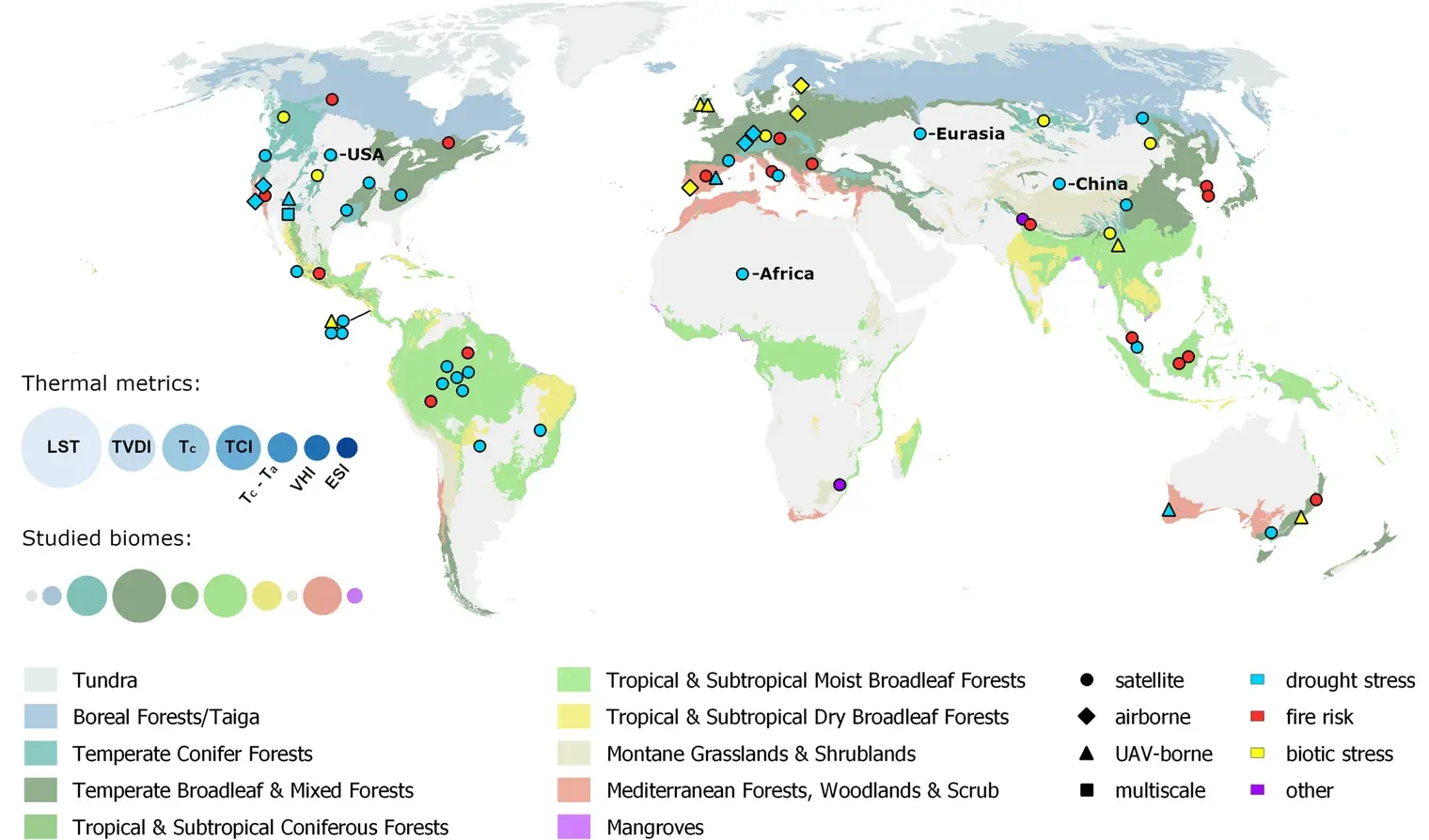
Рис. 3. Расположение участков исследований, включённых в обзор (n = 62). Условным знаком обозначена платформа съёмки, цветом — исследуемый фактор стресса. Участки нанесены на карту изученных биомов. Если в публикации использовано несколько удалённых друг от друга участков, каждый из них отмечен отдельно. Пузырьковые диаграммы показывают относительную частоту использования каждого теплового показателя и изучения каждого биома. Для упрощения в категорию TVDI включены также другие индексы, объединяющие LST и NDVI для определения границ, соответствующих отсутствию водного стресса и отсутствию транспирации (верхняя граница). LST — температура земной поверхности, TVDI — температурно-вегетационный индекс засушливости, Tс — температура полога, Tа — температура воздуха, TCI — индекс температурных условий, VHI — индекс состояния растительности, ESI — индекс стресса по испарению. Границы биомов приведены по Dinerstein и соавт. [99].
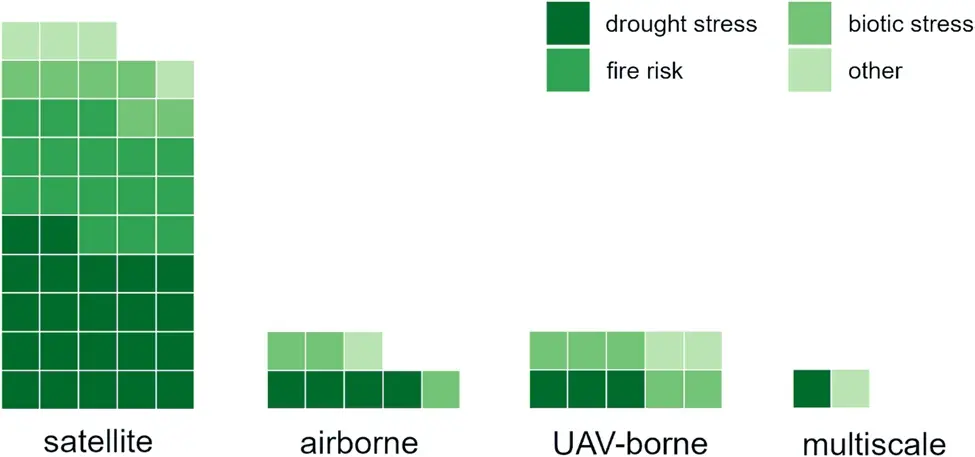
Рис. 4. Количество публикаций по тепловому дистанционному зондированию, посвящённых выявлению и оценке стрессовых реакций в лесах, с разбивкой по тематике для каждой платформы съёмки. Каждый квадрат соответствует одной публикации. Категории и критерии поиска литературы подробнее описаны в подписи к рис. 1 и дополнительных материалах.
Взаимодействия растений и паразитов стали предметом интереса благодаря возможности визуально разделять отдельные кроны на снимках высокого разрешения. Yuan и др. [71] обнаружили, что заселение лианами существенно повышало температуру полога, но абсолютное различие было небольшим — около 0,5 °C. Maes и др. [73] наблюдали повышение температуры крон эвкалиптов при поражении омелой. Различия были значимы лишь при максимальной солнечной радиации. Smigaj и др. [75] также показали, что различия температур крон сосны обыкновенной при разной степени поражения краснополосой пятнистостью хвои были наиболее выражены при максимальном дефиците давления водяного пара. Погода, способствующая усиленной транспирации, подчёркивает эти различия: устьица растений в состоянии стресса закрываются, чтобы ограничить потери воды, и температура листьев и полога повышается. Поэтому при планировании и выполнении тепловой съёмки с БПЛА следует учитывать условия среды.
Помимо условий среды, на температуру полога влияют структура и густота насаждения, способные маскировать стрессовую реакцию. Wang и др. [123] обнаружили тесную связь между температурой полога и индексом листовой поверхности (LAI), полученным лидаром. LAI влиял на зависимость температуры от степени повреждения сосновым лубоедом. Sankey и Tatum [77] также установили влияние густоты соснового леса: на прореженных участках температура крон стабильно была значительно выше, хотя в сильную засуху непрореженные насаждения испытывали больший дефицит влаги и характеризовались более высокой смертностью. При многолетних измерениях это расхождение не подтвердилось: разность температур засушливого и незасушливого годов была значительно выше в непрореженных насаждениях (9,5 против 6,9 °C), что указывало на больший стресс относительно незасушливого фона. Различия между температурой полога и воздуха, связанные с густотой и высотой деревьев, отмечены и Javadian и др. [76]. При этом суточная динамика температуры полога была тесно связана с измеренным сокодвижением и засушливым стрессом.
Небольшое число работ даёт представление о потенциале термографии с БПЛА, но показывает, что температурные отличия крон трудно интерпретировать из-за множества мешающих факторов. Для применения термографии за пределами относительных сравнений необходимо разработать и проверить методы прямой интерпретации разновременных тепловых данных полога в локальном масштабе. Этому могут помочь тепловые камеры и ИК-радиометры над пологом на наблюдательных вышках, хотя в обзоре они подробно не рассматриваются. Такие датчики охватывают небольшую территорию, но непрерывно измеряют температуру листьев или полога и показывают её временную динамику. Это помогает интерпретировать данные БПЛА, отражающие лишь отдельные моменты. Для точного восстановления температуры полога необходимо учитывать состояние атмосферы, дистанцию измерения и угол наблюдения [50, 124]. Эти датчики уже использовали в лесах для характеристики суточной динамики температуры [125–127], изучения реакций на изменение влажности почвы [54, 127], межвидовых различий [33, 54, 127] и связи температуры полога с валовой первичной продуктивностью [128].
Открытые вопросы и возможности мониторинга стрессовых реакций лесных экосистем методом ТИК-дистанционного зондирования
Как отделить реакцию на стресс от влияния условий среды
В подавляющем большинстве рассмотренных публикаций для выявления стресса напрямую использовали температурные измерения (LST, температуру полога или TCI, рис. 3). При спутниковой съёмке часто анализировали данные за разные даты, чтобы выявить нетипичные для данного времени года отклонения, предположительно вызванные началом засухи или дефолиацией. При использовании одной съёмки, обычно авиационной или с БПЛА, относительно сравнивали насаждения или отдельные деревья с разной степенью стресса или дефолиации. Прямой подход подходит для сравнения температур полога, снятых почти в одинаковых условиях, но существенно ограничивает использование тепловой информации для мониторинга физиологического состояния во времени. Тесная связь температуры полога с условиями среды (см. раздел о физиологических реакциях) затрудняет выделение стрессовой реакции на фоне терморегуляции.
Разработаны разные подходы к нормализации температуры листьев и полога с учётом переменных условий. Так называемые индексы стресса обычно применяют в сельскохозяйственных исследованиях с БПЛА и при съёмке с близкого расстояния [3, 129, 130]. Наиболее распространены индекс водного стресса сельскохозяйственных культур (CWSI) и разность температур полога и воздуха (T꜀ − Tₐ). Для нормализации CWSI использует нижнюю границу для растений без водного стресса и верхнюю для нетранспирирующих растений и позволяет устойчиво учитывать изменения погоды [131, 132]. Методы расчёта требуют разного числа входных переменных и дают разную степень нормализации. Подробный обзор этих методов и их ограничений, главным образом в сельском хозяйстве, представлен Maes и Steppe [3] и Nanda и др. [129]. Разность температур T꜀ − Tₐ вычислить проще: кроме температуры полога нужна лишь температура воздуха. Пока это единственный тепловой индекс стресса, применённый при съёмке леса с БПЛА [75]. Он обеспечивает некоторую нормализацию, но тоже зависит от погоды, что затрудняет его интерпретацию [3].
В ряде спутниковых исследований для интерпретации тепловых реакций совместно использовали LST и NDVI. По аналогии с CWSI для нормализации можно использовать «сухой край», представляющий верхнюю границу при отсутствии транспирации, и «влажный край», соответствующий условиям без водного стресса. Чтобы определить эти границы и рассчитать температурно-вегетационный индекс сухости (TVDI) или сходные индексы, нужна достаточно обширная территория, представляющая весь диапазон влажности и растительного покрытия, от влажных до сухих поверхностей и от открытой почвы до сплошной растительности. Хотя TVDI успешно применяли для изучения засухи на разных типах покрова, его неопределённость растёт с NDVI, что несколько ограничивает пригодность для лесов. Возможный вариант — индекс стресса испарения (ESI), использованный Pascolini-Campbell и др. [133] и Yang и др. [134••] для изучения смертности лесов и доступный как продукт миссии ECOSTRESS. ESI выражает отношение между потенциальной и фактической эвапотранспирацией и рассчитывается с помощью модели баланса энергии поверхности Пенмана — Монтейта. Это усложняет расчёт и требует метеоданных, заметно ограничивая применимость в локальном масштабе, но даёт более полное представление о стрессовых реакциях.
Чтобы определить, как термография может дополнять действующие методы мониторинга состояния лесов, требуется разработка и проверка способов анализа тепловых данных, включая оценку применимости к разным видам деревьев и чувствительности в разных климатических условиях. До сих пор видоспецифические тепловые реакции на стресс изучались мало. Для устранения пробела необходимо напрямую связать тепловые индексы с полевыми наблюдениями физиологического состояния деревьев (например, сокодвижения, радиальных изменений размеров ствола или водного потенциала листьев) и влиянием внешних факторов (условий среды или различий в структуре). Это позволит непосредственно интерпретировать разновременную тепловую информацию о лесном пологе.
Моделирование тепловых свойств леса
Определение температуры поверхности по спутниковым или авиационным ТИК-данным в лесу осложняют многочисленные переменные, влияющие на тепловой отклик. К ним относятся взаимная геометрия Солнца и датчика, состояние атмосферы, густота леса, архитектура полога, температура и излучательная способность его компонентов, а при разомкнутом пологе также температура и излучательная способность почвы. Связь этих переменных с температурой можно изучать с помощью моделей переноса излучения (RTM), имитирующих распространение и рассеяние излучения и суммарный тепловой сигнал выбранного датчика. Пользователь задаёт структурные, оптические и тепловые свойства всех компонентов сцены, а также атмосферный профиль [135–137]. По представлению полога различают простые одномерные и более сложные трёхмерные модели. Одномерные модели представляют полог одним или несколькими горизонтальными слоями однородной рассеивающей среды над почвой, что ограничивает их пригодность для неоднородных участков с прерывистым пологом [138–141]. Трёхмерные модели работают с неоднородными объёмными сценами и лучше описывают лесной полог. Подробный обзор ТИК-моделей переноса излучения и их развития приведён в Cao и др. [138•].
Главное преимущество трёхмерных моделей — возможность учитывать структурную сложность. Кроны можно представить геометрическими телами (сфероидами, конусами или цилиндрами) либо детальными моделями с явно заданной архитектурой вплоть до листьев и мелких ветвей [136, 137] (рис. 5). Реалистичные сцены повышают точность расчётов, поскольку позволяют учитывать вертикальную и горизонтальную неоднородность структуры, биохимических и тепловых свойств полога [135, 139, 141]. При этом есть три ограничения. (i) Вычисления медленны и требуют значительных ресурсов [142, 143]. (ii) Для моделирования излучения нужно задать температуру каждого компонента. Модель сама не рассчитывает потоки явного и скрытого тепла. (iii) Температура листа не связана с биохимическими признаками [135, 138, 144]. Например, уменьшение содержания воды в листе при моделировании засухи само по себе не приводит к закрытию устьиц и нагреву листа. Для решения последней проблемы трёхмерную модель переноса излучения можно связать с моделью энергетического баланса системы «атмосфера — почва — полог», как показали Baldocchi и Meyers [144] и Bian и др. [139]. Такой подход пока не реализован в более полных моделях, явно описывающих архитектуру полога, например DART (дискретный анизотропный перенос излучения) [135, 145] и DIRSIG (генерация цифровых изображений и изображений ДЗЗ) [146]. Другой вариант — задать трёхмерное распределение температур в пологе по тепловым облакам точек с БПЛА. Для этого нужно решить проблему перекрытий, препятствующих оценке температуры нижних ярусов и подлеска. Близко расположенные датчики в нижних ярусах могли бы её ослабить.
Трёхмерные модели переноса излучения в ТИК перспективны для интерпретации тепловых реакций леса по данным низкого пространственного разрешения. Они позволяют моделировать LST на уровне отдельного дерева как функцию яркостной температуры и излучательной способности и выделять вклад каждого компонента сцены — листвы, древесины, ветвей, подлеска и почвы — в суммарную температуру пикселя конкретного датчика. Один и тот же лес можно смоделировать для нескольких датчиков на БПЛА, пилотируемых воздушных судах и спутниках, что позволяет сопоставлять данные в разных масштабах (рис. 5). Такие сопоставления тепловых реакций на стресс пока редки. Только Javadian и др. [76] использовали для этого разные платформы. Параметризация реалистичных трёхмерных моделей на территории, достаточной для имитации спутниковой съёмки, остаётся сложной из-за числа входных параметров и протяжённости моделируемой области. Для более точного и эффективного масштабирования нужно определить наиболее значимые параметры. Перспективным подходом представляется объединение расчётов с измерениями высокого пространственного разрешения с БПЛА и приборов ближней съёмки.
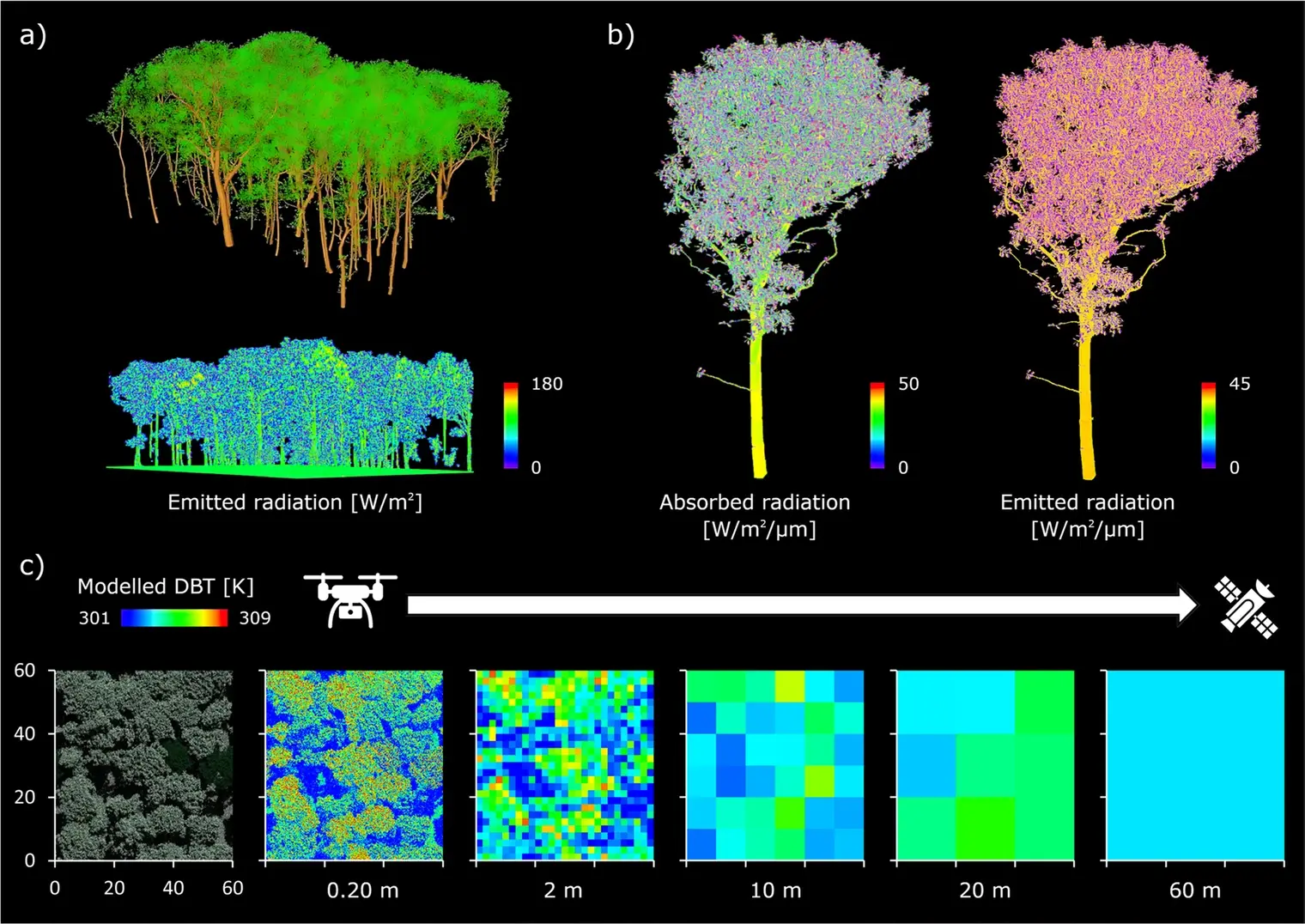
Рис. 5. а — сцена смешанного леса в модели DART, реконструированная по данным наземного лазерного сканирования насаждения в Уитам-Вудс (Великобритания). Сцена использована для моделирования направленной яркостной температуры (DBT). Трёхмерная модель леса получена из работы Calders и соавт. [136]. Рядом показан трёхмерный радиационный баланс с количеством ТИК-излучения, испускаемого каждым вокселем размером 0,2 м. б — отдельное дерево из исследуемого участка. Показано ТИК-излучение, поглощаемое и испускаемое отдельными листьями, ветвями, побегами и стволом. в — DBT, смоделированная для нескольких значений пространственного разрешения. Рядом с соответствующим RGB-изображением показана постепенная потеря пространственной детализации.
Трёхмерные тепловые облака точек и их ограничения
Съёмка с БПЛА позволяет получать тепловую информацию в трёх измерениях методом восстановления структуры по движению (SfM) и потенциально изучать температурные различия между ярусами полога. Эти данные могут быть полезны для задания распределения температуры в трёхмерных моделях переноса излучения. Однако обработка тепловых снимков леса методом SfM имеет особенности. Первоначально метод создавался для RGB-изображений с разных углов или ориентаций, на которых легко находить и сопоставлять характерные признаки. У тепловых изображений обычно более низкое пространственное разрешение — порядка нескольких дециметров. Температурные различия внутри полога часто невелики и сопоставимы с точностью камеры. Поэтому трудно найти на перекрывающихся снимках достаточно общих точек для точного восстановления положений камеры. Это затрудняет совмещение, снижает геометрическую точность или делает сшивку невозможной. При обработке одних тепловых снимков часто не удаётся получить плотное облако точек, необходимое для восстановления поверхности и построения тепловой ортомозаики. Во многих рассмотренных исследованиях с БПЛА авторы столкнулись с этим и анализировали отдельные кадры [71, 75, 77, 123].
Совмещение с RGB- или мультиспектральными данными более высокого разрешения помогает обработке тепловых снимков. В разных областях предложены несколько методов: одни требуют наземных опорных точек [147, 148], другие основаны на уточнении положений камер при постобработке [149] или совмещении облаков RGB и ТИК [150]. Эти методы либо трудоёмки, либо не решают исходных проблем совмещения в лесу. Один из вариантов — одновременно получать тепловые и совпадающие с ними высокодетальные RGB- или мультиспектральные данные, а затем совместно обрабатывать их фотограмметрически, развивая методику Ham и Golparvar-Fard [151]. На рис. 6 приведён пример с тепловизором FLIR Tau 2, установленным вместе с мультиспектральной камерой Airphen и синхронизированным с ней. Оба облака, RGB и ТИК, получены в программе SfM с изменённой последовательностью операций. Сначала восстанавливали надёжную геометрию: снимки всех мультиспектральных камер и тепловизора загружали и совмещали вместе методом SfM, затем строили плотное облако. Только после этого сигналы камер разделяли и калибровали, а точкам ранее построенного облака присваивали значения температуры (рис. 6). Такой подход позволяет преодолеть сложности совмещения тепловых снимков леса, отмеченные, например, Webster и др. [152], и даёт хорошую взаимную привязку мультиспектральных и тепловых продуктов SfM. Совмещение ТИК-данных вместе с RGB или мультиспектральными данными также исключает ряд операций из схемы Javadnejad и др. [153], в которой тепловые кадры добавляются на позднем этапе и не участвуют в непосредственном совмещении. Такая оптимизация обработки важна для эффективной термографии с БПЛА.
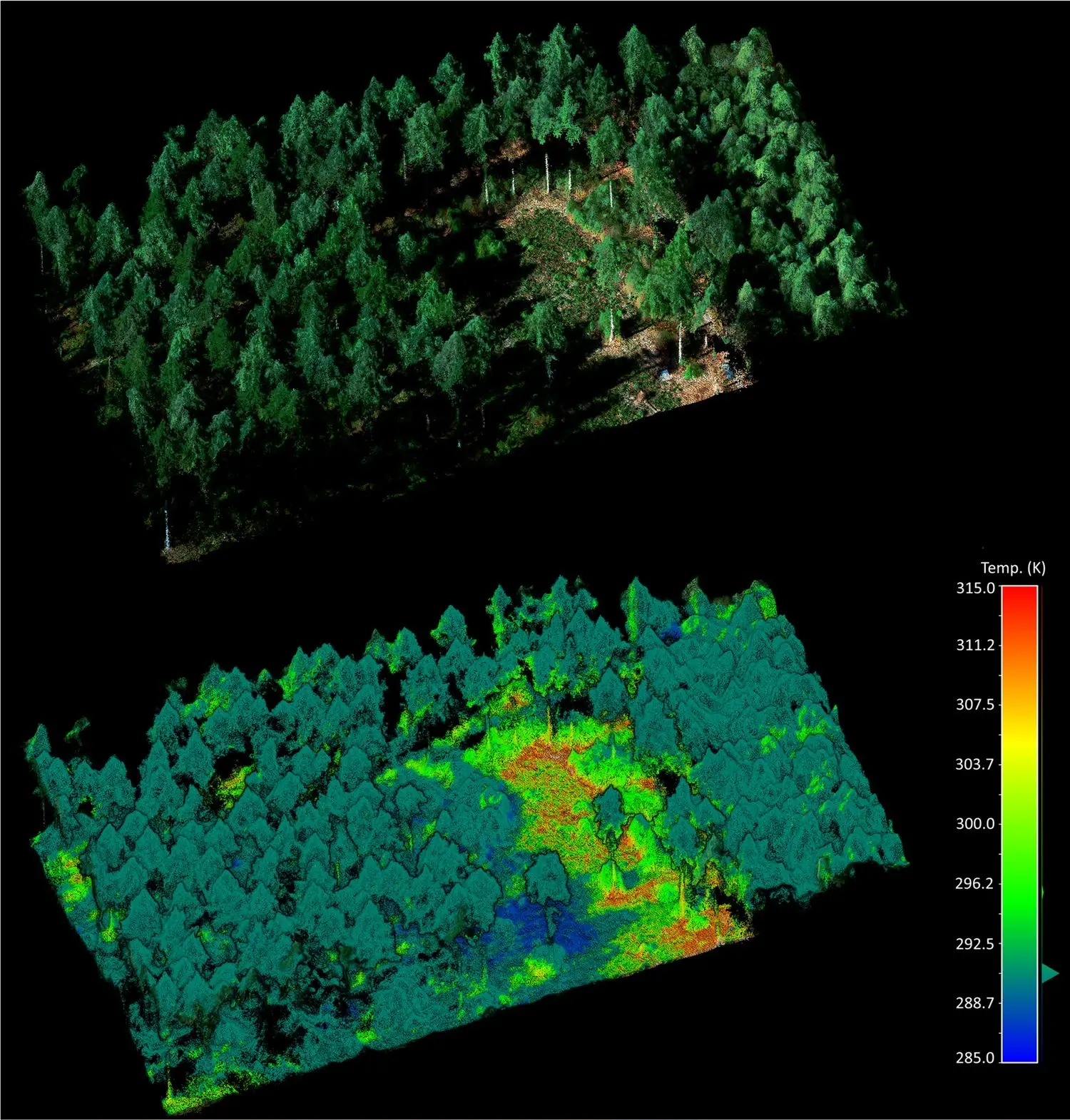
Рис. 6. Облака точек RGB и ТИК для насаждения псевдотсуги Мензиса в лесу Зволсе-Бос (Нидерланды). Цвет в ТИК-облаке точек соответствует температуре в кельвинах.
Качество тепловых снимков с БПЛА
Качество данных зависит от характеристик миниатюрных камер. Изготовители часто указывают точность в пределах 2 °C или 2 %, однако фактические отклонения могут быть гораздо больше, особенно при изменении внешних условий. Детектор поглощает ИК-излучение наблюдаемой поверхности. Количество выделяемого тепла изменяется, а с ним меняются электрические свойства детектора и значения пикселей. Поэтому на детекторы влияет и температура корпуса камеры, меняющаяся под действием окружающих условий. В частности, быстрый нагрев корпуса внешним источником существенно изменяет показания неохлаждаемых камер [89, 90, 154]. Чтобы улучшить стабильность, следует дать камере время адаптироваться к внешним условиям перед съёмкой и ограничивать нагрев солнцем во время съёмки, например экранированием. Важно также заранее включать камеру: во время прогрева наблюдается существенный тепловой дрейф. По данным прежних исследований, миниатюрные неохлаждаемые камеры стабилизируются за 30–60 мин [88–90, 147].
Даже при этих мерах возможен остаточный дрейф. Его может потребоваться учесть, чтобы наблюдаемые температурные различия крон отражали действительность. Например, можно сопоставить температуры одних и тех же участков на перекрывающихся кадрах [155]. Эта функция уже доступна в некоторых программах SfM. Альтернативой предложен внешний нагреваемый затвор на камере для калибровки непосредственно в полёте [156]. Условия в атмосфере и дальность измерения определяют ослабление теплового сигнала и влияют на зарегистрированные температуры. Наиболее значимы относительная влажность и температура атмосферы. Если необходимы абсолютные значения, например для анализа, выходящего за пределы сравнения относительных различий между кронами, требуется дополнительная коррекция по наземным измерениям. В сельскохозяйственных исследованиях используют ряд наземных эталонов, в идеале теплее и холоднее полога, и сопоставляют их температуру по наземным измерениям с показаниями камеры. Такой подход применяли Egea и др. [20], Messina и Modica [130] и Gómez-Candón и др. [157] с разной точностью. Требуется дальнейшая разработка надёжных процедур тепловой съёмки с БПЛА с учётом калибровки, неопределённости измерений и стабильности данных во времени.
Исследования спектральной излучательной способности
Термографию обычно используют для выявления ранних признаков стресса по температуре листьев и полога, однако тепловые данные содержат и другую потенциально полезную информацию. Спектральное изменение излучательной способности выявляет полосы поглощения, подобно спектрам в видимом и коротковолновом инфракрасном диапазонах (VIS–SWIR). Гиперспектральное ТИК-зондирование пока изучено преимущественно в геологии для картографирования минерального и литологического состава: многие минералы имеют сильные полосы поглощения и излучения в LWIR [158–161]. В науках о растениях этому уделялось мало внимания, главным образом из-за необходимости специализированных приборов для регистрации спектральных особенностей растений в ТИК.
Лабораторные исследования разных растений показали, что спектральная излучательная способность различается между видами и существенно зависит от состава поверхности листа, поскольку в ТИК излучение проникает в лист слабо [79, 86, 162, 163]. Первые исследования влияния стресса на спектральную излучательную способность листьев проведены лишь недавно и выявили видоспецифические реакции [164–166]. Их обычно связывают с биохимическими и структурными изменениями листа при стрессе. Например, Buitrago и др. [164] и Gerhards и др. [165] предположили, что наблюдавшееся повышение излучательной способности связано с утолщением кутикулы и эффектом полости: многократное рассеяние на поверхности снижает спектральный контраст и повышает излучательную способность [167]. Gerhards и др. [165] установили, что у картофеля этот показатель чувствительнее к началу засухи, чем вегетационные индексы VNIR и SWIR.
Чтобы оценить перспективность подхода, необходимо выяснить: (i) как разные стратегии приспособления к стрессу влияют на спектральную излучательную способность листьев у разных видов, (ii) какие эффекты вызывают разные биотические и абиотические стрессоры и (iii) какие уровни стресса различимы в ТИК-спектрах. Нужны также исследования полога, чтобы оценить различимость стрессовых реакций по его спектральной излучательной способности. Meerdink и др. [79] показали, что значительная доля исследованных древесных видов различалась по спектрам листьев. Однако по авиационным данным картографировать эти виды не удалось из-за существенного перекрытия спектральных откликов полога в ТИК. Ribeiro da Luz и Crowley [163] также обнаружили влияние геометрии и состава полога на излучательную способность и различимость видов. Для оценки потенциала спектральной излучательной способности необходимы улучшения поля зрения датчиков, отношения сигнал/шум и методов анализа, особенно тех, которые связывают ТИК-отклики листьев и полога.
Заключение и перспективы
Мониторинг температуры листьев и полога позволяет получить ценную информацию о физиологическом состоянии деревьев. Однако влияние факторов среды и структуры насаждений затрудняет непосредственную интерпретацию тепловых данных. Чтобы определить, как тепловое дистанционное зондирование может наиболее эффективно дополнить применяемые методы мониторинга состояния лесов, необходимо продолжить разработку и проверку методов анализа данных, в том числе оценить их применимость к разным видам деревьев и чувствительность в разных климатических условиях. Для этого потребуется установить прямые связи между тепловыми данными, физиологическим состоянием деревьев и воздействием внешних факторов, например различиями в условиях среды или структуре насаждений. В этой связи мы ожидаем, что термография с БПЛА будет играть всё более важную роль, позволяя анализировать отдельные деревья и получать тепловую информацию в трёх измерениях. Применение моделей переноса излучения может помочь решить некоторые проблемы, связанные с изменчивостью структурных признаков листьев и архитектуры полога, и позволит переносить оценки реакций на уровень лесного насаждения. Для такого переноса требуется дальнейшее развитие моделей.
Запуск новых спутниковых миссий, таких как Sentinel LSTM и Landsat Next, позволит получать данные высокого пространственного и временного разрешения и откроет новые возможности для детального мониторинга изменчивости температуры земной поверхности и, следовательно, эвапотранспирации. Однако для полной реализации потенциала ТИК-данных в мониторинге состояния лесов потребуются методы, объединяющие несколько типов данных и позволяющие исследовать различные реакции на стресс. В ряде работ гиперспектральные и мультиспектральные данные были успешно объединены с показателями, полученными методом LiDAR [168–170]. Интеграция этих данных с ТИК-данными для выявления стресса в лесных экосистемах остаётся малоизученной, несмотря на обнадёживающие результаты в сельском хозяйстве [171]. Хотя такой совместный подход подробно здесь не рассматривается, мы рекомендуем его для более глубокого понимания влияния структуры леса на тепловые реакции на стресс и получения более целостной картины состояния лесных насаждений.
Дополнительные материалы
Дополнительные материалы доступны в онлайн-версии статьи по адресу https://doi.org/10.1007/s40725-023-00207-z.
Вклад авторов
M.S. разработала концепцию обзора, спланировала и провела систематический поиск литературы и руководила подготовкой рукописи при участии A.A., H.B., M.D., A.E. и A.J. Иллюстрации подготовили M.S. (рис. 1, 2, 3, 4 и 5), A.A. (рис. 2), H.B. (рис. 6) и A.E. (рис. 5). Все авторы критически рассмотрели рукопись и одобрили опубликованную версию.
Заявления
Конфликт интересов. Авторы заявляют об отсутствии конфликта интересов.
Права человека и животных и информированное согласие. Ни один из авторов не проводил для настоящей статьи исследований с участием людей или животных.
Открытый доступ. Статья распространяется по международной лицензии Creative Commons Attribution 4.0, которая разрешает использование, обмен, адаптацию, распространение и воспроизведение в любом формате и на любом носителе при условии указания авторов и источника, предоставления ссылки на лицензию и указания внесённых изменений. Изображения и прочие материалы третьих лиц охватываются лицензией статьи, если в указании авторства соответствующего материала не оговорено иное. Если материал не охвачен лицензией и предполагаемое использование не разрешено законом или выходит за пределы разрешённого использования, необходимо получить разрешение непосредственно у правообладателя. Текст лицензии доступен по адресу https://creativecommons.org/licenses/by/4.0/.
Список литературы
Недавние публикации, представляющие особый интерес, отмечены следующим образом: • важные, •• особо важные.
1. Leinonen I, Grant OM, Tagliavia CPP, Chaves MM, Jones HG. Estimating stomatal conductance with thermal imagery. Plant, Cell Environ. 2006;29(8):1508–18. https://doi.org/10.1111/j.1365-3040.2006.01528.x.
2. Grant OM, Chaves MM, Jones HG. Optimizing thermal imag-ing as a technique for detecting stomatal closure induced by drought stress under greenhouse conditions. Physiol Plant. 2006;127(3):507–18. https://doi.org/10.1111/j.1399-3054.2006.00686.x.
3. Maes WH, Steppe K. Estimating evapotranspiration and drought stress with ground-based thermal remote sensing in agriculture: a review. J Exp Bot. 2012;63(13):4671–712. https://doi.org/10.1093/jxb/ers165.
4. Lima RSN, García-Tejero I, Lopes TS, Costa JM, Vaz M, Durán-Zuazo VH, et al. Linking thermal imaging to physiological indi-cators in Carica papaya L. under different watering regimes. Agricult Water Manag. 2016;164:148–57. https://doi.org/10.1016/j.agwat.2015.07.017.
5. Chaerle L, Hagenbeek D, De Bruyne E, Van Der Straeten D. Chlorophyll fluorescence imaging for disease-resistance screen-ing of sugar beet. Plant Cell, Tissue Organ Cult. 2007;91(2):97– 106. https://doi.org/10.1007/s11240-007-9282-8.
6. Oerke EC, Fröhling P, Steiner U. Thermographic assessment of scab disease on apple leaves. Precision Agric. 2011;12(5):699– 715. https://doi.org/10.1007/s11119-010-9212-3.
7. Jafari M, Minaei S, Safaie N. Detection of pre-symptomatic rose powdery-mildew and gray-mold diseases based on thermal vision. Infrared Phys Technol. 2017;85:170–83. https://doi.org/10.1016/j.infrared.2017.04.023.
8. Wen D-M, Chen M-X, Zhao L, Ji T, Li M, Yang X-T. Use of thermal imaging and Fourier transform infrared spectroscopy for the pre-symptomatic detection of cucumber downy mildew. Eur J Plant Pathol. 2019;155(2):405–16. https://doi.org/10.1007/s10658-019-01775-2.
9. Bandeen WR, Hanel RA, Licht J, Stampfl RA, Stroud WG. Infrared and reflected solar radiation measurements from the Tiros II meteorological satellite. J Geophys Res (1896-1977). 1961;66(10):3169–85. https://doi.org/10.1029/JZ066i010p03169.
10. Hua L, Shao G. The progress of operational forest fire monitor-ing with infrared remote sensing. J For Res. 2017;28(2):215–29. https://doi.org/10.1007/s11676-016-0361-8.
11. Wooster MJ, Roberts G, Smith AMS, Johnston J, Freeborn P, Amici S, et al. Thermal remote sensing of active vegetation fires and biomass burning events. In: Kuenzer C, Dech S, edi-tors., et al., Thermal infrared remote sensing: sensors, methods, applications. Dordrecht: Springer, Netherlands; 2013. p. 347–90. https://doi.org/10.1007/978-94-007-6639-6_18.
12. Leblon B, San-Miguel-Ayanz J, Bourgeau-Chavez L, Kong M. 3 - Remote Sensing of Wildfires. In: Land surface remote sens-ing: Elsevier. 2016. p. 55–95.
13. Schroeder W, Oliva P, Giglio L, Csiszar IA. The New VIIRS 375m active fire detection data product: algorithm description and initial assessment. Remote Sens Environ. 2014;143:85–96. https://doi.org/10.1016/j.rse.2013.12.008.
14. Schroeder W, Prins E, Giglio L, Csiszar I, Schmidt C, Morisette J, et al. Validation of GOES and MODIS active fire detection products using ASTER and ETM+ data. Remote Sens Environ. 2008;112(5):2711–26. https://doi.org/10.1016/j.rse.2008.01.005.
15. Lizundia-Loiola J, Otón G, Ramo R, Chuvieco E. A spatio-temporal active-fire clustering approach for global burned area mapping at 250 m from MODIS data. Remote Sens Environ. 2020;236:111493. https://doi.org/10.1016/j.rse.2019.111493.
16. Chowdhury EH, Hassan QK. Operational perspective of remote sensing-based forest fire danger forecasting systems. ISPRS J Photogramm Remote Sens. 2015;104:224–36. https://doi.org/10.1016/j.isprsjprs.2014.03.011.
17. Szpakowski DM, Jensen JLR. A review of the applica-tions of remote sensing in fire ecology. Remote Sensing. 2019;11(22):2638. https://doi.org/10.3390/rs11222638.
18. Berni JAJ, Zarco-Tejada PJ, Sepulcre-Cantó G, Fereres E, Vil-lalobos F. Mapping canopy conductance and CWSI in olive orchards using high resolution thermal remote sensing imagery. Remote Sens Environ. 2009;113(11):2380–8. https://doi.org/10.1016/j.rse.2009.06.018.
19. Gonzalez-Dugo V, Zarco-Tejada P, Nicolás E, Nortes PA, Alarcón JJ, Intrigliolo DS, et al. Using high resolution UAV ther-mal imagery to assess the variability in the water status of five fruit tree species within a commercial orchard. Precision Agric. 2013;14(6):660–78. https://doi.org/10.1007/s11119-013-9322-9.
20. Egea G, Padilla-Díaz CM, Martinez-Guanter J, Fernández JE, Pérez-Ruiz M. Assessing a crop water stress index derived from aerial thermal imaging and infrared thermometry in super-high density olive orchards. Agric Water Manag. 2017;187:210–21. https://doi.org/10.1016/j.agwat.2017.03.030.
21. Zarco-Tejada PJ, Poblete T, Camino C, Gonzalez-Dugo V, Calderon R, Hornero A, et al. Divergent abiotic spectral pathways unravel pathogen stress signals across species. Nat Commun. 2021;12(1):6088. https://doi.org/10.1038/s41467-021-26335-3.
22. Ekinzog EK, Schlerf M, Kraft M, Werner F, Riedel A, Rock G, et al. Revisiting crop water stress index based on potato field experiments in Northern Germany. Agric Water Manag. 2022;269:107664. https://doi.org/10.1016/j.agwat.2022.107664.
23. Prashar A, Jones HG. Infra-red thermography as a high-through-put tool for field phenotyping. Agronomy. 2014;4(3):397–417. https://doi.org/10.3390/agronomy4030397.
24. Jones HG, Rotenburg E. Energy, radiation and temperature regu-lation in plants. Encycl: Life Sci; 2011. https://doi.org/10.1002/9780470015902.a0003199.pub2.
25. Wohl K, James WO. The energy changes associated with plant respiration. The New Phytologist. 1942;41(4):230–56. http:// www.jstor.org/stable/2428730
26. Demmig-Adams B, Adams WW III. Photoprotection in an eco-logical context: the remarkable complexity of thermal energy dissipation. New Phytol. 2006;172(1):11–21. https://doi.org/10.1111/j.1469-8137.2006.01835.x.
27. Ye H, Yuan Z, Zhang S. The heat and mass transfer analysis of a leaf. J Bionic Eng. 2013;10(2):170–6. https://doi.org/10.1016/ S1672-6529(13)60212-7.
28. Albrecht H, Fiorani F, Pieruschka R, Müller-Linow M, Jed-mowski C, Schreiber L, Schurr U, Rascher U. Quantitative Esti-mation of Leaf Heat Transfer Coefficients by Active Thermog-raphy at Varying Boundary Layer Conditions. Front Plant Sci. 2020;10:1684. https://doi.org/10.3389/fpls.2019.01684.
29. Caird MA, Richards JH, Donovan LA. Nighttime stomatal con-ductance and transpiration in C3 and C4 plants. Plant Physiol. 2007;143(1):4–10. https://doi.org/10.1104/pp.106.092940.
30. Harrison EL, Arce Cubas L, Gray JE, Hepworth C. The influence of stomatal morphology and distribution on photosynthetic gas exchange. Plant J. 2020;101(4):768–79. https://doi.org/10.1111/tpj.14560.
31. Schuepp PH. Tansley Review No. 59 Leaf boundary layers. New Phytologist. 1993;125(3):477–507. https://doi.org/10.1111/j.1469-8137.1993.tb03898.x.
32. Leigh A, Sevanto S, Close JD, Nicotra AB. The influence of leaf size and shape on leaf thermal dynamics: does theory hold up under natural conditions? Plant, Cell Environ. 2017;40(2):237– 48. https://doi.org/10.1111/pce.12857.
33. Leuzinger S, Körner C. Tree species diversity affects canopy leaf temperatures in a mature temperate forest. Agric For Meteorol. 2007;146(1):29–37. https://doi.org/10.1016/j.agrformet.2007.05.007.
34. Reinert S, Bögelein R, Thomas FM. Use of thermal imaging to determine leaf conductance along a canopy gradient in Euro-pean beech (Fagus sylvatica). Tree Physiol. 2012;32(3):294–302. https://doi.org/10.1093/treephys/tps017.
35. Sack L, Melcher PJ, Liu WH, Middleton E, Pardee T. How strong is intracanopy leaf plasticity in temperate deciduous trees? Am J Bot. 2006;93(6):829–39. https://doi.org/10.3732/ajb.93.6.829.
36. Finnigan JJ, Shaw RH, Patton EG. Turbulence structure above a vegetation canopy. J Fluid Mech. 2009;637:387–424. https://doi.org/10.1017/S0022112009990589.
37. Henrion W, Tributsch H. Optical solar energy adaptations and radiative temperature control of green leaves and tree barks. Sol Energy Mater Sol Cells. 2009;93(1):98–107. https://doi.org/10.1016/j.solmat.2008.08.009.
38. Scherrer D, Bader MK-F, Körner C. Drought-sensitivity ranking of deciduous tree species based on thermal imaging of forest canopies. Agric For Meteorol. 2011;151(12):1632–40. https://doi.org/10.1016/j.agrformet.2011.06.019.
39. Costa JM, Grant OM, Chaves MM. Thermography to explore plant–environment interactions. J Exp Bot. 2013;64(13):3937– 49. https://doi.org/10.1093/jxb/ert029.
40. Still C, Powell R, Aubrecht D, Kim Y, Helliker B, Roberts D, et al. Thermal imaging in plant and ecosystem ecology: applica-tions and challenges. Ecosphere. 2019;10(6):e02768. https://doi.org/10.1002/ecs2.2768. В обзоре представлены дополнительные сведения о тепловых режимах деревьев и экосистем и их функциональных последствиях.
41. Thomson SJ, Ouellet-Plamondon CM, DeFauw SL, Huang Y, Fisher DK, English PJ. Potential and challenges in use of thermal imaging for humid region irrigation system management. J Agric Sci. 2012;4:103. https://doi.org/10.5539/jas.v4n4p103.
42. Zhang J-L, Zhu J-J, Cao K-F. Seasonal variation in photosynthe-sis in six woody species with different leaf phenology in a val-ley savanna in southwestern China. Trees. 2007;21(6):631–43. https://doi.org/10.1007/s00468-007-0156-9.
43. Zhao Y, Gao J, Im Kim J, Chen K, Bressan RA, Zhu J-K. Control of plant water use by ABA induction of senescence and dor-mancy: an overlooked lesson from evolution. Plant Cell Physiol. 2017;58(8):1319–27. https://doi.org/10.1093/pcp/pcx086.
44. Kumar M, Kesawat MS, Ali A, Lee S-C, Gill SS, Kim HU. Integration of abscisic acid signaling with other signaling pathways in plant stress responses and development. Plants. 2019;8(12):592. https://doi.org/10.3390/plants8120592.
45. Attia Z, Domec J-C, Oren R, Way DA, Moshelion M. Growth and physiological responses of isohydric and anisohydric poplars to drought. J Exp Bot. 2015;66(14):4373–81. https://doi.org/10.1093/jxb/erv195.
46. Bennett AC, McDowell NG, Allen CD, Anderson-Teixeira KJ. Larger trees suffer most during drought in forests worldwide. Nature Plants. 2015;1(10):15139. https://doi.org/10.1038/nplants.2015.139.
47. McDowell NG, Sapes G, Pivovaroff A, Adams HD, Allen CD, Anderegg WRL, et al. Mechanisms of woody-plant mortality under rising drought, CO2 and vapour pressure deficit. Nat Rev Earth Environ. 2022;3(5):294–308. https://doi.org/10.1038/s43017-022-00272-1.
48. McGregor IR, Helcoski R, Kunert N, Tepley AJ, Gonzalez-Akre EB, Herrmann V, et al. Tree height and leaf drought tolerance traits shape growth responses across droughts in a temperate broadleaf forest. New Phytol. 2021;231(2):601–16. https://doi.org/10.1111/nph.16996.
49. Way DA, Holly C, Bruhn D, Ball MC, Atkin OK. Diurnal and seasonal variation in light and dark respiration in field-grown Eucalyptus pauciflora. Tree Physiol. 2015;35(8):840–9. https://doi.org/10.1093/treephys/tpv065.
50. Kim Y, Still CJ, Roberts DA, Goulden ML. Thermal infrared imaging of conifer leaf temperatures: comparison to thermocou-ple measurements and assessment of environmental influences. Agric For Meteorol. 2018;248:361–71. https://doi.org/10.1016/j.agrformet.2017.10.010.
51. Tay Zar Myo S, Zhang Y, Song Q, Deng Y, Fei X, Zhou R, et al. Analysis of canopy temperature depression between tropi-cal rainforest and rubber plantation in Southwest China. iForest Biogeosci For. 2019;12(6):518–26. https://doi.org/10.3832/ifor3101-012.
52. Guo Z, Zhang K, Lin H, Majcher BM, Lee CKF, Still CJ, et al. Plant canopies exhibit stronger thermoregulation capability at the seasonal than diurnal timescales. Agric For Meteorol. 2023;339:109582. https://doi.org/10.1016/j.agrformet.2023.109582.
53. Habibi F, Liu T, Shahid MA, Schaffer B, Sarkhosh A. Physi-ological, biochemical, and molecular responses of fruit trees to root zone hypoxia. Environ Exp Bot. 2023;206:105179. https://doi.org/10.1016/j.envexpbot.2022.105179.
54. Yi K, Smith JW, Jablonski AD, Tatham EA, Scanlon TM, Lerdau MT, et al. High heterogeneity in canopy temperature among co-occurring tree species in a temperate forest. J Geo-phys Res: Biogeosci. 2020;125(12):e2020JG005892. https://doi.org/10.1029/2020JG005892.
55. Roelfsema MRG, Hedrich R. In the light of stomatal opening: new insights into ‘the Watergate.’ New Phytol. 2005;167(3):665–91. https://doi.org/10.1111/j.1469-8137.2005.01460.x.
56. Daley MJ, Phillips NG. Interspecific variation in nighttime tran-spiration and stomatal conductance in a mixed New England deciduous forest. Tree Physiol. 2006;26(4):411–9. https://doi.org/10.1093/treephys/26.4.411.
57. Lin H, Chen Y, Zhang H, Fu P, Fan Z. Stronger cooling effects of transpiration and leaf physical traits of plants from a hot dry hab-itat than from a hot wet habitat. Funct Ecol. 2017;31(12):2202– 11. https://doi.org/10.1111/1365-2435.12923.
58. Zhang S, Gao R. Diurnal changes of gas exchange, chlorophyll fluorescence, and stomatal aperture of hybrid poplar clones sub-jected to midday light stress. Photosynthetica. 1999;37(14):559– 71. https://doi.org/10.1023/a:1007119524389.
59. Urban J, Ingwers M, McGuire MA, Teskey RO. Stomatal con-ductance increases with rising temperature. Plant Signal Behav. 2017;12(8):e1356534. https://doi.org/10.1080/15592324.2017.1356534.
60. Reynolds-Henne CE, Langenegger A, Mani J, Schenk N, Zum-steg A, Feller U. Interactions between temperature, drought and stomatal opening in legumes. Environ Exp Bot. 2010;68(1):37– 43. https://doi.org/10.1016/j.envexpbot.2009.11.002.
61. Rodríguez-Gamir J, Ancillo G, González-Mas MC, Primo-Millo E, Iglesias DJ, Forner-Giner MA. Root signalling and modula-tion of stomatal closure in flooded citrus seedlings. Plant Physiol Biochem. 2011;49(6):636–45. https://doi.org/10.1016/j.plaphy.2011.03.003.
62. Wilkinson S, Clephan AL, Davies WJ. Rapid low temperature-induced stomatal closure occurs in cold-tolerant Commelina communis leaves but not in cold-sensitive tobacco leaves, via a mechanism that involves apoplastic calcium but not abscisic acid. Plant Physiol. 2001;126(4):1566–78. https://doi.org/10.1104/pp.126.4.1566.
63. Pineda M, Barón M, Pérez-Bueno M-L. Thermal imaging for plant stress detection and phenotyping. Remote Sensing. 2021;13(1):68. https://doi.org/10.3390/rs13010068.
64. Mohamed HI, El-Shazly HH, Badr A. Role of salicylic acid in biotic and abiotic stress tolerance in plants. In: Lone R, Shuab R, Kamili AN. Plant phenolics in sustainable agriculture : Volume 1. Singapore: Springer Singapore. 2020. p. 533–54. https://doi.org/10.1007/978-981-15-4890-1_23.
65. NERC ARSF. ARSF 2014_219b - GB14_04 Flight. 2014. https://data.ceda.ac.uk/neodc/arsf/2014/GB14_04.
66. Coates AR, Dennison PE, Roberts DA, Roth KL. Monitoring the impacts of severe drought on southern California chaparral spe-cies using hyperspectral and thermal infrared imagery. Remote Sensing. 2015;7(11):14276–91. https://doi.org/10.3390/rs71114276.
67. Grulke N, Maxfield J, Riggan P, Schrader-Patton C. Pre-emptive detection of mature pine drought stress using multispectral aerial imagery. Remote Sensing. 2020;12(14):2338. https://doi.org/10.3390/rs12142338.
68. Junttila S, Vastaranta M, Hämäläinen J, Latva-käyrä P, Hol-opainen M, Hernández Clemente R, et al. Effect of forest structure and health on the relative surface temperature cap-tured by airborne thermal imagery – case study in Norway Spruce-dominated stands in Southern Finland. Scand J For Res. 2017;32(2):154–65. https://doi.org/10.1080/02827581.2016.1207800.
69. Zakrzewska A, Kopeć D. Remote sensing of bark beetle dam-age in Norway spruce individual tree canopies using thermal infrared and airborne laser scanning data fusion. For Ecosyst. 2022;9:100068. https://doi.org/10.1016/j.fecs.2022.100068.
70. Hornero A, Zarco-Tejada PJ, Quero JL, North PRJ, Ruiz-Gómez FJ, Sánchez-Cuesta R, et al. Modelling hyperspectral- and thermal-based plant traits for the early detection of Phytoph-thora-induced symptoms in oak decline. Remote Sens Environ. 2021;263:112570. https://doi.org/10.1016/j.rse.2021.112570.
71. Yuan X, Laakso K, Marzahn P, Sanchez-Azofeifa GA. Can-opy Temperature differences between Liana-infested and non-Liana infested areas in a neotropical dry forest. Forests. 2019;10(10):890. https://doi.org/10.3390/f10100890.
72. Santini F, Kefauver SC, Resco de Dios V, Araus JL, Voltas J. Using unmanned aerial vehicle-based multispectral, RGB and thermal imagery for phenotyping of forest genetic trials: a case study in Pinus halepensis. Ann Appl Biol. 2019;174(2):262–76. https://doi.org/10.1111/aab.12484.
73. Maes WH, Huete AR, Avino M, Boer MM, Dehaan R, Pendall E, et al. Can UAV-based infrared thermography be used to study plant-parasite interactions between mistletoe and eucalypt trees? Remote Sensing. 2018;10(12):2062. https://doi.org/10.3390/rs10122062.
74. Smigaj M, Gaulton R, Barr SL, Suárez JC. UAV-borne ther-mal imaging for forest health monitoring: detection of disease-induced canopy temperature increase. Int Arch Photogramm Remote Sens Spatial Inf Sci. 2015;XL-3/W3:349-54. 10.5194/ isprsarchives-XL-3-W3-349-2015
75. Smigaj M, Gaulton R, Suárez JC, Barr SL. Canopy temperature from an Unmanned Aerial Vehicle as an indicator of tree stress associated with red band needle blight severity. For Ecol Man-age. 2019;433:699–708. https://doi.org/10.1016/j.foreco.2018.11.032.
76. Javadian M, Smith WK, Lee K, Knowles JF, Scott RL, Fisher JB, et al. Canopy temperature is regulated by ecosystem struc-tural traits and captures the ecohydrologic dynamics of a semiarid mixed conifer forest site. J Geophys Res: Biogeoscie. 2022;127(2):e2021JG006617. https://doi.org/10.1029/2021J G006617.
77. Sankey T, Tatum J. Thinning increases forest resiliency during unprecedented drought. Sci Rep. 2022;12(1):9041. https://doi.org/10.1038/s41598-022-12982-z.
78. Rock G, Gerhards M, Schlerf M, Hecker C, Udelhoven T. Plant species discrimination using emissive thermal infrared imag-ing spectroscopy. Int J Appl Earth Obs Geoinf. 2016;53:16–26. https://doi.org/10.1016/j.jag.2016.08.005.
79. Meerdink S, Roberts D, Hulley G, Gader P, Pisek J, Adamson K, et al. Plant species’ spectral emissivity and temperature using the hyperspectral thermal emission spectrometer (HyTES) sen-sor. Remote Sens Environ. 2019;224:421–35. https://doi.org/10.1016/j.rse.2019.02.009.
80. Richardson AD, Aubrecht DM, Basler D, Hufkens K, Muir CD, Hanssen L. Developmental changes in the reflectance spectra of temperate deciduous tree leaves and implications for thermal emissivity and leaf temperature. New Phytol. 2021;229(2):791– 804. https://doi.org/10.1111/nph.16909.
81. Meerdink SK, Hook SJ, Roberts DA, Abbott EA. The ECOS-TRESS spectral library version 10. Remote Sens Environ. 2019;230:111196. https://doi.org/10.1016/j.rse.2019.05.015.
82. Gillespie A, Rokugawa S, Matsunaga T, Cothern JS, Hook S, Kahle AB. A temperature and emissivity separation algorithm for Advanced Spaceborne Thermal Emission and Reflection Radiometer (ASTER) images. IEEE Trans Geosci Remote Sens. 1998;36(4):1113–26. https://doi.org/10.1109/36.700995.
83. Li Z-L, Tang B-H, Wu H, Ren H, Yan G, Wan Z, et al. Satellite-derived land surface temperature: current status and perspec-tives. Remote Sens Environ. 2013;131:14–37. https://doi.org/10.1016/j.rse.2012.12.008.
84. Borel C. Error analysis for a temperature and emissivity retrieval algorithm for hyperspectral imaging data. Int J Remote Sens. 2008;29(17–18):5029–45. https://doi.org/10.1080/01431160802036540.
85. Jacob F, Lesaignoux A, Olioso A, Weiss M, Caillault K, Jac-quemoud S, et al. Reassessment of the temperature-emissivity separation from multispectral thermal infrared data: introduc-ing the impact of vegetation canopy by simulating the cavity effect with the SAIL-Thermique model. Remote Sens Environ. 2017;198:160–72. https://doi.org/10.1016/j.rse.2017.06.006.
86. Ribeiro da Luz B, Crowley JK. Spectral reflectance and emis-sivity features of broad leaf plants: prospects for remote sensing in the thermal infrared (8.0–14.0 μm). Remote Sens Environ. 2007;109(4):393–405. https://doi.org/10.1016/j.rse.2007.01.008.
87. Meerdink SK, Roberts DA, King JY, Roth KL, Dennison PE, Amaral CH, et al. Linking seasonal foliar traits to VSWIR-TIR spectroscopy across California ecosystems. Remote Sens Envi-ron. 2016;186:322–38. https://doi.org/10.1016/j.rse.2016.08.003.
88. Smigaj M, Gaulton R, Suarez JC, Barr SL. Use of miniature thermal cameras for detection of physiological stress in conifers. Remote Sensing. 2017;9(9):957. https://doi.org/10.3390/rs9090957.
89. Kelly J, Kljun N, Olsson P-O, Mihai L, Liljeblad B, Weslien P, et al. Challenges and best practices for deriving temperature data from an uncalibrated UAV thermal infrared camera. Remote Sensing. 2019;11(5):567. https://doi.org/10.3390/rs11050567.
90. Wan Q, Brede B, Smigaj M, Kooistra L. Factors influencing tem-perature measurements from miniaturized thermal infrared (TIR) cameras: a laboratory-based approach. Sensors. 2021;21(24). https://doi.org/10.3390/s21248466.
91. Johnston MR, Andreu A, Verfaillie J, Baldocchi D, Moorcroft PR. What lies beneath: vertical temperature heterogeneity in a Mediterranean woodland savanna. Remote Sens Environ. 2022;274: 112950. https://doi.org/10.1016/j.rse.2022.112950.
92. Jurdao S, Chuvieco E, Arevalillo JM. Modelling fire ignition probability from satellite estimates of live fuel moisture content. Fire Ecology. 2012;8(1):77–97. https://doi.org/10.4996/fireecol-ogy.0801077.
93. Qin Y, Xiao X, Wigneron J-P, Ciais P, Canadell JG, Brandt M, et al. Large loss and rapid recovery of vegetation cover and aboveground biomass over forest areas in Australia during 2019– 2020. Remote Sens Environ. 2022;278:113087. https://doi.org/10.1016/j.rse.2022.113087.
94. Manzo-Delgado L, Sánchez-Colón S, Álvarez R. Assessment of seasonal forest fire risk using NOAA-AVHRR: a case study in central Mexico. Int J Remote Sens. 2009;30(19):4991–5013. https://doi.org/10.1080/01431160902852796.
95. Fernandes K, Bell M, Muñoz ÁG. Combining precipitation fore-casts and vegetation health to predict fire risk at subseasonal timescale in the Amazon. Environ Res Lett. 2022;17(7):074009. https://doi.org/10.1088/1748-9326/ac76d8.
96. Leblon B. Monitoring forest fire danger with remote sensing. Nat Hazards. 2005;35(3):343–59. https://doi.org/10.1007/s11069-004-1796-3.
97. Abdullah H, Darvishzadeh R, Skidmore AK, Heurich M. Sen-sitivity of Landsat-8 OLI and TIRS data to foliar properties of early stage bark beetle (Ips typographus, L.) infestation. Remote Sensing. 2019;11(4):398. https://doi.org/10.3390/rs11040398.
98. Sprintsin M, Chen JM, Czurylowicz P. Combining land surface temperature and shortwave infrared reflectance for early detec-tion of mountain pine beetle infestations in western Canada. J Appl Remote Sens. 2011;5(1):053566. https://doi.org/10.1117/1.3662866.
99. Dinerstein E, Olson D, Joshi A, Vynne C, Burgess ND, Wikra-manayake E, et al. An ecoregion-based approach to protect-ing half the terrestrial realm. Bioscience. 2017;67(6):534–45. https://doi.org/10.1093/biosci/bix014.
100. Zhong S, Di L, Sun Z, Xu Z, Guo L. Investigating the long-term spatial and temporal characteristics of vegetative drought in the contiguous United States. IEEE J Sel Top Appl Earth Observ Remote Sens. 2019;12(3):836–48. https://doi.org/10.1109/JSTARS.2019.2896159.
101. Shi S, Yao F, Zhang J, Yang S. Evaluation of temperature vegeta-tion dryness index on drought monitoring over Eurasia. IEEE Access. 2020;8:30050–9. https://doi.org/10.1109/ACCESS.2020.2972271.
102. Wei W, Zhang J, Zhou L, Xie B, Zhou J, Li C. Comparative eval-uation of drought indices for monitoring drought based on remote sensing data. Environ Sci Pollut Res. 2021;28(16):20408–25. https://doi.org/10.1007/s11356-020-12120-0.
103. Jiménez-Muñoz JC, Sobrino JA, Mattar C, Malhi Y. Spatial and temporal patterns of the recent warming of the Amazon forest. J Geophys Res: Atmospheres. 2013;118(11):5204–15. https://doi.org/10.1002/jgrd.50456.
104. Vilanova RS, Delgado RC, da Silva Abel EL, Teodoro PE, Silva Junior CA, Wanderley HS, et al. Past and future assessment of vegetation activity for the state of Amazonas-Brazil. Remote Sens Appl: Soc Environ. 2020;17:100278. https://doi.org/10.1016/j.rsase.2019.100278.
105. Mildrexler D, Yang Z, Cohen WB, Bell DM. A forest vulner-ability index based on drought and high temperatures. Remote Sens Environ. 2016;173:314–25. https://doi.org/10.1016/j.rse.2015.11.024.
106. Lemon MGT, Allen ST, Edwards BL, King SL, Keim RF. Sat-ellite-derived temperature data for monitoring water status in a floodplain forest of the Upper Sabine River, Texas. Southeast Nat. 2016;15(sp9):90–102. https://doi.org/10.1656/058.015.0sp911.
107. Decuyper M, Chávez RO, Čufar K, Estay SA, Clevers JGPW, Prislan P, et al. Spatio-temporal assessment of beech growth in relation to climate extremes in Slovenia – an integrated approach using remote sensing and tree-ring data. Agric For Meteorol. 2020;287:107925. https://doi.org/10.1016/j.agrformet.2020.107925.
108. Deshayes M, Guyon D, Jeanjean H, Stach N, Jolly A, Hagolle O. The contribution of remote sensing to the assessment of drought effects in forest ecosystems. Ann For Sci. 2006;63(6):579–95. https://doi.org/10.1051/forest:2006045.
109. Pierce LL, Running SW, Riggs GA. Remote detection of canopy water stress in coniferous forests using the NS001 thematic map-per simulator and the thermal infrared multispectral scanner. Photogramm Eng Remote Sens. 1990;56:579–86.
110. Alonzo M, Andersen H-E, Morton DC, Cook BD. Quantifying boreal forest structure and composition using UAV structure from motion. Forests. 2018;9(3):119. https://doi.org/10.3390/f9030119.
111. Brede B, Calders K, Lau A, Raumonen P, Bartholomeus HM, Herold M, et al. Non-destructive tree volume estimation through quantitative structure modelling: comparing UAV laser scanning with terrestrial LIDAR. Remote Sens Environ. 2019;233:111355. https://doi.org/10.1016/j.rse.2019.111355.
112. Qin H, Zhou W, Yao Y, Wang W. Individual tree segmentation and tree species classification in subtropical broadleaf forests using UAV-based LiDAR, hyperspectral, and ultrahigh-resolu-tion RGB data. Remote Sens Environ. 2022;280:113143. https://doi.org/10.1016/j.rse.2022.113143.
113. Schiefer F, Kattenborn T, Frick A, Frey J, Schall P, Koch B, et al. Mapping forest tree species in high resolution UAV-based RGB-imagery by means of convolutional neural networks. ISPRS J Photogramm Remote Sens. 2020;170:205–15. https://doi.org/10.1016/j.isprsjprs.2020.10.015.
114. Ecke S, Dempewolf J, Frey J, Schwaller A, Endres E, Klemmt H-J, et al. UAV-based forest health monitoring: a systematic review. Remote Sensing. 2022;14(13):3205. https://doi.org/10.3390/rs14133205.
115. Dash JP, Watt MS, Pearse GD, Heaphy M, Dungey HS. Assessing very high resolution UAV imagery for monitoring forest health during a simulated disease outbreak. ISPRS J Photogramm Remote Sens. 2017;131:1–14. https://doi.org/10.1016/j.isprsjprs.2017.07.007.
116. Berra EF, Gaulton R, Barr S. Assessing spring phenology of a temperate woodland: a multiscale comparison of ground, unmanned aerial vehicle and Landsat satellite observations. Remote Sens Environ. 2019;223:229–42. https://doi.org/10.1016/j.rse.2019.01.010.
117. Park JY, Muller-Landau HC, Lichstein JW, Rifai SW, Dandois JP, Bohlman SA. Quantifying leaf phenology of individual trees and species in a tropical forest using unmanned aerial vehicle (UAV) images. Remote Sensing. 2019;11(13):1534. https://doi.org/10.3390/rs11131534.
118. de Sá NC, Castro P, Carvalho S, Marchante E, López-Núñez FA, Marchante H. Mapping the flowering of an invasive plant using unmanned aerial vehicles: is there potential for biocontrol moni-toring? Front Plant Sci. 2018;9:293. https://doi.org/10.3389/fpls.2018.00293.
119. Smigaj M, Gaulton R. Capturing hedgerow structure and flow-ering abundance with UAV remote sensing. Remote Sens Ecol Conserv. 2021;7(3):521–33. https://doi.org/10.1002/rse2.208.
120. Zhang L, Niu Y, Zhang H, Han W, Li G, Tang J, Peng X. Maize Canopy Temperature Extracted From UAV Thermal and RGB Imagery and Its Application in Water Stress Monitoring. Front Plant Sci. 2019;10:1270. https://doi.org/10.3389/fpls.2019.01270.
121. Bian J, Zhang Z, Chen J, Chen H, Cui C, Li X, et al. Simpli-fied evaluation of cotton water stress using high resolution unmanned aerial vehicle thermal imagery. Remote Sensing. 2019;11(3):267. https://doi.org/10.3390/rs11030267.
122. Drake PL, Callow NJ, Leopold M, Pires RN, Veneklaas EJ. Thermal imagery of woodland tree canopies provides new insights into drought-induced tree mortality. Sci Total Environ. 2022;834:155395. https://doi.org/10.1016/j.scitotenv.2022.155395.
123. Wang J, Meng S, Lin Q, Liu Y, Huang H. Detection of Yunnan pine shoot beetle stress using UAV-based thermal imagery and LiDAR. Appl Sci. 2022;12(9):4372. https://doi.org/10.3390/app12094372.
124. Aubrecht DM, Helliker BR, Goulden ML, Roberts DA, Still CJ, Richardson AD. Continuous, long-term, high-frequency ther-mal imaging of vegetation: uncertainties and recommended best practices. Agric For Meteorol. 2016;228–229:315–26. https://doi.org/10.1016/j.agrformet.2016.07.017.
125. Kim Y, Still CJ, Hanson CV, Kwon H, Greer BT, Law BE. Canopy skin temperature variations in relation to climate, soil temperature, and carbon flux at a ponderosa pine forest in central Oregon. Agric For Meteorol. 2016;226–227:161–73. https://doi.org/10.1016/j.agrformet.2016.06.001.
126. Still CJ, Page G, Rastogi B, Griffith DM, Aubrecht DM, Kim Y, et al. No evidence of canopy-scale leaf thermoregulation to cool leaves below air temperature across a range of forest ecosystems. Proc Natl Acad Sci. 2022;119(38):e2205682119. https://doi.org/10.1073/pnas.2205682119.
127. Lapidot O, Ignat T, Rud R, Rog I, Alchanatis V, Klein T. Use of thermal imaging to detect evaporative cooling in coniferous and broadleaved tree species of the Mediterranean maquis. Agric For Meteorol. 2019;271:285–94. https://doi.org/10.1016/j.agrformet.2019.02.014.
128. Pau S, Detto M, Kim Y, Still CJ. Tropical forest tempera-ture thresholds for gross primary productivity. Ecosphere. 2018;9(7):e02311. https://doi.org/10.1002/ecs2.2311.
129. Nanda MK, Giri U, Bera N. Canopy temperature-based water stress indices: potential and limitations. In: Bal SK, Mukherjee J, Choudhury BU, Dhawan AK, editors. Advances in crop envi-ronment interaction. Singapore: Springer Singapore; 2018. p. 365–85. https://doi.org/10.1007/978-981-13-1861-0_14.
130. Messina G, Modica G. Applications of UAV thermal imagery in precision agriculture: state of the art and future research outlook. Remote Sensing. 2020;12(9):1491. https://doi.org/10.3390/rs12091491.
131. Idso SB, Jackson RD, Pinter PJ, Reginato RJ, Hatfield JL. Nor-malizing the stress-degree-day parameter for environmental vari-ability. Agric Meteorol. 1981;24:45–55. https://doi.org/10.1016/0002-1571(81)90032-7.
132. Idso SB. Non-water-stressed baselines: a key to measuring and interpreting plant water stress. Agric Meteorol. 1982;27(1):59– 70. https://doi.org/10.1016/0002-1571(82)90020-6.
133. Pascolini-Campbell M, Lee C, Stavros N, Fisher JB. ECOS-TRESS reveals pre-fire vegetation controls on burn severity for Southern California wildfires of 2020. Glob Ecol Biogeogr. 2022;31(10):1976–89. https://doi.org/10.1111/geb.13526.
134. Yang Y, Anderson MC, Gao F, Wood JD, Gu L, Hain C. Study-ing drought-induced forest mortality using high spatiotemporal resolution evapotranspiration data from thermal satellite imag-ing. Remote Sens Environ. 2021;265:112640. https://doi.org/10.1016/j.rse.2021.112640. Показано, что показатели эвапотранспирации по тепловым снимкам позволяют выявлять последствия засухи.
135. Guillevic P, Gastellu-Etchegorry JP, Demarty J, Prévot L. Ther-mal infrared radiative transfer within three-dimensional vegeta-tion covers. J Geophys Res. 2003;108(D8):4248. https://doi.org/10.1029/2002JD002247.
136. Calders K, Origo N, Burt A, Disney M, Nightingale J, Rau-monen P, et al. Realistic forest stand reconstruction from terres-trial LiDAR for radiative transfer modelling. Remote Sensing. 2018;10(6):933. https://doi.org/10.3390/rs10060933.
137. Kobayashi H, Iwabuchi H. A coupled 1-D atmosphere and 3-D canopy radiative transfer model for canopy reflectance, light environment, and photosynthesis simulation in a heterogeneous landscape. Remote Sens Environ. 2008;112(1):173–85. https://doi.org/10.1016/j.rse.2007.04.010.
138. Cao B, Liu Q, Du Y, Roujean J-L, Gastellu-Etchegorry J-P, Trigo IF, et al. A review of earth surface thermal radiation directional-ity observing and modeling: historical development, current sta-tus and perspectives. Remote Sens Environ. 2019;232:111304. https://doi.org/10.1016/j.rse.2019.111304. Рекомендуемый источник основных сведений о моделировании переноса излучения в тепловом диапазоне.
139. Bian Z, Wu S, Roujean J-L, Cao B, Li H, Yin G, et al. A TIR forest reflectance and transmittance (FRT) model for directional temperatures with structural and thermal stratification. Remote Sens Environ. 2022;268:112749. https://doi.org/10.1016/j.rse.2021.112749.
140. Hernández-Clemente R, Hornero A, Mottus M, Penuelas J, González-Dugo V, Jiménez JC, et al. Early diagnosis of veg-etation health from high-resolution hyperspectral and thermal imagery: lessons learned from empirical relationships and radia-tive transfer modelling. Curr For Rep. 2019;5(3):169–83. https://doi.org/10.1007/s40725-019-00096-1. A review highlighting how different remote sensing modalities can be combined for improved vegetation health monitoring.
141. Kobayashi H, Baldocchi DD, Ryu Y, Chen Q, Ma S, Osuna JL, et al. Modeling energy and carbon fluxes in a heterogene-ous oak woodland: a three-dimensional approach. Agric For Meteorol. 2012;152:83–100. https://doi.org/10.1016/j.agrformet.2011.09.008.
142. Wang Y, Kallel A, Yang X, Regaieg O, Lauret N, Guilleux J, et al. DART-Lux: an unbiased and rapid Monte Carlo radiative transfer method for simulating remote sensing images. Remote Sens Environ. 2022;274:112973. https://doi.org/10.1016/j.rse.2022.112973.
143. Goodenough AA, Brown SD. DIRSIG5: next-generation remote sensing data and image simulation framework. IEEE J Select Top Appl Earth Obs Remote Sens. 2017;10(11):4818– 33. https://doi.org/10.1109/JSTARS.2017.2758964.
144. Baldocchi D, Meyers T. On using eco-physiological, micro-meteorological and biogeochemical theory to evaluate carbon dioxide, water vapor and trace gas fluxes over vegetation: a perspective. Agric For Meteorol. 1998;90(1):1–25. https://doi.org/10.1016/S0168-1923(97)00072-5.
145. Gastellu-Etchegorry JP, Demarez V, Pinel V, Zagolski F. Modeling radiative transfer in heterogeneous 3-D vegetation canopies. Remote Sens Environ. 1996;58(2):131–56. https://doi.org/10.1016/0034-4257(95)00253-7.
146. Mason J, Schott J, Rankin-Parobek D. radiometric integrity of RIT's synthetic image generation model, DIRSIG, Proc. SPIE 2223, Characterization and Propagation of Sources and Backgrounds, 1994; https://doi.org/10.1117/12.177938.
147. Berni JAJ, Zarco-Tejada PJ, Suarez L, Fereres E. Thermal and narrowband multispectral remote sensing for vegetation moni-toring from an unmanned aerial vehicle. IEEE Trans Geosci Remote Sens. 2009;47(3):722–38. https://doi.org/10.1109/ TGRS.2008.2010457.
148. Nishar A, Richards S, Breen D, Robertson J, Breen B. Ther-mal infrared imaging of geothermal environments and by an unmanned aerial vehicle (UAV): a case study of the Wairakei – Tauhara geothermal field, Taupo, New Zealand. Renewable Energy. 2016;86:1256–64. https://doi.org/10.1016/j.renene.2015.09.042.
149. Hoegner L, Tuttas S, Xu Y, Eder K, Stilla U. Evaluation of methods for coregistration and fusion of RPAS-baseD 3D point clouds and thermal infrared images. Int Arch Photo-gramm Remote Sens Spatial Inf Sci. 2016. https://doi.org/10.5194/isprs-archives-XLI-B3-241-2016.
150. Maset E, Fusiello A, Crosilla F, Toldo R, Zorzetto D. Photogrammetric 3D building reconstruction from ther-mal images. ISPRS Ann Photogramm Remote Sens Spat Inform Sci. 2017;4:25. https://doi.org/10.5194/isprs-annals-IV-2-W3-25-2017.
151. Ham Y, Golparvar-Fard M. An automated vision-based method for rapid 3D energy performance modeling of existing build-ings using thermal and digital imagery. Adv Eng Inform. 2013;27(3):395–409. https://doi.org/10.1016/j.aei.2013.03.005.
152. Webster C, Westoby M, Rutter N, Jonas T. Three-dimensional thermal characterization of forest canopies using UAV photo-grammetry. Remote Sens Environ. 2018;209:835–47. https://doi.org/10.1016/j.rse.2017.09.033.
153. Javadnejad F, Gillins DT, Parrish CE, Slocum RK. A photogram-metric approach to fusing natural colour and thermal infrared UAS imagery in 3D point cloud generation. Int J Remote Sens. 2020;41(1):211–37. https://doi.org/10.1080/01431161.2019.1641241.
154. Smigaj M, Gaulton R, Barr S, Suarez J. Investigating the per-formance of a low-cost thermal imager for forestry applications: SPIE; 2016. https://doi.org/10.1117/12.2241417.
155. Mesas-Carrascosa F-J, Pérez-Porras F, Meroño de Larriva JE, Mena Frau C, Agüera-Vega F, Carvajal-Ramírez F, et al. Drift correction of lightweight microbolometer thermal sen-sors on-board unmanned aerial vehicles. Remote Sensing. 2018;10(4):615. https://doi.org/10.3390/rs10040615.
156. Virtue J, Turner D, Williams G, Zeliadt S, McCabe M, Lucieer A. Thermal sensor calibration for unmanned aerial systems using an external heated shutter. Drones. 2021;5(4):119. https://doi.org/10.3390/drones5040119.
157. Gómez-Candón D, Virlet N, Labbé S, Jolivot A, Regnard J-L. Field phenotyping of water stress at tree scale by UAV-sensed imagery: new insights for thermal acquisition and calibration. Precision Agric. 2016;17(6):786–800. https://doi.org/10.1007/s11119-016-9449-6.
158. Boubanga-Tombet S, Huot A, Vitins I, Heuberger S, Veuve C, Eisele A, et al. Thermal infrared hyperspectral imaging for mineralogy mapping of a mine face. Remote Sensing. 2018;10(10):1518. https://doi.org/10.3390/rs10101518.
159. Vaughan RG, Hook SJ, Calvin WM, Taranik JV. Surface min-eral mapping at Steamboat Springs, Nevada, USA, with multi-wavelength thermal infrared images. Remote Sens Environ. 2005;99(1):140–58. https://doi.org/10.1016/j.rse.2005.04.030.
160. Reath KA, Ramsey MS. Exploration of geothermal systems using hyperspectral thermal infrared remote sensing. J Vol-canol Geoth Res. 2013;265:27–38. https://doi.org/10.1016/j.jvolgeores.2013.08.007.
161. Black M, Riley TR, Ferrier G, Fleming AH, Fretwell PT. Auto-mated lithological mapping using airborne hyperspectral thermal infrared data: a case study from Anchorage Island, Antarctica. Remote Sens Environ. 2016;176:225–41. https://doi.org/10.1016/j.rse.2016.01.022.
162. Ullah S, Schlerf M, Skidmore AK, Hecker C. Identifying plant species using mid-wave infrared (2.5–6μm) and thermal infrared (8–14μm) emissivity spectra. Remote Sens Environ. 2012;118:95–102. https://doi.org/10.1016/j.rse.2011.11.008.
163. Ribeiro da Luz B, Crowley JK. Identification of plant species by using high spatial and spectral resolution thermal infrared (8.0– 13.5μm) imagery. Remote Sens Environ. 2010;114(2):404–13. https://doi.org/10.1016/j.rse.2009.09.019.
164. Buitrago MF, Groen TA, Hecker CA, Skidmore AK. Changes in thermal infrared spectra of plants caused by temperature and water stress. ISPRS J Photogramm Remote Sens. 2016;111:22– 31. https://doi.org/10.1016/j.isprsjprs.2015.11.003.
165. Gerhards M, Rock G, Schlerf M, Udelhoven T. Water stress detection in potato plants using leaf temperature, emissivity, and reflectance. Int J Appl Earth Obs Geoinf. 2016;53:27–39. https://doi.org/10.1016/j.jag.2016.08.004.
166. Fabre S, Lesaignoux A, Olioso A, Briottet X. Influence of water content on spectral reflectance of leaves in the 3–15- μm domain. IEEE Geosci Remote Sens Lett. 2011;8(1):143–7. https://doi.org/10.1109/LGRS.2010.2053518.
167. Kirkland L, Herr K, Keim E, Adams P, Salisbury J, Hackwell J, et al. First use of an airborne thermal infrared hyperspectral scanner for compositional mapping. Remote Sens Environ. 2002;80(3):447–59. https://doi.org/10.1016/S0034-4257(01)00323-6.
168. Smigaj M, Gaulton R, Suárez JC, Barr SL. Combined use of spectral and structural characteristics for improved red band nee-dle blight detection in pine plantation stands. For Ecol Manage. 2019;434:213–23. https://doi.org/10.1016/j.foreco.2018.12.005.
169. Campbell MJ, Dennison PE, Tune JW, Kannenberg SA, Kerr KL, Codding BF, et al. A multi-sensor, multi-scale approach to mapping tree mortality in woodland ecosystems. Remote Sens Environ. 2020;245:111853. https://doi.org/10.1016/j.rse.2020.111853.
170. Shendryk I, Broich M, Tulbure MG, McGrath A, Keith D, Alex-androv SV. Mapping individual tree health using full-waveform airborne laser scans and imaging spectroscopy: a case study for a floodplain eucalypt forest. Remote Sens Environ. 2016;187:202– 17. https://doi.org/10.1016/j.rse.2016.10.014.
171. Berger K, Machwitz M, Kycko M, Kefauver SC, Van Witten-berghe S, Gerhards M, et al. Multi-sensor spectral synergies for crop stress detection and monitoring in the optical domain: a review. Remote Sens Environ. 2022;280:113198. https://doi.org/10.1016/j.rse.2022.113198.
Примечание издателя. Springer Nature сохраняет нейтралитет в отношении юрисдикционных притязаний, отражённых на опубликованных картах и в сведениях об организациях, с которыми связаны авторы.
24 ноября 2026